
Contents GEO — Content Design Principles AI Can’t Help but Cite
 임재복
임재복
This article is part 10/20 of Growth’s GEO whitepaper series — Ch. 7, Contents GEO. You can find the full table of contents and PDF on the whitepaper page.
Answer-First: As the Princeton KDD research covered in “SEO, AEO, GEO, AIEO: A Complete Comparison” shows, adding statistics alone significantly improves AI visibility, and the effect doubles when combined with cited sources and expert quotes. Content competitiveness in the AI era depends not on “keyword density” but on “the structure and authority of your information.”
From keyword-centric to question-centric
The core of traditional SEO content strategy was the “keyword.” The standard formula was to find a high-volume keyword and naturally place it in the title and body. That approach isn’t entirely obsolete, but the era of AI search requires a fundamental shift. Users don’t give AI keywords — they ask questions. You can see where this shift fits into the overall GEO strategy in our AI Engine Optimization (GEO) Guide.
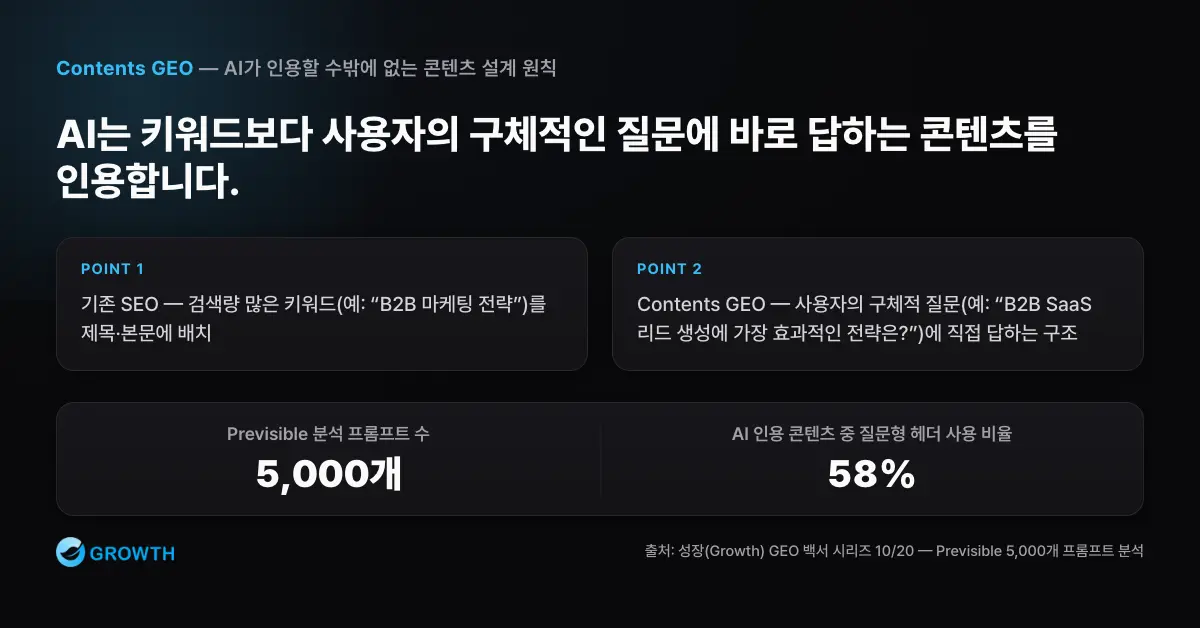
Let’s make this concrete with an example. Under traditional SEO, you’d build content targeting a keyword like “B2B marketing strategy.” But in AI search, a user asks something like, “What’s the most effective marketing strategy for a B2B SaaS company trying to generate leads?” The difference between a keyword and a question is specificity of intent. AI finds and cites the content that most precisely answers that specific question.
A large-scale study by Previsible analyzing 5,000 prompts backs this up. 58% of the content AI cited used question-format headers. In other words, the subheadings themselves were phrased as “What is ~?”, “How does ~ work?”, or “What’s the best way to ~?” That’s because AI matches a user’s question against a piece of content’s headers to extract the most relevant answer block.
In practice, this shift starts at the content-planning stage. When doing keyword research, collect related questions, not just search volume. Identify Google’s “People Also Ask” questions, the follow-up questions that come up frequently in AI chat, and the questions that recur in communities — and design your content structure around those questions. That’s the starting point of Contents GEO.
The Answer-First content structure
The most important design principle in Contents GEO is Answer-First. As the name suggests, it’s a structure that presents the answer first, then develops the supporting evidence and context afterward. Why does this matter?
Liu et al.’s “Lost in the Middle” study (TACL, 2024) provides the key evidence. According to this research, LLMs show a U-shaped attention pattern, concentrating attention on information at the beginning and end of an input text while relatively ignoring information buried in the middle. In other words, if your core message is buried somewhere in the middle of your content, the odds of AI extracting it drop. Conversely, placing your conclusion and core answer at the top of your content dramatically raises the odds that AI will cite it.
Let’s show what a real difference this makes with a before/after example.
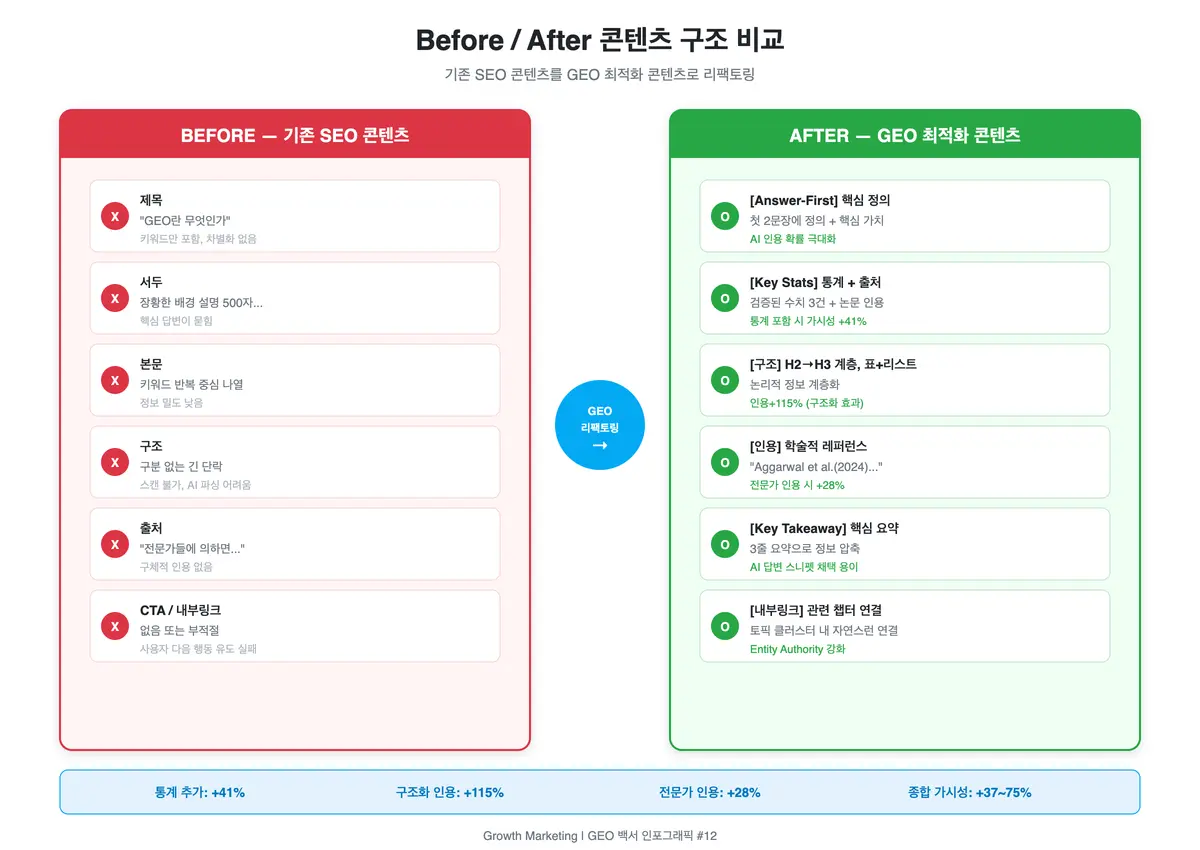
[Before — the intro of a typical SEO blog post]
“The digital marketing landscape is changing fast. In particular, recent advances in AI technology are giving rise to a new paradigm in search engine optimization (SEO). Today, we’ll look at how B2B companies should respond to this shift. First, let’s briefly review the history of SEO — since the emergence of search engines in the 1990s…”
[After — a GEO-optimized Answer-First intro]
“There are three core strategies for securing AI search visibility as a B2B company. First, structure your content with question-format headers (58% of AI-cited content uses question-format headers). Second, attach statistics and sources to every core claim (top optimization techniques improve visibility by 30–40%). Third, design your content in independent 200–400 character chunks. According to Princeton’s KDD research, source-citation optimization alone raised the AI visibility of a website ranked 5th in search by up to 115.1%.”
Can you see the difference? The “before” version starts by “setting the mood.” The reader (and the AI) has to scroll through several paragraphs to get the core information. The “after” version concentrates the core answer → specific figures → source into the first paragraph. When AI scans this content, it can construct an answer about “AI search strategy for B2B companies” from the very first chunk alone.
Data-driven content design
Another key finding from the KDD research is that AI overwhelmingly prefers a “claim with evidence” over a bare “claim.” As we’ve seen, the reason adding statistics meaningfully boosts AI visibility is simple: AI has to give users an accurate answer, and content with numbers and sources is easier to verify for accuracy.
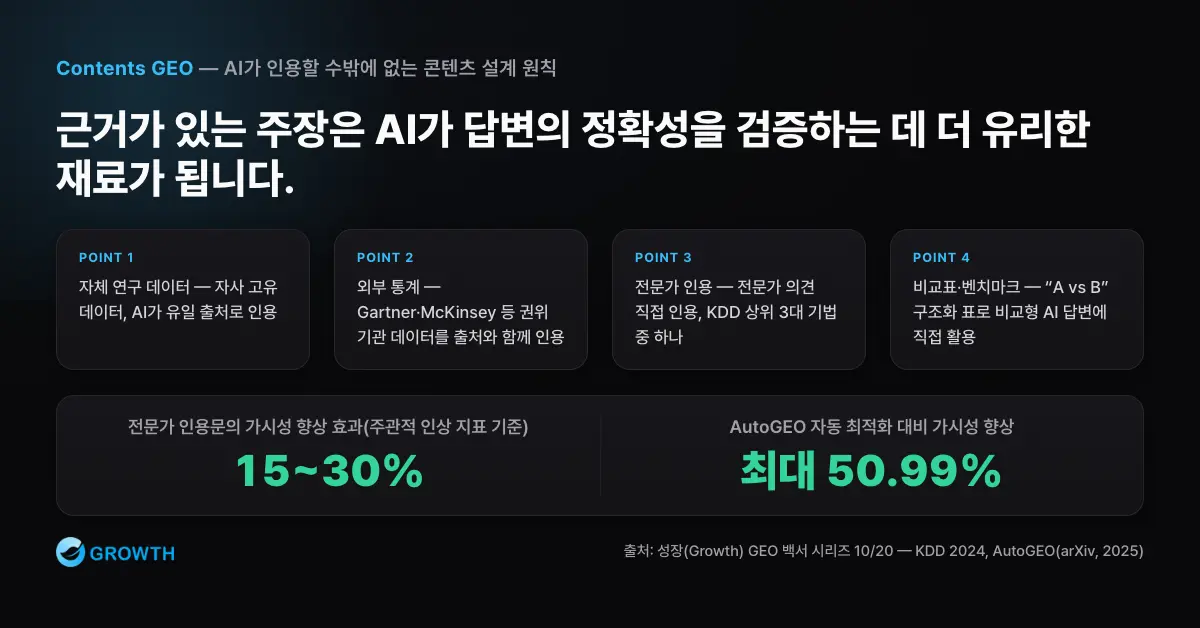
There are broadly four types of data your content should include. First, proprietary research data. Use the customer data, campaign performance, and industry benchmarks your company holds. Proprietary data has unique value that can’t be replicated elsewhere, and AI is more likely to cite it as the sole source. Second, cited external statistics. Cite data from authoritative research organizations (Gartner, McKinsey, academic papers, etc.) with a precise source. Third, expert quotes. Directly quoting an expert’s opinion in the field is one of the top three optimization techniques identified by the KDD research, showing a 15–30% visibility improvement on subjective-impression metrics. This is exactly the Experience and Expertise that Google’s QRG (Search Quality Rater Guidelines) emphasizes as part of E-E-A-T. Fourth, comparison tables and benchmarks. Structuring an “A vs. B” comparison as a table lets AI use that table directly when constructing an answer to a comparison question.
The AutoGEO study (arXiv, 2025) confirmed that automating this approach can improve visibility by up to 50.99% over existing optimization techniques. This research presented a methodology that automatically learns AI engine preferences to optimize content, and found that the single most effective element was, in the end, “structured data and claims backed by sources.”
Designing content by chunk
Once you understand how AI cites content, the importance of “chunk” design becomes clear. AI doesn’t cite your content in its entirety. It extracts the single paragraph (chunk) that best answers a specific question. That means each paragraph needs to be able to convey meaning independently.
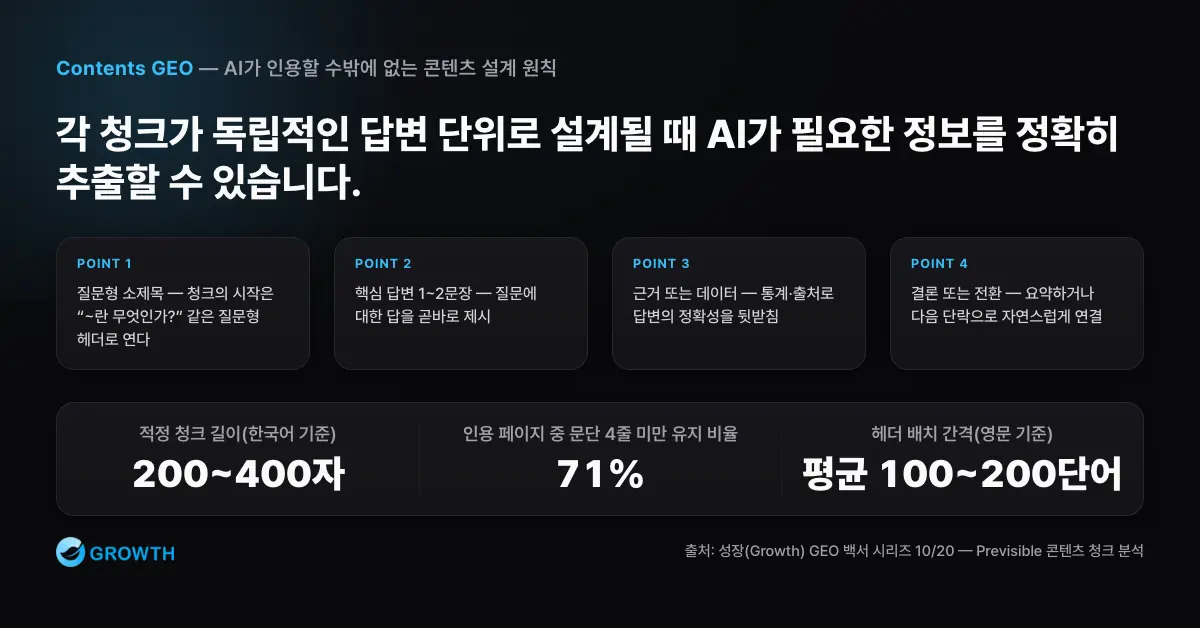
According to Previsible’s analysis, the most frequently AI-cited content chunks share these traits: 71% of cited pages kept paragraphs under 4 lines, frequently cited pages had roughly one header per 100–200 words (in English), and each chunk was structured to answer one clear question.
Applied to Korean-language content, the appropriate range is 200–400 characters per chunk. Each chunk should consist of (1) a question-format subheading, (2) a 1–2 sentence core answer, (3) supporting evidence or data, and (4) a conclusion or transition. Designed this way, AI can accurately extract the relevant chunk no matter what question it receives.
Think of it as designing content the way each entry in an encyclopedia is designed. The overall flow of the piece still matters, but the core skill in Contents GEO is making each section function as an independent “unit of answer.”
A workflow for refactoring existing content for GEO
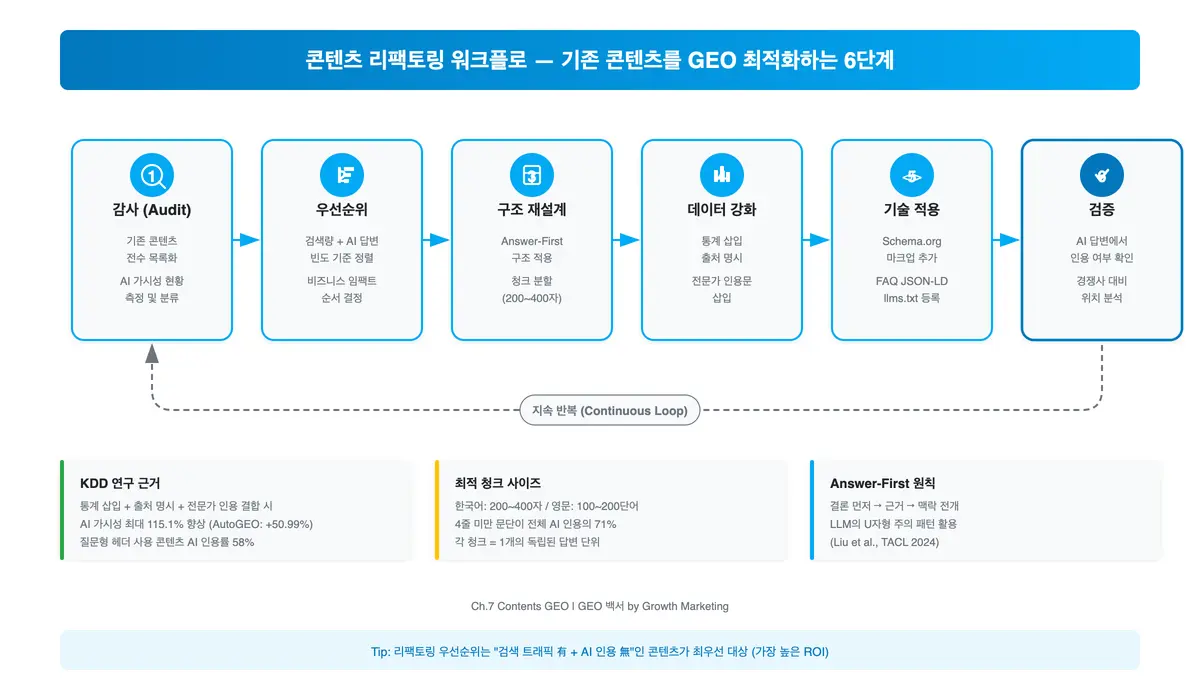
Most companies already have hundreds or thousands of pieces of content. You can’t rewrite all of it from scratch. Here’s an efficient refactoring workflow in four steps.
Step 1: Content audit. Survey your existing content in full and classify it from an AI-visibility standpoint. Sort it into content already being cited by AI, content that gets search traffic but no AI citations, and content with neither traffic nor citations. Maintain and reinforce the first group; the second group is your top priority for refactoring.
Step 2: Prioritize. Among the content that needs refactoring, start with whatever has the biggest business impact. Judge this by (1) how frequently the topic comes up in AI search, (2) its relevance to conversion, and (3) how differentiated the content is versus competitors.
Step 3: Answer-First rewriting. Rewrite the selected content into an Answer-First structure. Replace the intro with the core answer, apply question-format headers to each section, and add statistics, sources, and expert quotes. Restructure paragraphs into chunks (200–400 characters). If you use generative AI as a writing tool at this stage, there are separate quality standards to follow — we cover those in detail in our Generative AI Content Marketing article.
Step 4: Add schema and distribute. Apply appropriate schema markup (Article, FAQPage, etc.) to the refactored content, and register it as a key entry in your llms.txt (see Technical GEO for the technical framework). Then start monitoring AI citations to measure the impact.
Who owns this: the content team’s role
Contents GEO should be led by the content team, but close collaboration with the brand marketing team is essential. The content team owns Answer-First structural design, writing question-format headers, and producing data-driven content. The brand marketing team provides guidelines to ensure consistent brand messaging across all content and oversees entity consistency. The content team also leads collaboration with outside subject matter experts (SMEs), with securing expert quotes and proprietary data as its core responsibility. See GEO Team Design — A 4-Team Collaboration Model and RACI for a detailed breakdown of roles.
Key Takeaways
- Shift your content planning from keyword-centric to question-centric. AI users ask questions.
- Answer-First: place the core answer at the very top of your content. The “Lost in the Middle” research is the evidence behind this.
- Attach statistics and sources to every claim. AI ignores claims without data.
- Design content in chunks (200–400 characters). Each chunk should stand as one independent answer.
- Refactor existing content in four steps: audit → prioritize → rewrite → add schema.
Curious how your brand currently shows up in AI answers? Reach out for an AI answer share diagnostic. You can also request the full GEO whitepaper PDF.
Frequently Asked Questions (FAQ)
What is the Answer-First content structure?
It’s a content structure that presents the core answer at the very top of the piece first, then develops the supporting evidence and context afterward. Because LLMs show a U-shaped attention pattern that concentrates on the beginning and end of an input text (per the “Lost in the Middle” research), placing your conclusion higher up raises the odds that AI will cite it.
Why do question-format headers help with AI citation?
AI matches a user’s question against a piece of content’s subheadings to extract the answer block. Previsible’s analysis of 5,000 prompts found that 58% of AI-cited content used question-format headers like “What is ~?” Simply turning your subheadings into questions raises the odds of a match.
How long should a content chunk be?
For Korean-language content, 200–400 characters per chunk is the right range. Each chunk should be structured as a question-format subheading, a 1–2 sentence core answer, supporting data, and a conclusion — and needs to make sense on its own, without relying on other paragraphs. That’s because AI extracts and cites a single paragraph, not the entire piece of content.
Do I need to rewrite all of my existing content?
No. It’s more efficient to classify everything through a content audit, then prioritize content that gets search traffic but no AI citations and rewrite it into an Answer-First structure — a four-step workflow. Finish by adding schema markup and registering it in llms.txt, and the refactoring is complete.
GEO whitepaper series: ← Previous chapter · Full table of contents · Next chapter →