
GEO Organizational Design: A 4-Team Collaboration Model and RACI
 임재복
임재복
This article is chapter 13/20 of Growth’s GEO Whitepaper series — Ch.9, Organizational Design and Collaboration Models. You can find the full table of contents and the complete PDF on the whitepaper page.
GEO (Generative Engine Optimization) isn’t work a single team can absorb — it’s a company-wide collaboration project where the brand marketing, content, PR, and IT teams all have to move under one shared goal. To answer the question “who executes GEO,” this article lays out a 4-team collaboration model and RACI role-assignment chart, plus the selection criteria for choosing among three organizational structures: dedicated team, cross-functional, and hybrid.
The typical launch — and stall — of a GEO project
Picture a marketing director at a large enterprise trying to kick off a GEO project. Leadership has approved it after hearing “we need to prepare for the AI search era,” and budget has been secured. The order comes down to the marketing team that already handles SEO: “handle GEO too.” The SEO lead diligently asks the IT team to build an llms.txt file and implement schema markup. IT says it can’t get to it for two months because of its own sprint schedule. Ask the content team to refactor existing articles into a question-based structure, and the answer is: “our KPI is monthly publication count, and refactoring doesn’t count as a new publication.” PR asks, “what exactly does ‘creating brand mentions on external platforms’ mean, and how is that different from what PR already does?”
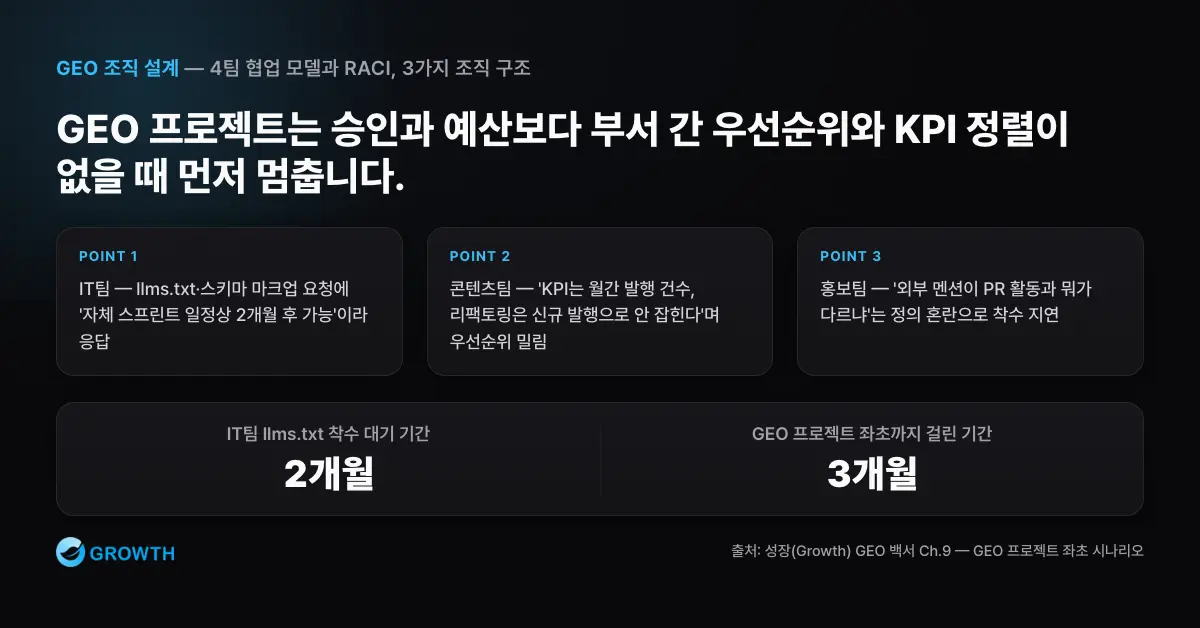
Three months pass. The llms.txt file still hasn’t shipped, content is still in its old format, and the external-mention strategy hasn’t even started. Leadership asks, “you said we were doing GEO — where are the results?” and all the marketing director can say is “the teams aren’t cooperating.” This scenario isn’t hypothetical. According to Accenture’s Technology Vision 2025, 69% of executives say that AI’s adoption — faster than any technology before it — makes it urgent to redesign organizational systems and processes, and 77% believe AI’s real benefits only materialize on a foundation of trust. The number-one reason GEO stalls isn’t technical difficulty — it’s organizational silos.
Why a single team can’t make GEO work
Traditional SEO could be absorbed by one team. Researching keywords, optimizing meta tags, publishing content, and building backlinks all fit into a single workflow. GEO is fundamentally different. As we saw in The Three-Axis Execution Strategy for GEO, each of GEO’s three axes demands a completely different kind of expertise. Technical GEO requires development skills — server configuration, schema markup, crawler policy. Contents GEO requires editorial skills to restructure content the way AI prefers. Off-Page GEO requires communications skills to get the brand mentioned on external platforms. And you need one more role on top of these three: managing the consistent brand message that runs through all three axes — the “single entity identity” that is the heart of Entity Authority.
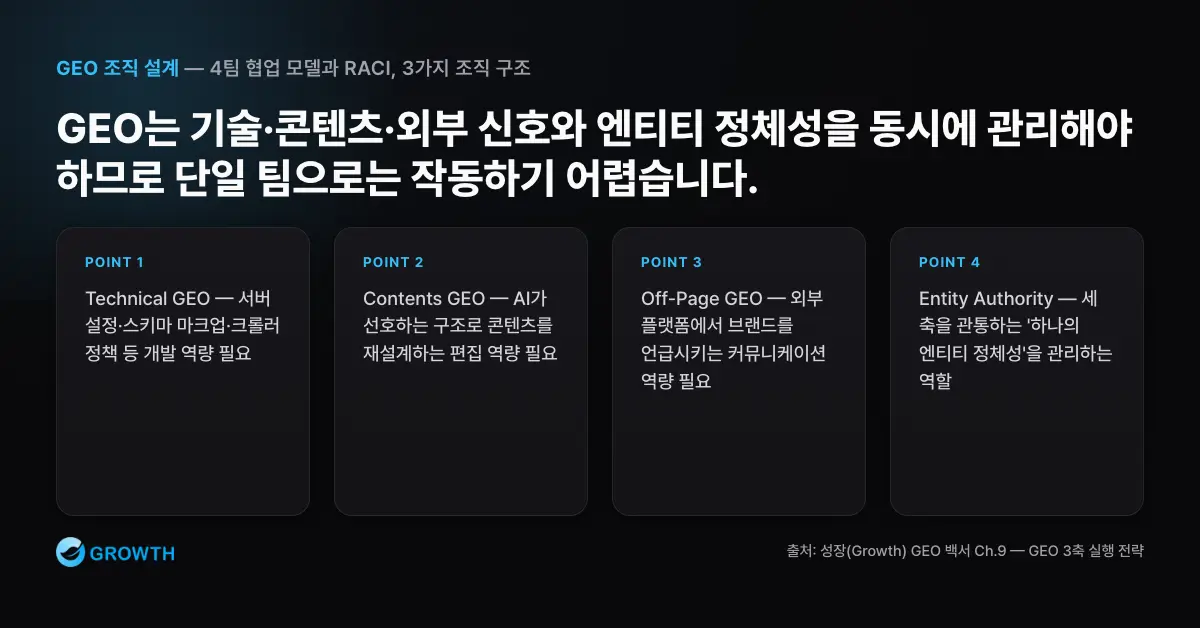
Deloitte’s State of AI in the Enterprise 2026 report shows the scale of this problem. The share of employees with access to approved AI tools grew from under 40% to roughly 60% in a single year, but only 23% of companies use agentic AI at a meaningful level. The organization’s capacity to make use of the tools isn’t keeping pace with how quickly the tools spread. GEO has the same shape. The technology is ready, but without an organizational system to execute it in an integrated way, each team moves in its own direction, and the brand signals AI collects become fragmented. If one piece of content says “digital marketing specialist,” another says “full-stack agency,” and the schema markup says “IT consulting,” AI can’t determine what this brand actually does. Entity Authority shatters, literally.
The 4-team collaboration model for enterprise GEO
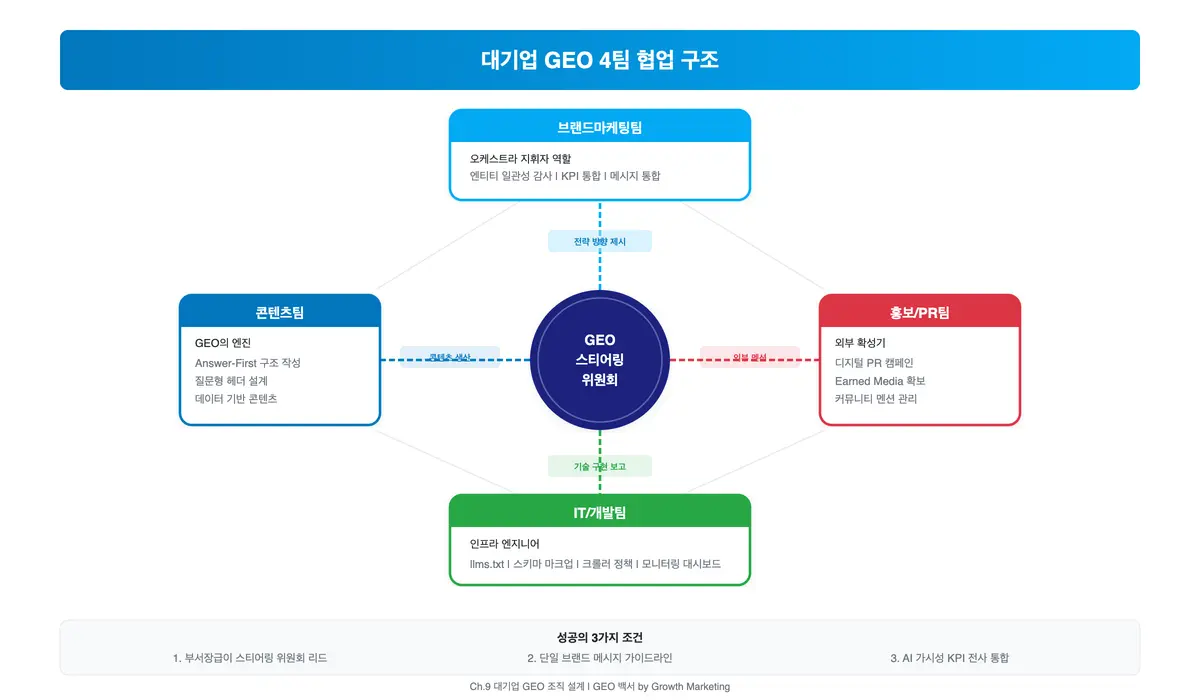
To execute GEO successfully, four teams need to move organically under one shared goal. Let’s look at each team’s role.
The brand marketing team is the conductor of the whole GEO orchestra. Its single most important job is answering the question, “what should AI perceive our brand as?” Concretely, this means unifying the brand message so a consistent entity identity is maintained across every channel, running regular Entity Consistency Audits, and integrating AI visibility KPIs into the company-wide marketing performance framework. A director-level leader from this team needs to chair the GEO steering committee, because the moment GEO gets perceived as “an add-on task for the SEO team,” it loses the organizational authority it needs to secure cooperation from other departments.
The content team is the engine of GEO. It’s the actual production unit that plans and writes content in a form AI can cite. This is the team that implements, on the ground, the strategy covered in the Contents GEO chapter — shifting to question-based headers, adopting an Answer-First format, embedding trust-building sentences with statistics and sources, systematically designing FAQ sections, and refactoring existing content through a GEO lens. The most important change here is a shift in KPI: “AI-citable content share” needs to replace “monthly publication count” as the core metric. Without this KPI shift, the content team has no choice but to prioritize new publications over refactoring, and the GEO transition drags.
The PR team is GEO’s external megaphone. As the team that executes the strategy described in the Off-Page GEO chapter, it secures brand mentions in authoritative media through digital PR and creates natural mentions on external platforms that AI learns from — Reddit, communities, review sites. YouTube GEO — securing AI training sources through video content — falls under this team’s domain too. Where traditional PR aimed at “media exposure,” PR in the GEO era aims at “structured mentions on sources AI trains on.” Once the definition of the goal changes, so does the approach and the criteria for choosing partners.
The IT/development team is GEO’s infrastructure engineer. It’s responsible for building and maintaining the llms.txt file, applying Schema.org structured-data markup, setting access policies for AI crawlers (GPTBot, PerplexityBot, Google-Extended, and others), site performance optimization, and building and operating the AI visibility monitoring dashboard. Every technical implementation of Technical GEO happens in this team’s hands. Critically, this team can’t just “process requests” — it has to participate in technical decisions as a member of the GEO steering committee. Decisions like which crawlers to allow and which to block, or to what level to implement schema, require business judgment and technical judgment at the same time.
The RACI matrix — who executes, who is accountable
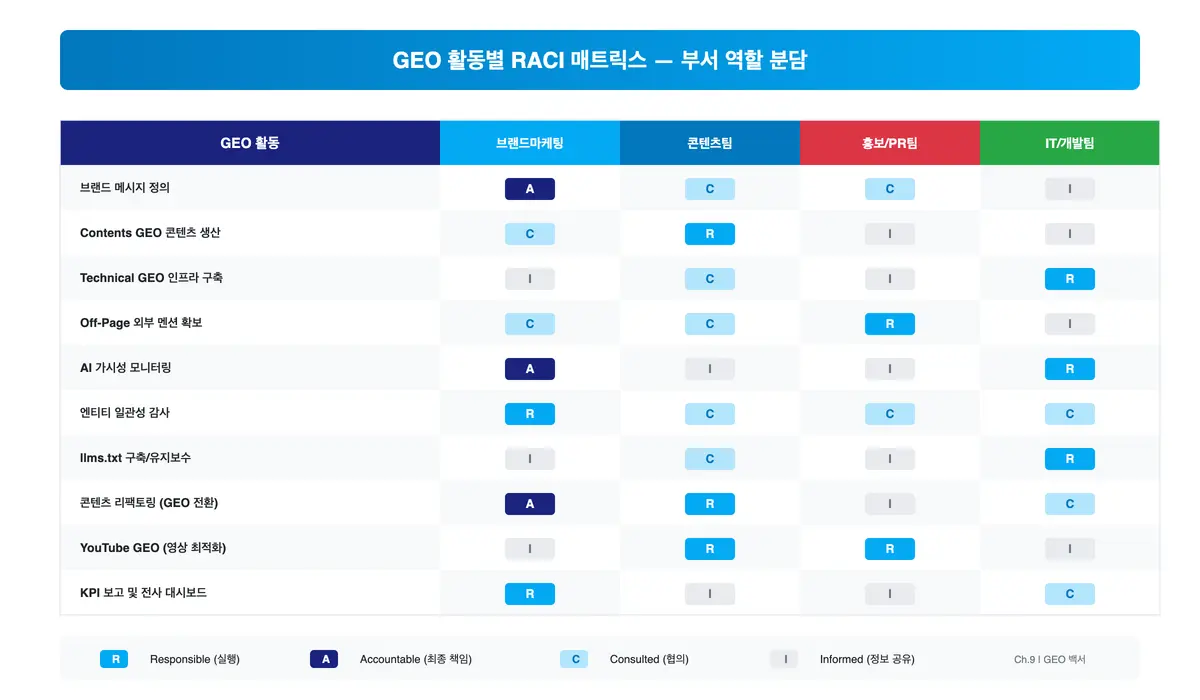
Having four teams collaborate doesn’t automatically make things run smoothly. “Everyone’s job” tends to quickly become “nobody’s job.” That’s why you need to clearly define, for every GEO activity, who executes it (R), who is ultimately accountable (A), who needs to be consulted (C), and who needs to be informed (I). A RACI matrix is the tool that shows this division of roles at a glance.
The design principle behind this matrix is simple: “execution belongs to the team with the expertise; ultimate accountability belongs to the team that coordinates the whole.” For example, Contents GEO production is executed (R) by the content team, but ultimate accountability (A) for confirming that content is consistent with the brand entity sits with the brand marketing team. Technical GEO implementation is executed (R) by the IT team, but the final call (A) on how a given technical decision affects the brand also sits with brand marketing. Exactly one team must hold R (execution) for any given activity, and exactly one team must hold A (accountability). When this gets blurred, an accountability gap opens up.
| GEO activity | Brand marketing | Content team | PR | IT/development |
|---|---|---|---|---|
| Define brand message | A | C | C | I |
| Produce Contents GEO | C | R | I | I |
| Build Technical GEO | I | C | I | R |
| Secure Off-Page mentions | C | C | R | I |
| AI visibility monitoring | A | I | I | R |
| Entity consistency audit | R | C | C | C |
R = Responsible (executes), A = Accountable (ultimate ownership), C = Consulted, I = Informed
Three organizational models — finding the right fit for your company
Not every large enterprise can execute GEO with the same organizational structure. The right model depends on your digital maturity, available headcount, time pressure, and budget size. Let’s compare three models that work in practice.
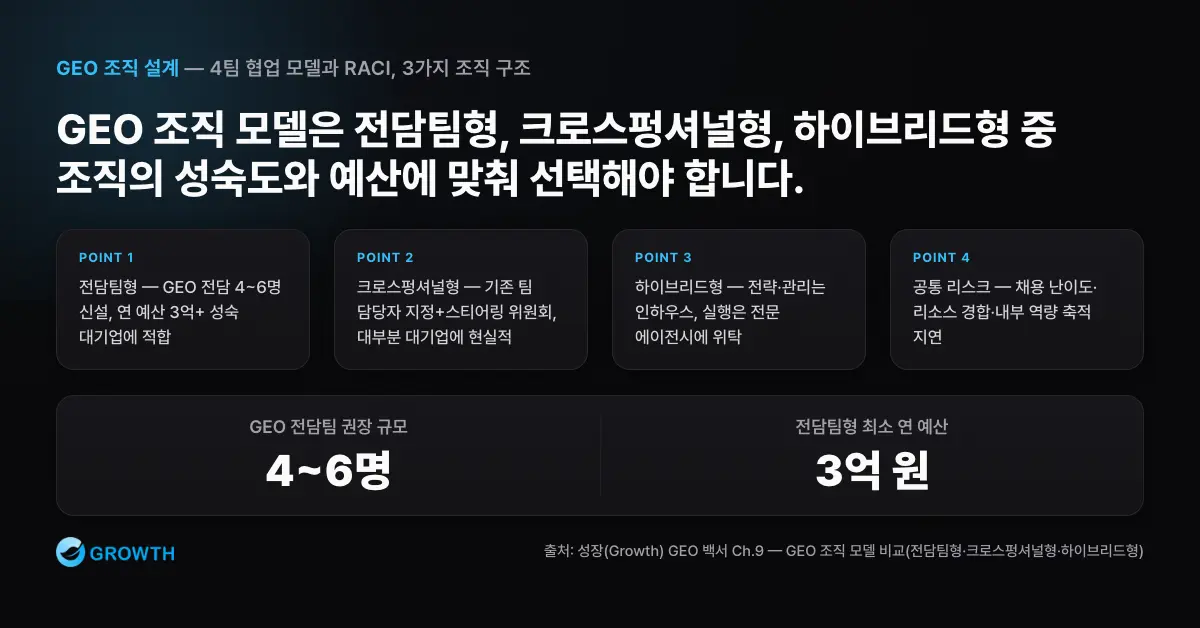
The Dedicated Team model means standing up a new 4–6 person team focused solely on GEO. This model fits large enterprises with high digital-transformation maturity that have already run a dedicated SEO team and can allocate an annual GEO budget of at least ₩300 million. The advantages are clear: expertise accumulates quickly, decisions move fast, and the team can focus purely on GEO without conflicting interests with other departments. The catch is that hiring the right people isn’t easy — the talent pool with real experience in “AI search optimization” is still very shallow. Forrester’s 2026 forecast projects a 15% reduction in marketing agency headcount over the course of the year, which, ironically, could be an opportunity for GEO specialists to enter the open market.
The Cross-Functional model designates a GEO point person within each existing team, coordinated by a steering committee. This is the most realistic choice for most large enterprises. It uses existing staff, so you can start immediately without new hires, and you get to apply each team’s existing expertise directly to GEO. The risk is resource contention — GEO point people juggling GEO alongside their existing workload can lead to priority conflicts. To prevent this, explicitly allocate a share of working time to GEO (e.g., 30%), and have the steering committee meet at least every other week to check on progress. McKinsey’s State of AI 2025 survey also found that direct CEO ownership of AI governance is one of the factors most strongly correlated with AI’s contribution to the bottom line — a regular, executive-involved review cadence matters that much.
The Hybrid model keeps strategy and management in-house while outsourcing execution to a specialized agency. This fits situations where you need results quickly, or in-house GEO capability isn’t there yet. You can borrow an agency’s expertise to produce short-term results while building a structure where your internal team learns along the way. The thing to watch for is that heavy reliance on the agency can delay building internal capability. Spell out a “knowledge transfer” clause in the contract, and design a system where the internal team receives visibility into the agency’s process and results.
| Model | Structure | Best fit | Advantages | Risk |
|---|---|---|---|---|
| Dedicated team | New 4–6 person GEO team | Digitally mature large enterprises | Expertise, speed | Hiring difficulty, headcount cost |
| Cross-functional | Point person in each existing team + steering committee | Most large enterprises | Fast start, leverages existing skills | Resource contention, priority conflicts |
| Hybrid | Strategy in-house + execution via agency | When fast results are needed | Borrows expertise, speed | Delayed internal capability building |
How to decide: in-house vs. agency
How much to handle internally and where to bring in agency help needs to be a realistic, budget-driven decision. According to Gartner’s 2025 CMO Spend Survey, marketing budgets sit at around 7.7% of revenue, and how much of that each company can allocate to GEO varies. If your monthly budget is under ₩10 million, it’s realistic to set strategic direction in-house and outsource execution to an agency — covering Technical, Contents, and Off-Page GEO all at once with a small team simply spreads too thin.
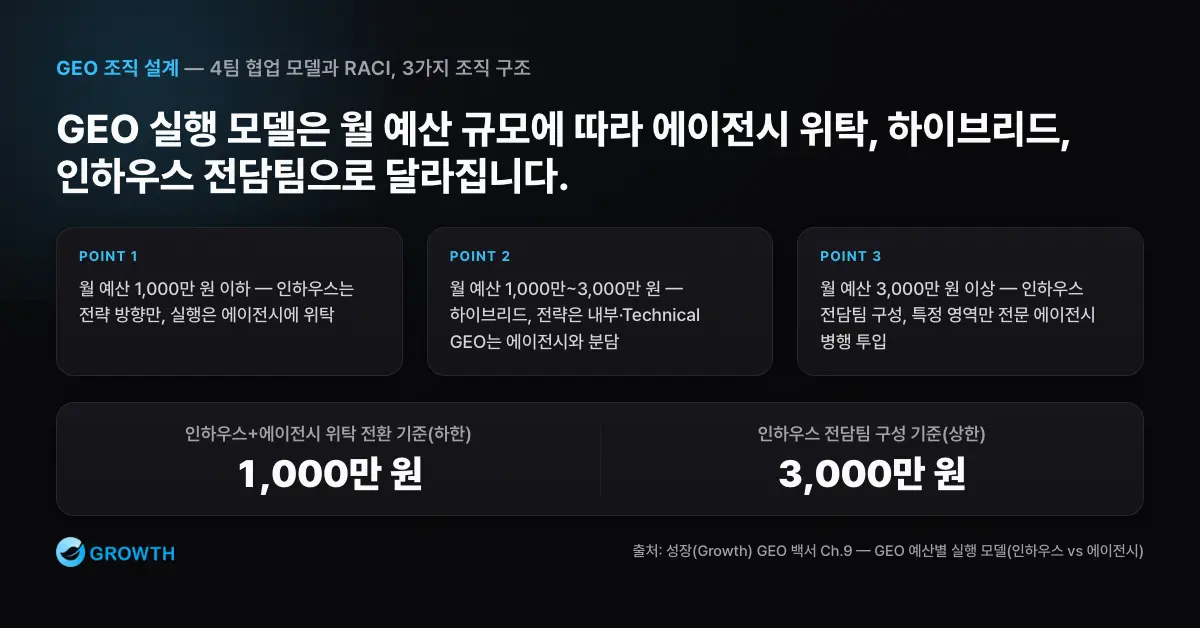
If your monthly budget is in the ₩10–30 million range, the hybrid model is most effective — strategy and Contents GEO handled internally, with Technical GEO and monitoring-tool operations shared with an agency. If you’re a large enterprise able to invest over ₩30 million a month, the optimal approach is building an in-house dedicated team while bringing in a specialized agency only for specific areas — advanced structured-data implementation or large-scale content refactoring, for example. If you’re considering working with an agency, the questions for vetting candidates and the selection criteria are covered separately in the GEO Agency Selection Guide.
Three conditions for enterprise GEO success
Finally, regardless of which organizational model you choose, here are three essential conditions for GEO to succeed at a large enterprise. These lessons are drawn from common patterns across multiple industry reports and the principles running through the entire GEO Whitepaper.
First, a director-level leader from brand marketing needs to chair the GEO steering committee. Because GEO requires cooperation across multiple departments, it needs to be led by someone with the authority to allocate resources and adjudicate priorities across teams. No matter how capable an individual contributor is, if they lack the organizational authority to ask another department to “do this first,” the stall scenario we saw earlier repeats itself. In Accenture’s survey, 74% of organizations said their generative AI and automation investments met or exceeded expectations — and results like that only become real when leadership is genuinely involved.
Second, a single brand-message guideline shared by every department needs to exist. AI forms its notion of your Entity by collecting brand information scattered across the entire web. If the brand description the content team writes differs from the one PR distributes in a press release, AI learns a confused entity. Create a single guideline document so every team uses the same core message, the same terminology, and the same description of your expertise.
Third, AI visibility KPIs need to be integrated into company-wide marketing KPIs. As long as GEO performance is reported as a separate “experimental project” report, organizational attention and resources will inevitably stay concentrated on existing KPIs. Integrate GEO-specific metrics — Share of Answer (SoA), AI-referred conversion rate — into your existing marketing dashboard, and include them in quarterly executive reporting. This third condition connects directly to GEO ROI Measurement, where we cover concrete KPI design and dashboard construction in detail.
Key Takeaway
- GEO is a 4-team collaboration project (brand marketing, content, PR, IT), not a single team’s job
- A director-level leader from brand marketing needs to chair the steering committee to secure entity consistency
- A RACI matrix that clearly divides roles prevents organizational silos
- Choose among dedicated-team, cross-functional, and hybrid models based on your monthly budget
Curious how your brand currently shows up in AI answers? Request an AI Answer Share diagnostic. You can also download the full GEO Whitepaper PDF.
Frequently Asked Questions
Do we absolutely need to build a dedicated GEO team?
No. Unless you’re a digitally mature large enterprise able to allocate at least ₩300 million a year, a cross-functional model — designating a point person in each existing team, coordinated by a steering committee — is the most realistic choice. If you need fast results, consider a hybrid model where strategy stays in-house and execution is outsourced to an agency.
Who should lead the GEO steering committee?
A director-level leader from brand marketing. Because GEO requires allocating resources and adjudicating priorities across content, PR, IT, and other departments, execution stalls without the organizational authority to request cooperation from other teams.
What’s the most common mistake when building a RACI matrix?
Spreading execution (R) or accountability (A) for a single activity across multiple teams. “Everyone’s job” quickly becomes “nobody’s job.” Assigning exactly one team to R and one team to A for each activity prevents accountability gaps.
We already have an SEO team — do we still need to design a separate GEO organization?
The moment GEO gets perceived as “an add-on task for the SEO team,” it loses the authority to secure cooperation from other departments. The capability built through SEO is an important foundation for GEO, but for GEO to actually work, you need to separately design a collaboration structure and shared KPIs that bring content, PR, and IT into the fold as well.
GEO Whitepaper series: ← Previous chapter · Full table of contents · Next chapter →