Off-Page GEO — 48% of AI Citations Come From Earned Media
 임재복
임재복
This article is Chapter 8, part 11 of 20, in Growth’s GEO whitepaper series — our Off-Page GEO chapter. You can find the full table of contents and the complete PDF on the whitepaper page.
Answer-first: Omniscient Digital analyzed 23,387 AI citations gathered from brand-related queries and found that 48% of the sources AI cites are earned media (news, reviews, community mentions), while a brand’s own content accounts for just 23%. In the AI era, brand authority isn’t built inside your own website alone.
From Backlinks to Brand Mentions — the Evolution
It’s not an exaggeration to say traditional SEO’s Off-Page strategy used to come down entirely to “backlinks.” The number and quality of hyperlinks pointing to your site from other websites determined your search ranking. Google’s PageRank algorithm literally measured a page’s authority through backlinks.
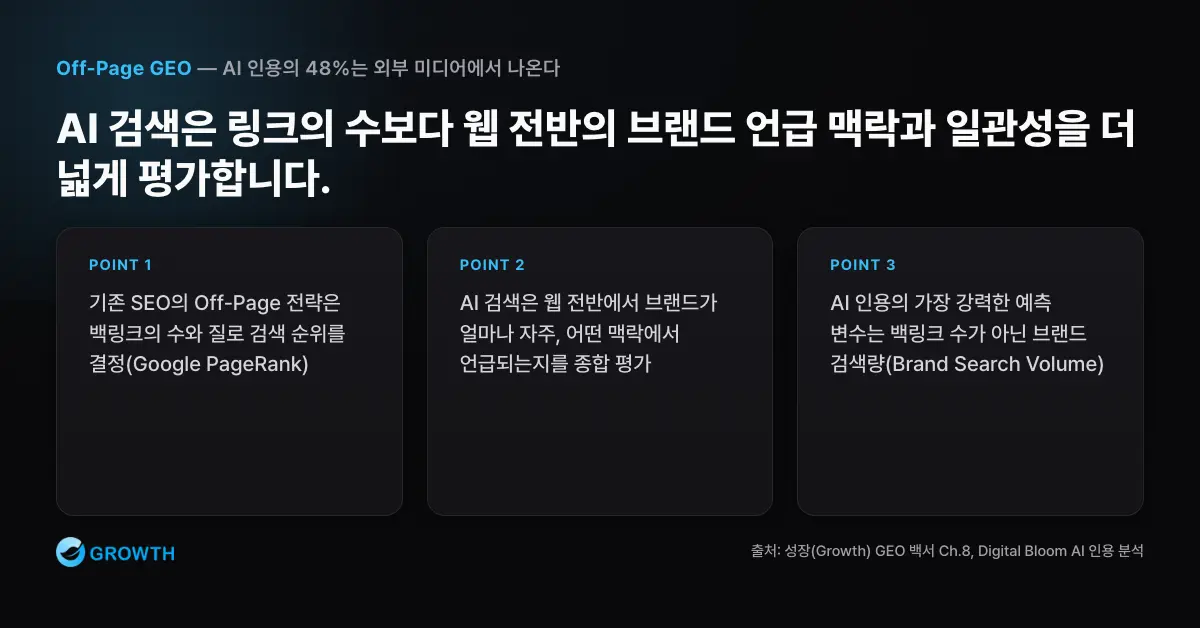
But in the age of AI search, this paradigm shifts fundamentally. AI doesn’t look at whether a hyperlink exists — it looks at how often, and in what context, your brand gets mentioned across the web. That’s the shift “from backlinks to brand mentions.” We’ve laid out where this shift sits within the overall GEO strategy in our guide to AI engine optimization (GEO).
Digital Bloom’s large-scale AI citation analysis, covered in detail in our Entity Authority article, demonstrates this shift empirically. The single strongest predictor of AI citation wasn’t backlink count — it was brand search volume. ChatGPT and Perplexity shared cited sources only 11% of the time. Since each AI engine references different sources, a strategy focused on just one platform is a risky bet.
EMNLP 2024’s research on global brand bias (“Global is Good, Local is Bad?”) makes the problem even clearer. LLMs show a measurable bias favoring global brands. For a new or niche brand to break into AI answers, it needs a proportionally larger volume of external-source mentions. NAACL 2025’s research on the Matthew Effect supports the same conclusion: when generating references, LLMs tend to cite sources that are already heavily cited even more, which means the later a brand enters the race, the more urgent its Off-Page strategy becomes.
AI isn’t “counting links” — it’s “reading context.” When a brand gets cited as an industry expert in news articles, recommended by real users on Reddit, and covered in depth in YouTube videos, AI gathers all of that context and evaluates your brand as a trustworthy entity.
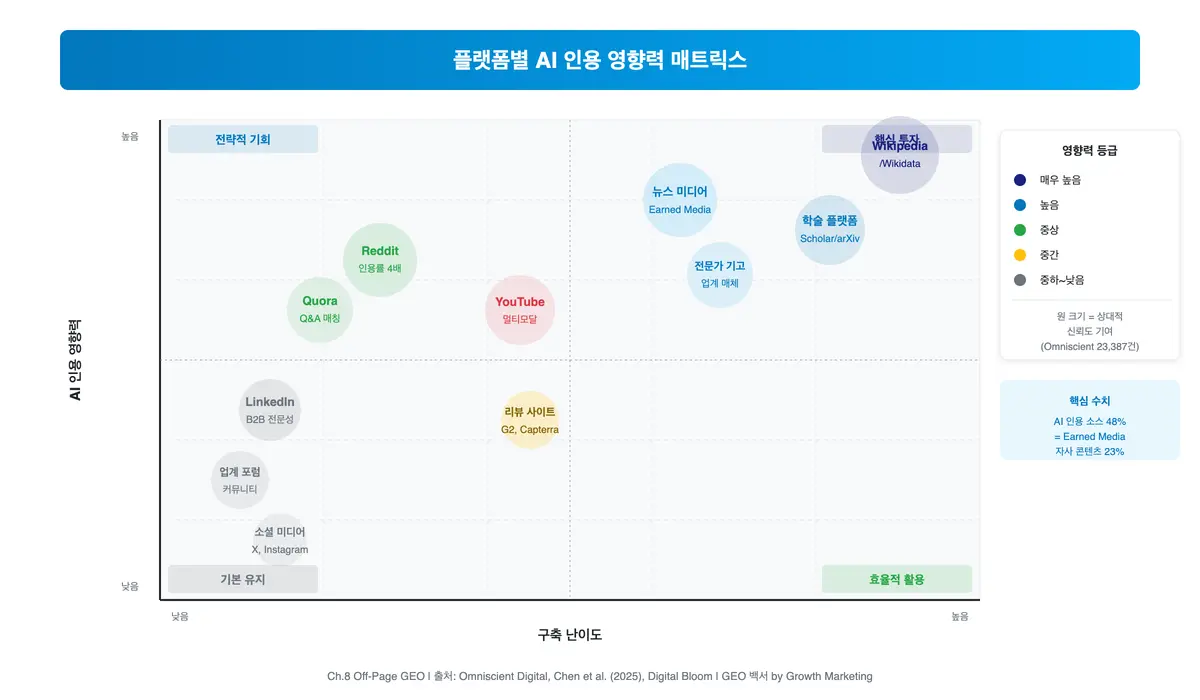
AI Citation Influence by Platform
Executing Off-Page GEO well requires understanding how each platform influences AI citation, because the value differs from platform to platform.
Wikipedia and Wikidata are foundational infrastructure for AI trust. Most LLMs used Wikipedia in their pretraining data, and reference Wikidata as the basic unit of entity recognition. If your company has a Wikipedia entry, that entry alone sends a powerful baseline signal that “this organization is real and notable.”
Reddit is a hidden powerhouse of the AI search era. It’s no accident that Google struck a $60 million-a-year data licensing deal with Reddit. Reddit is one of the most frequently cited domains in Google AIO. Because it’s packed with real users’ experiences and recommendations, AI reads it as a signal of “how people actually rate this.” SE Ranking’s analysis found that domains with a large volume of brand mentions on Reddit and Quora are roughly 4x more likely to be cited by AI.
Quora is ranked among the most-cited sites in AIO precisely because its question-and-answer format matches how AI generates answers in the first place. It’s effective to post authoritative answers to relevant questions and naturally weave in your brand’s experience or expertise within them.
Academic platforms (Google Scholar, arXiv, and similar) matter especially for B2B companies, tech companies, and research-driven organizations. AI treats academic papers as high-trust sources. Research presented at ICLR 2026 on source preference showed that LLM agents systematically favor certain sources based on where they come from, not just what they say.
News media and industry trade publications are the core channel for earned media. Research from Chen et al. (2025) found that AI search overwhelmingly favors earned media. A brand quote that runs in a news article carries straight through into AI-generated answers.
LinkedIn, as a B2B professional network, is a source AI frequently references when verifying the expertise of organizations and individuals. Consistency between your company page and your executives’ profiles contributes to entity authority.
YouTube is a multimodal source AI is leaning on more and more. Google Gemini already integrates YouTube content into its answers, and other AI engines reference YouTube transcripts as well.
Here’s a side-by-side comparison of what each platform brings to the table.
| Platform | AI Citation Influence | Trust Contribution | Execution Difficulty | Recommended For |
|---|---|---|---|---|
| Wikipedia/Wikidata | Very high | Entity foundation | High (notability criteria to meet) | Any company (mid-size and up) |
| High | Real-user validation | Medium (must feel organic) | B2C, SaaS, tech | |
| Quora | High | Q&A format match | Low | Professional services, B2B |
| Academic platforms | High | Top-tier expertise | High (requires research capability) | Tech, healthcare, R&D |
| News media | High | Timeliness + third-party validation | Medium to high | Any company |
| Medium | B2B expertise | Low | B2B, professional services | |
| YouTube | Medium to high (rising) | Multimodal differentiation | Medium | Any company |
A Global Community Strategy for Korean Companies
There’s something Korean enterprises need to weigh especially carefully when executing Off-Page GEO. Since global AI engines (ChatGPT, Perplexity, Claude) are trained primarily on English-language sources, Korean-language content alone makes it hard to get surfaced in their answers. As EMNLP 2024’s brand bias research points out, AI leans toward global brands. Overcoming that requires mentions from English-language external sources.
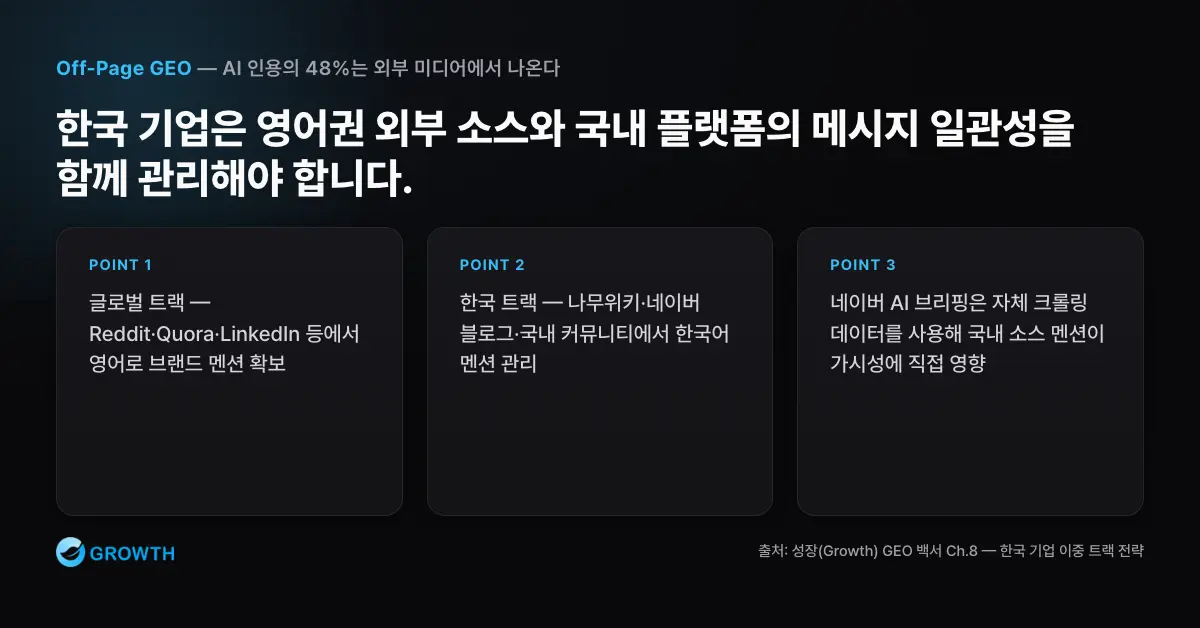
The practical strategy here is a dual-track approach. On the global track, earn brand mentions in English on global platforms like Reddit, Quora, and LinkedIn — ideally through natural participation from your overseas business unit, global communications team, or local partners. On the Korean track, manage Korean-language mentions on Namuwiki, Naver Blog, and domestic communities. Since Naver’s AI briefing runs on its own crawled data, mentions from domestic sources feed directly into Naver AI visibility.
The two tracks can’t contradict each other. Your brand’s core message, figures, and facts need to stay consistent across global and domestic platforms alike. If AI detects an inconsistency, it may end up trusting neither side. The “consistency” principle from our Entity Authority article applies directly here too.
Digital PR and an Earned Media Strategy
Chen et al.’s (2025) finding that AI search overwhelmingly favors earned media is one of the most important discoveries for Off-Page GEO. Omniscient’s analysis backs this up too: 48% of brand-related AI citations came from earned media. Your digital PR campaigns are, in effect, a primary supply line for AI citations.
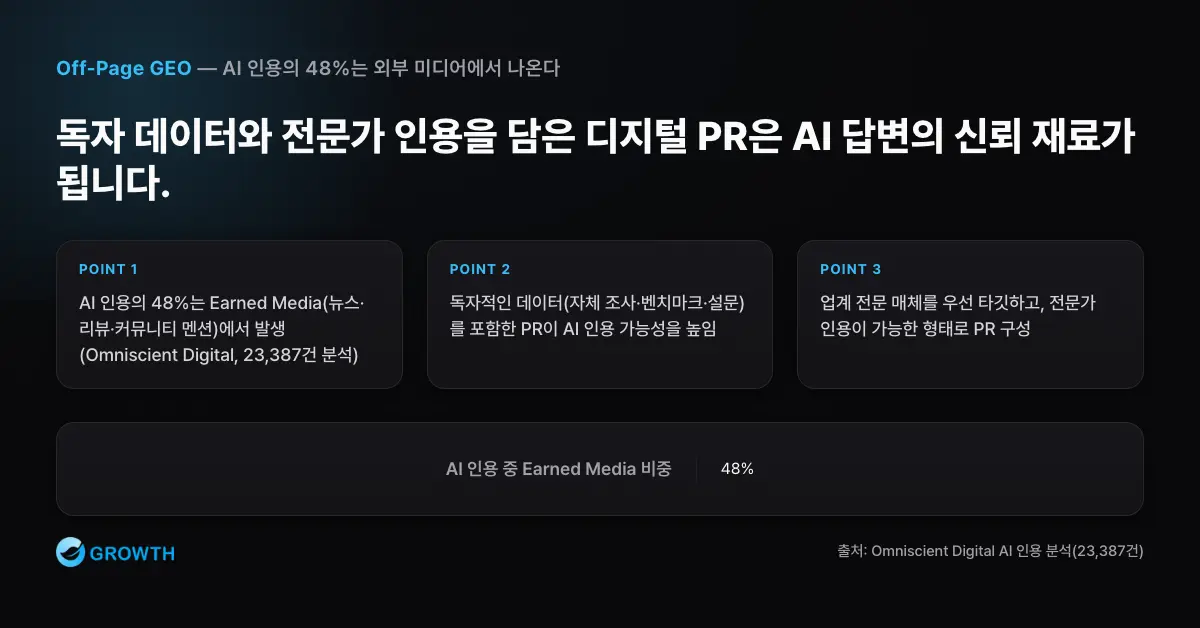
Designing a digital PR campaign AI will actually cite requires moving past the traditional press-release-distribution playbook. PR content AI is likely to cite tends to meet three conditions.
First, it needs to include proprietary data. PR built around original industry research, benchmark data, or survey findings, rather than plain company news, is far more likely to get used as an AI answer source. A PR piece that says “we surveyed 500 companies and found that businesses adopting AI marketing saw revenue grow by an average of 23%” is much more likely to get cited by AI than one that simply announces “we launched a new product.”
Second, prioritize industry trade publications as your primary target. Coverage in a specialized outlet within your industry sends a stronger expertise signal to AI than coverage in general news. If you’re a marketing company, it’s effective to pursue both global outlets like Marketing Week and AdAge alongside domestic specialist platforms.
Third, structure your PR so it’s quotable by experts. When your CEO or CTO gives a quote as an industry expert, it appears in news coverage as “[Name], CEO, said…” — and AI uses that quote directly in its answers. You can find more detail on step-by-step tactics for earning mentions in our AI search optimization execution guide.
YouTube GEO — an Off-Page Strategy for the Multimodal Era
YouTube GEO is an area many companies overlook, but it’s becoming important fast. Google Gemini already uses YouTube content when generating answers, and other AI engines reference YouTube’s auto-generated transcripts (captions) as a text source too.
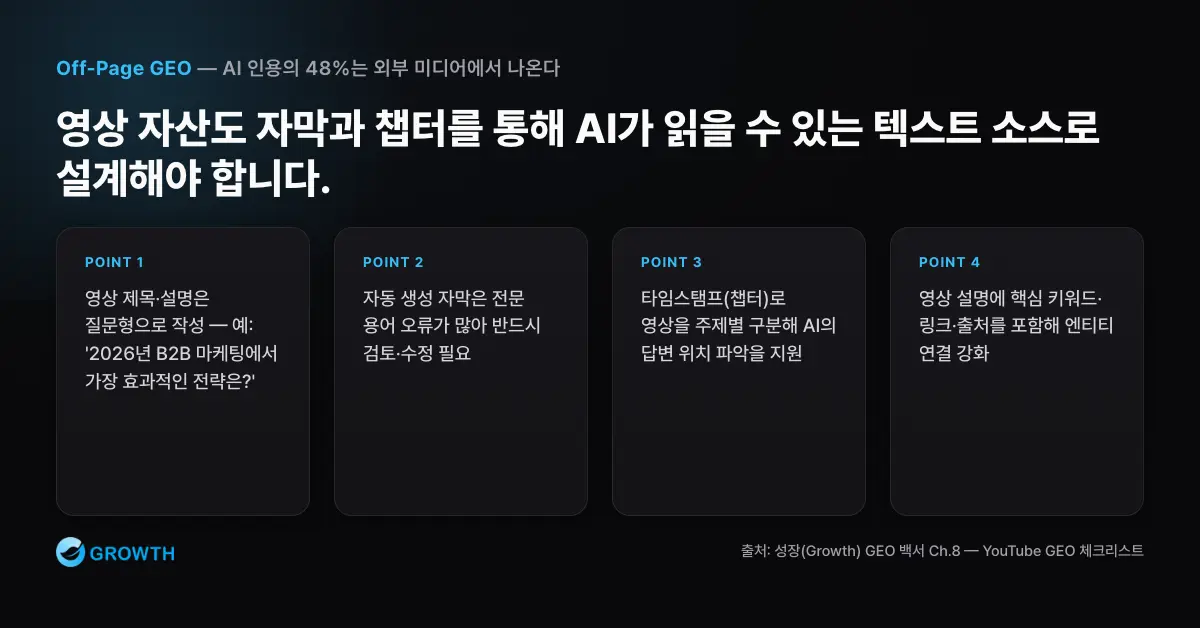
Here are the most important optimization points for YouTube GEO. Write video titles and descriptions as questions. “B2B marketing trends” is weaker for AI matching than “What’s the most effective B2B marketing strategy in 2026?” Always review and correct your transcript. Auto-generated captions frequently mangle technical terms, and those errors get in the way of AI comprehension — an accurate transcript is exactly the text content AI reads. Use timestamps (chapters). Breaking a video into topic-based sections makes it easier for AI to find where in the video the answer to a specific question lives. Include key keywords and links in your video description. Adding links to related content on your own site, sources for any data you cite, and your social media profiles strengthens entity connections.
Ownership: The Role of the PR Team
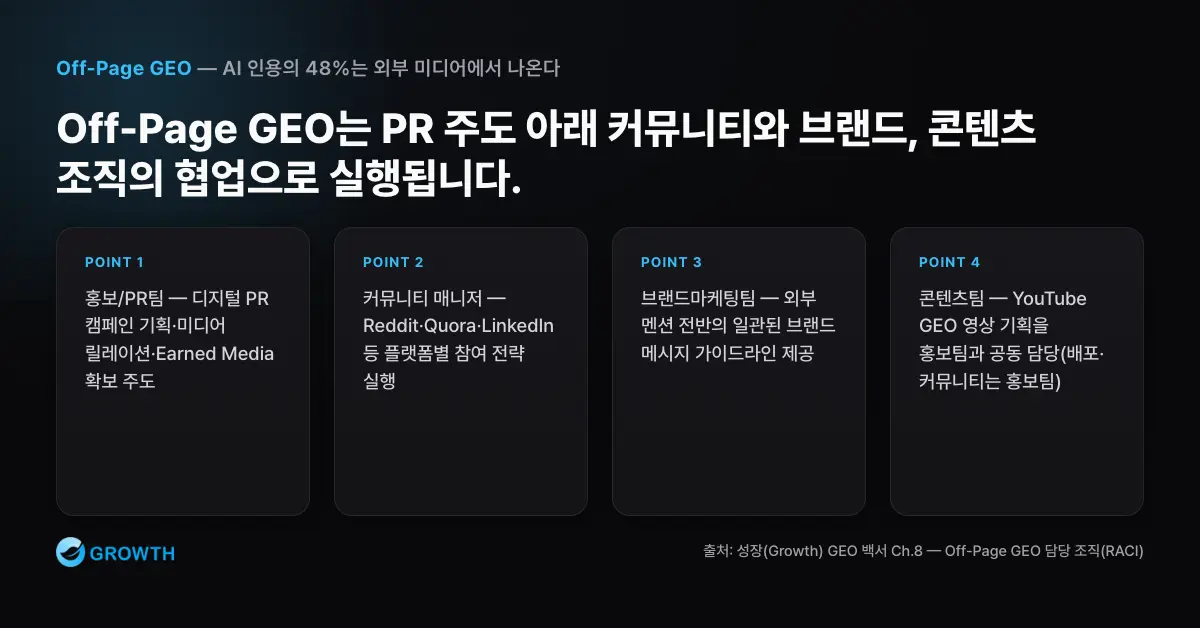
Off-Page GEO works best when the PR team leads and the community manager and brand marketing team collaborate alongside them. The PR team owns digital PR campaign planning, media relations, and earning media. The community manager executes platform-specific engagement strategies on Reddit, Quora, LinkedIn, and elsewhere, while the brand marketing team sets guidelines to keep the brand message consistent across every external mention. YouTube GEO works best as a joint effort between the content team and the PR team, with the content team handling video planning and the PR team handling distribution and community management. You can find a detailed breakdown of Off-Page GEO role assignments in GEO organizational design — the four-team collaboration model and RACI.
Key Takeaways
- 48% of AI citations come from earned media. Your own site alone can’t build brand authority in the AI era.
- Brand search volume is a stronger predictor of AI citation than backlink count.
- Wikipedia, Reddit, Quora, news media, YouTube — understand each platform’s role and set priorities accordingly.
- Korean companies need a dual-track strategy: global (English) and domestic (Korean).
- Digital PR campaigns built around proprietary data significantly raise the odds of AI citation.
Curious how your brand shows up in AI answers right now? Reach out for an AI answer share diagnostic. You can also request the full GEO whitepaper PDF.
FAQ
What is earned media, and why does it matter for AI citation?
Earned media is brand-related content created voluntarily by third parties — news articles, reviews, community mentions. Omniscient Digital’s analysis of 23,387 citations found that 48% of brand-related AI citations came from earned media. That’s because AI trusts independent third-party validation more than a brand’s own claims about itself.
Are backlinks no longer necessary in the AI era?
Backlinks haven’t become meaningless, but brand search volume and brand mentions are now stronger predictors of AI citation. Even without a link, having your brand mentioned in a trustworthy context sends an authority signal to AI on its own. Prioritize the context and consistency of your mentions over simply chasing links.
Which platform should Off-Page GEO start with?
It depends on your company type. B2B and professional-services companies should start with LinkedIn, Quora, and industry trade publications; B2C and tech companies get more mileage starting with Reddit and YouTube. If you’re mid-size or larger, it’s also worth reviewing Wikipedia and Wikidata notability requirements, since they serve as a foundational entity signal.
Do Korean companies really need an English-language community strategy?
Yes, if you want to show up in global AI engines’ answers. ChatGPT, Perplexity, and similar engines are trained and search primarily on English-language sources, so Korean-language content alone has real limits in terms of exposure. Run both a global (English) and domestic (Korean) track, and the key is keeping the message and facts consistent across both.
GEO whitepaper series: ← Previous chapter · Full table of contents · Next chapter →