SEO vs AEO vs GEO vs AIEO: How the Search Optimization Terms Relate
 임재복
임재복
This article is part 5/20 of Growth’s GEO whitepaper series — Ch. 3, What Is GEO. The full table of contents and the complete PDF are available on the whitepaper page.
GEO (Generative Engine Optimization) is a strategy that integrates technical infrastructure, content structure, and brand authority so that generative AI systems — ChatGPT, Perplexity, Google AI Overview, and the like — cite a specific brand’s content as a trustworthy source when composing their answers. Where traditional SEO aimed for “ranking at the top of search results,” GEO aims for “being cited in AI answers” itself. This isn’t a minor technical upgrade — it’s a fundamental paradigm shift in digital marketing.
GEO’s definition and full execution strategy are covered comprehensively in our AI engine optimization (GEO) guide. This article zeroes in on the part of that picture that causes the most confusion in practice: where the terms SEO, AEO, GEO, and AIEO came from, how they relate to each other, and the question of whether GEO replaces SEO.
How did GEO come to exist?
The term GEO was formally introduced in 2024, in a paper titled “GEO: Generative Engine Optimization” (Aggarwal et al., 2024), presented at ACM KDD 2024 by a joint research team from Princeton University, Georgia Tech, the Allen Institute for AI, and IIT Delhi. The study was a large-scale experiment that applied nine optimization strategies to 10,000 search queries to measure how content visibility changed within generative search engines. The results were striking. Top-tier techniques — inserting statistics, adding quotations, citing sources — improved a visibility metric (Position-Adjusted Word Count) by 41% and a subjective-impression metric by 28% over baseline. Notably, a website sitting at position 5 saw its visibility jump by 115.1% after applying the “cite sources” technique. That number isn’t the result of a simple trick — it’s empirical proof that AI evaluates information in a fundamentally different way than traditional search engines do.
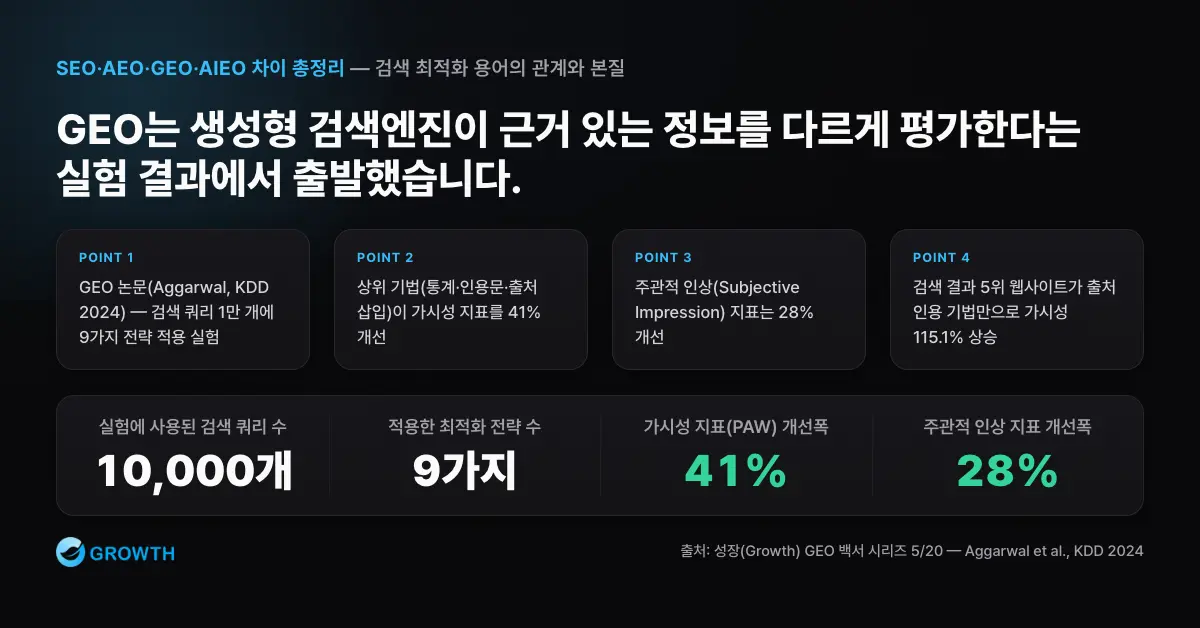
The weight of this research isn’t in coining the term GEO. It’s in being the first study in the history of search marketing to scientifically identify “the content factors that influence the quality of an AI engine’s answers.” Where traditional SEO optimized against a single system — Google’s PageRank algorithm — GEO has to contend with multiple AI engines at once, each with a different underlying mechanism: ChatGPT, Perplexity, Google AI Overview, Bing Copilot. Follow-up research by Chen et al. (2025) made this even clearer: each AI engine favored different content types and citation patterns, and notably, major AI search engines systematically rated earned media (third-party mentions) higher than brand-owned content.
How GEO relates to SEO, AEO, and AIEO — an extension, not a replacement
To really understand GEO, you first need to sort out how it relates to existing SEO, AEO, and AIEO. In the field, these four terms get used interchangeably enough to cause real confusion. Let’s go through them one at a time.
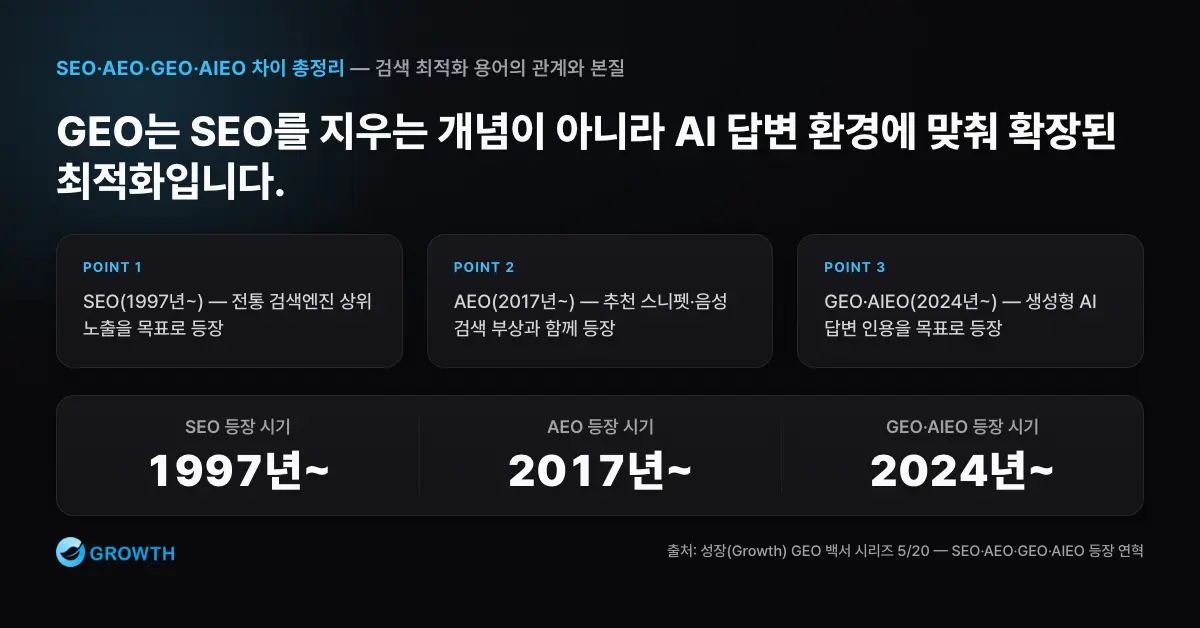
SEO (Search Engine Optimization) is the oldest of these concepts, in use since roughly 1997, and it aims to rank at the top of results pages on traditional search engines like Google and Naver. Its core tactics are keyword optimization, backlink building, and site speed improvement, and its key KPIs are search ranking, organic traffic, and CTR (click-through rate). SEO is a game of “getting a user to click your link in the search results.”
AEO (Answer Engine Optimization) emerged around 2017, as Google’s Featured Snippets and voice search rose to prominence. Its goal is to be displayed directly as the answer on the search results page, and its core tactics are FAQ structuring, Q&A-format content, and schema markup. AEO is a game of “getting a search engine to adopt your content as the answer” — in other words, an extension of SEO.
AIEO (AI Engine Optimization) is a term some marketers and agencies started using in 2024–2025, sitting somewhere between AEO and GEO in the sense of “optimizing for AI search engines.” It hasn’t been formally defined by academia, though, and in practice its scope is nearly identical to GEO’s. Some practitioners distinguish AIEO as “AI search engine optimization” and GEO as “generative engine optimization,” but since AI search essentially is generative search, the practical difference is minimal.
GEO (Generative Engine Optimization) encompasses all of these concepts while adding a fundamentally new dimension on top. Where SEO aimed for “visibility” and AEO for “being adopted as the answer,” GEO aims for “being cited as a trustworthy source in the process by which AI constructs its answer.” The dividing line is the evaluation criteria. In SEO, metrics like PageRank, domain authority, and backlink count were decisive. In GEO, the key evaluation factors instead become a content’s factual accuracy, how clearly it’s sourced, how well its information is structured, and how consistently the brand shows up across the web as a whole (Entity Authority).
Here’s an analogy. If SEO is “getting your book placed on a shelf where library visitors will notice it,” GEO is “getting the librarian to cite your book as a reference when answering a patron’s question.” The former is a matter of placement; the latter, a matter of trust.
Does GEO replace SEO?
This is the question practitioners ask most, and the answer is clear: no. GEO doesn’t replace SEO — it’s an extension built on top of SEO. According to enterprise data BrightEdge tracked for 16 months after AI Overviews launched, the overlap between sources cited in AIO and pages ranking in organic search climbed as high as 54.5%. That means a solid SEO foundation is a precondition for GEO performance. Chasing GEO while ignoring SEO is like attempting a marathon without any base fitness. A detailed, one-to-one comparison of the two concepts is available in our GEO vs. SEO article.
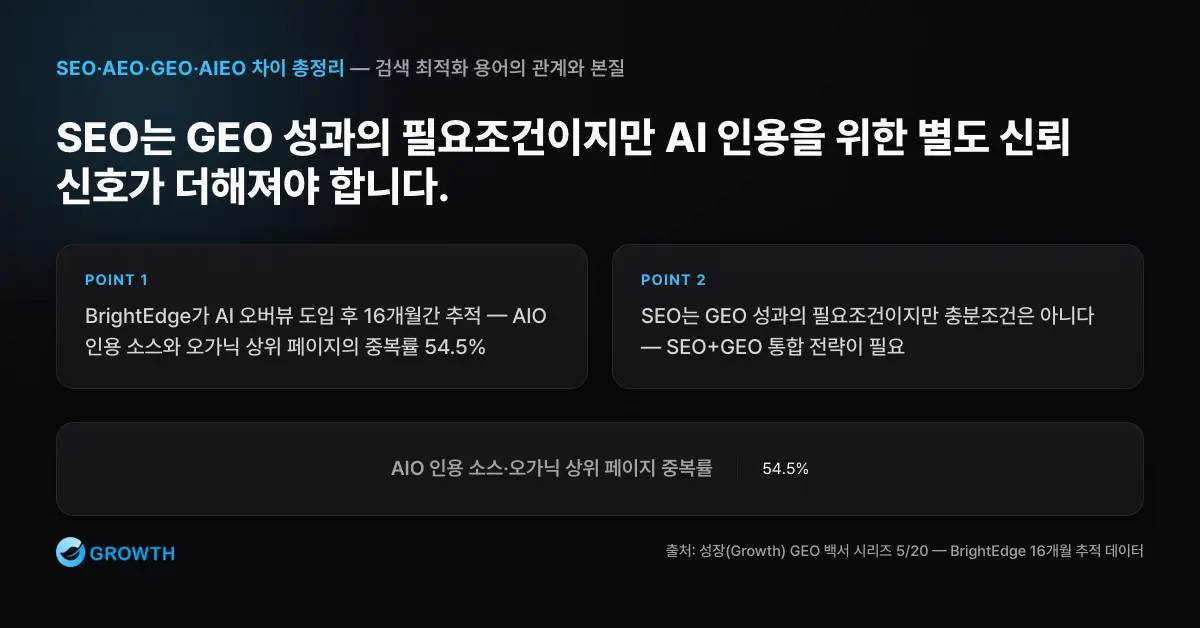
At the same time, it’s equally clear that SEO alone is no longer sufficient. As we covered in our analysis of zero-click search, the decline in traditional search volume and shrinking organic traffic are already well underway, and the projected traffic losses for companies that fail to adapt to AI search are quite severe. We’ve entered an era where SEO is necessary but not sufficient. A successful digital marketing strategy today has to be an “integrated SEO+GEO strategy,” run so the two reinforce each other.
In practice, that integration works like this: the organic ranking and domain authority you’ve built through SEO serve as trust signals when AI engines select sources. Content structured for GEO — answer-first format, statistics included, sources clearly cited — simultaneously raises your odds of being picked up in Google’s Featured Snippets. Technical elements like schema markup pay off in both SEO and GEO at once. A well-designed GEO strategy lifts your SEO performance right along with it.
GEO’s three-axis structure — Technical, Contents, Off-Page
A GEO strategy is built on three interlocking axes. Understanding this three-axis structure is essential before you can properly apply our three-axis GEO execution strategy and the sub-guides beneath it.
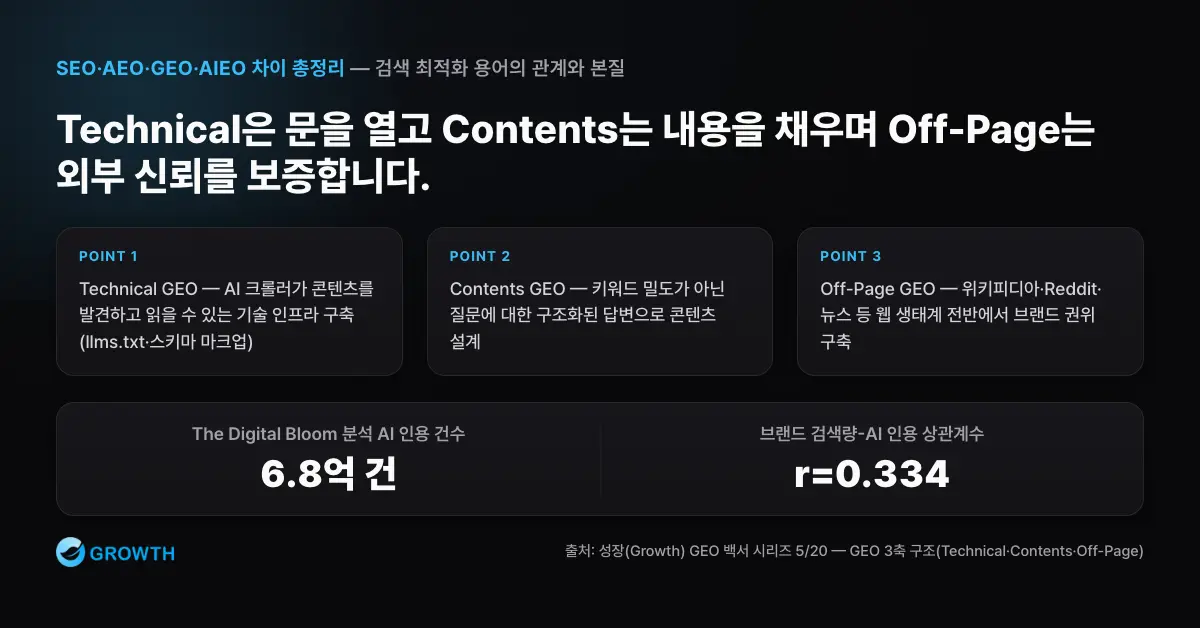
The first axis, Technical GEO, is about building the technical infrastructure that lets AI crawlers discover and read your content. No matter how excellent your content is, if an AI crawler can’t reach it, the chance of ever being cited disappears entirely. Adopting llms.txt, applying schema markup (JSON-LD) comprehensively, and strategically allowing AI crawlers like GPTBot and ClaudeBot are the core elements of this axis. According to the HtmlRAG study (WWW 2025), content that preserved HTML structural information — headings, tables — performed noticeably better on RAG question-answering tasks than content converted to plain text. That’s direct evidence that technical structuring affects AI citation. The concrete execution framework is covered in Technical GEO.
The second axis, Contents GEO, is about designing content that AI has no choice but to cite. This requires one mental shift: where traditional SEO content strategy centered on “keyword density,” GEO’s center is “a structured answer to a question.” As Aggarwal et al. (2024) showed, the reason inserting statistics, citing sources, and including expert quotes ranked highest among the nine tested techniques is that AI systematically favors “well-substantiated information.” Liu et al.’s “Lost in the Middle” study (TACL, 2024) confirmed a U-shaped pattern where AI pays more attention to information placed at the beginning and end of a document. That’s empirical evidence that where information sits within your content determines whether it gets cited. Answer-first structure, data-driven writing, and chunk-based content design are the core tactics of this axis, with the concrete design principles covered in Contents GEO.
The third axis, Off-Page GEO, is about building brand authority across the broader web ecosystem, beyond your own website. AI doesn’t judge trustworthiness from a single website’s information alone — it cross-references how consistently and how positively a brand is mentioned across multiple sources: Wikipedia, Reddit, Quora, news media, and industry forums. In a report analyzing 680 million AI citations, The Digital Bloom found that Brand Search Volume was the predictor with the strongest correlation to AI citation (r=0.334) — meaning brand awareness is directly tied to visibility in the AI world. Digital PR, community engagement, expert contributions, and multimedia content distribution are the core tactics of this axis; the full strategy is covered in Off-Page GEO.
These three axes don’t operate independently. It’s an organic relationship: Technical GEO opens the door, Contents GEO fills the room, and Off-Page GEO vouches for its trustworthiness. When any one axis is weak, the effectiveness of the other two is cut in half as well.
A full bird’s-eye view of GEO through the 5W1H lens
Growth’s GEO whitepaper covers GEO systematically through six lenses (5W1H). Here’s a summary of which question each lens answers and where in the series that answer lives.
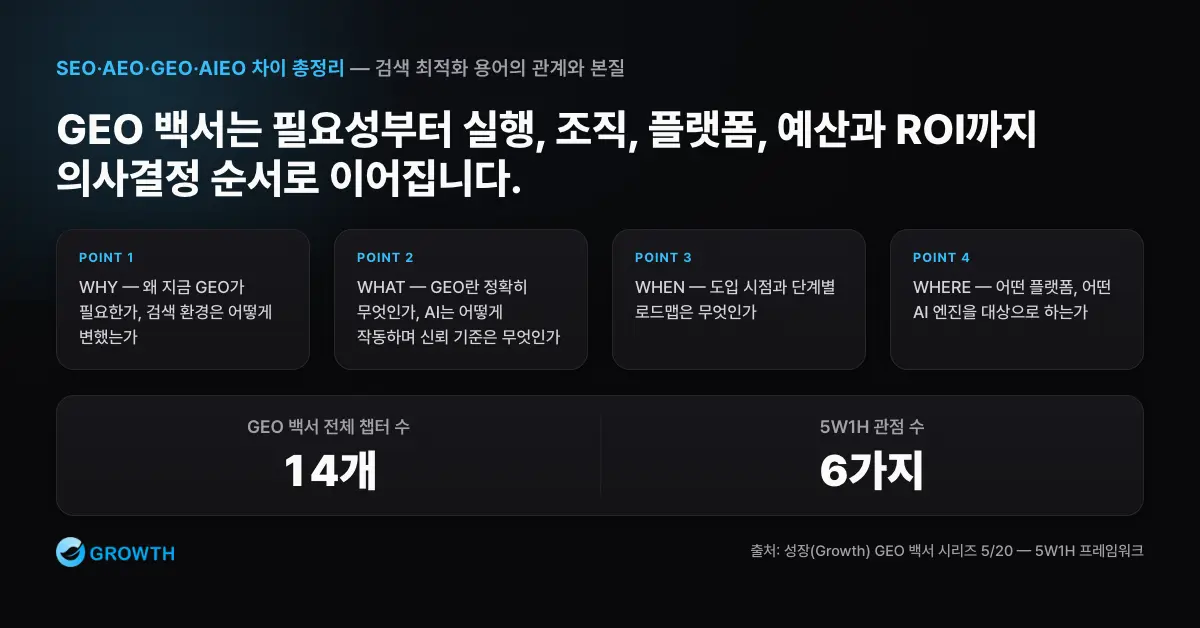
| Lens | Key question | Relevant article |
|---|---|---|
| WHY | Why is GEO necessary right now? How has the search landscape changed? | Zero-click search, The AI dark funnel |
| WHAT | What exactly is GEO? How does AI actually work? What are its trust criteria? | SEO vs. AEO vs. GEO vs. AIEO (this article), How AI generates answers, Entity Authority |
| HOW | How do you build technical infrastructure, content, and external authority? | Technical GEO, Contents GEO, Off-Page GEO |
| WHO | Which organization, which department, actually executes GEO? | GEO team structure and cross-team collaboration |
| WHEN | When should you adopt it, and what does a phased roadmap look like? | A 90-day GEO adoption roadmap |
| WHERE | Which platforms, which AI engines, should you target? | Multi-platform GEO strategy |
| HOW MUCH | How much budget do you need, and how do you measure ROI? | GEO budget planning, Measuring GEO ROI, Case studies and the road ahead |
SEO vs. AEO vs. GEO vs. AIEO, side by side
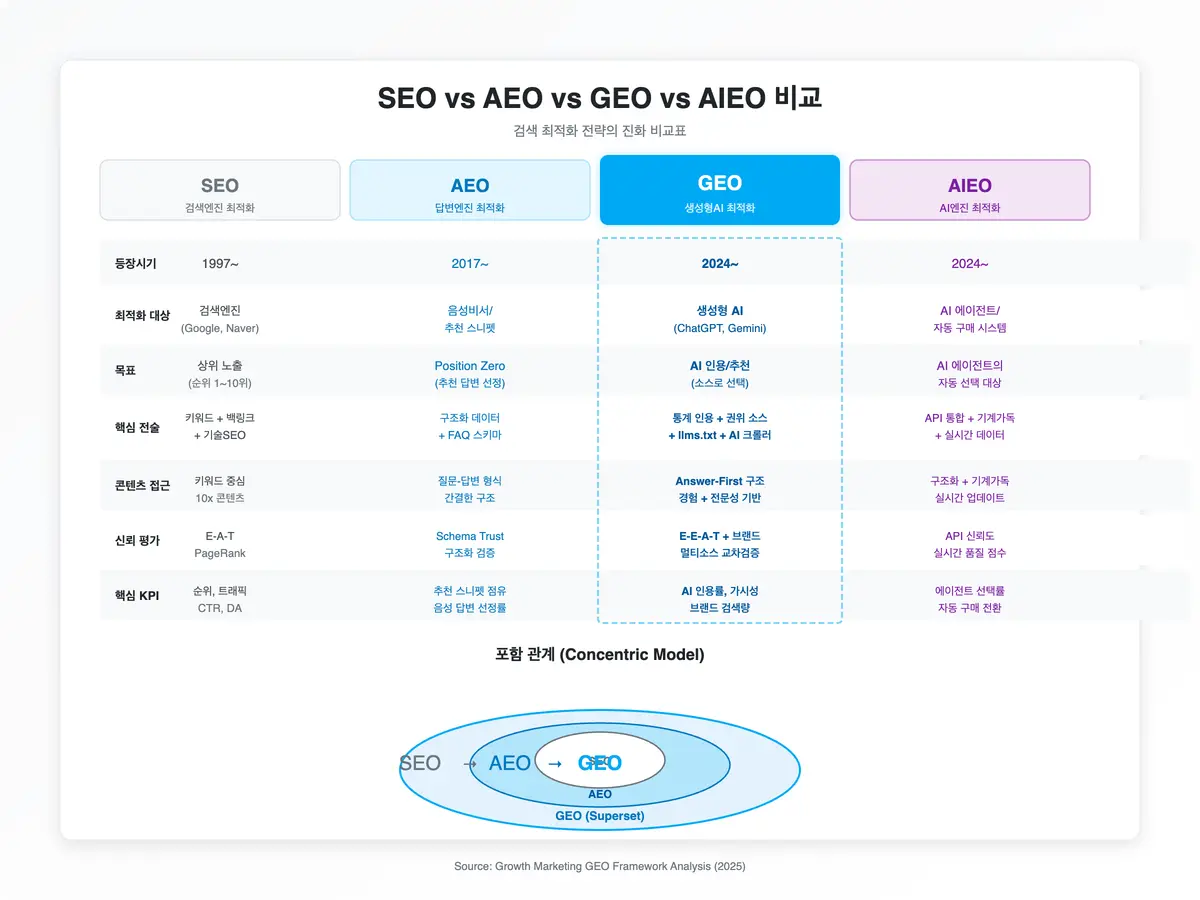
Here’s a side-by-side comparison of the core differences between the four concepts we’ve covered so far.
| Category | SEO | AEO | GEO | AIEO |
|---|---|---|---|---|
| Emerged | ~1997 | ~2017 | ~2024 | ~2024 |
| What it optimizes for | Traditional search engines (Google, Naver) | Answer engines (Featured Snippets, voice search) | Generative AI (ChatGPT, Perplexity, AI Overview) | AI search engines (similar to GEO) |
| Goal | Rank at the top of search results | Get adopted as the answer | Get cited in AI answers | Optimize for AI search results |
| Core tactics | Keywords, backlinks, site speed | FAQ structure, schema markup | 3-axis integration (technical + content + authority) | Per-AI-engine optimization |
| Content approach | Keyword-density-centered | Q&A format | Answer-first + data-driven + chunk structure | AI-preferred formats |
| Trust evaluation | Domain authority, PageRank | E-A-T | Entity Authority + E-E-A-T | Per-AI-engine trust signals |
| Key KPIs | Rankings, traffic, CTR | Snippet adoption rate | AI visibility, brand mentions, conversion rate | AI visibility |
| Academic definition | Extensive body of research | Industry term | Formally defined at KDD 2024 | No formal definition |
| Relationship to SEO | Foundation | Extension of SEO | Built on SEO + adds a new dimension | Extension of SEO |
A guide to all the chapters in the GEO whitepaper
This whitepaper’s 14 chapters interlock with each other. You’re welcome to start with whichever topic interests you, but reading them in order lets the full picture of GEO come together naturally.
Part I. WHY — Why GEO Is Necessary
- The structural shift in search — the zero-click era
- The reshaping of the customer journey — the AI dark funnel
Part II. WHAT — What GEO Is
- SEO vs. AEO vs. GEO vs. AIEO, fully explained (this article)
- How AI generates answers — the AI citation mechanism
- Brand trust in the AI era — from E-E-A-T to Entity Authority
Part III. HOW — How to Execute GEO
- Technical GEO — building a website AI can read
- Contents GEO — designing content AI can’t help but cite
- Off-Page GEO — building brand authority across the web ecosystem
Part IV. WHO & WHEN — Who Executes GEO, and When
Part V & VI. WHERE & HOW MUCH — Where, and How Much
Key takeaway: GEO doesn’t replace SEO — it’s a strategy that extends it for the AI era. Only when you execute all three axes — Technical, Contents, and Off-Page — together do you become “the brand AI chooses to cite.”
If you’re curious how your brand shows up in AI answers right now, reach out for an AI answer share diagnosis. You can also request the full GEO whitepaper PDF.
Frequently asked questions (FAQ)
What’s the biggest difference between SEO and GEO?
The goal is different. SEO aims to “rank at the top of the results page and earn the click”; GEO aims to “be cited as a trustworthy source in a generative AI’s answer.” The evaluation criteria shift too — from keywords and backlinks toward factual accuracy, clear sourcing, and Entity Authority.
How is AEO different from GEO?
AEO is a strategy — emerging around 2017 — for getting a search engine to “adopt your content as the answer,” as with Google’s Featured Snippets or voice search. GEO goes a step further: the goal is to be cited as a trustworthy source in the process by which generative AI synthesizes multiple sources into a single answer.
Is AIEO just another word for GEO?
In practice, their scope is nearly identical. The difference is that GEO has an academically established definition, from the ACM KDD 2024 paper, while AIEO is a term used by some marketers and agencies without any formal definition. To reduce confusion, it’s safer to treat GEO as the standard term.
If we start on GEO, can we stop doing SEO work?
No. As the tracking data showing overlap between AIO-cited sources and organically ranking pages climbing to 54.5% demonstrates, SEO is a precondition for GEO. A well-designed GEO strategy lifts SEO outcomes too — like your Featured Snippet adoption rate — right along with it, so the two need to be run as an integrated whole.
GEO whitepaper series: ← Previous chapter · Full table of contents · Next chapter →