
The Complete Guide to Writing SEO Content: From Search Intent to Publishing and Refreshing
 임재복
임재복
SEO content isn’t writing designed to trick a search engine — it’s content built to satisfy a searcher’s intent as fully as possible, so it gets chosen in both search results and AI answers. What separates winners from losers isn’t keyword density or word count — it’s three things: ① a match between search intent and content format, ② E-E-A-T evidence placed throughout the body, and ③ a data-driven measure-and-refresh loop after publishing. In a study analyzing roughly 14 billion pages in its own index, Ahrefs found that 96.55% got zero traffic from Google search. Most content fails not because of weak writing, but because of missing intent analysis and missing refreshes. This guide covers the full process of SEO content — from planning through what happens after publication — including the four types of search intent and how to match them to content, a 7-step writing process checklist, an AI-era citation strategy (GEO), criteria for deciding when to refresh, and a quality self-check table.
What is SEO content? — the essence is satisfying search intent, not keywords
SEO content is content that covers a topic with confirmed search demand, structured to satisfy the intent behind the user’s query, so that search engines and AI engines can discover, understand, and recommend it. The common assumption — “writing designed to look good to search engines” — actually gets the real order of operations backwards. The essence of writing SEO content is to first create something genuinely useful to a person, then add structure that lets a search engine recognize that usefulness.
This isn’t rhetoric — it’s an evaluation standard Google states in its official documentation. In its Creating helpful, reliable, people-first content guide, Google states that “our automated ranking systems are designed to present helpful, reliable information that’s primarily created to benefit people, not to gain search engine rankings.” The same document’s self-assessment questions even include: “Are you writing to a particular word count because you’ve heard or read that Google has a preferred word count? (No, it doesn’t.)” The era of buying rankings with length and keyword repetition is officially over.
Why can’t keyword density be a quality standard?
Keyword density — the share of a specific keyword within a body of text — was a metric that briefly held validity in the early 2000s, when search engines relied on literal word matching. Today’s Google determines a page’s relevance to a query using synonyms, related concepts, and context. Google’s SEO Starter Guide advises “thinking about the words users would search for to find your content,” while also explicitly stating that because language-matching systems are sophisticated, you don’t need to cram every possible phrasing variation into your text. In fact, mechanically repeating the same word (keyword stuffing) is something Google’s title link documentation explicitly warns you to avoid. How the keyword-density myth was created, and why it fell apart, is examined separately in our piece Does higher keyword density mean better content?
“Writing for SEO” as a separate genre is over
The Helpful Content System, introduced in 2022, was folded into Google’s core ranking system — no longer a standalone system — as of March 2024. The evaluation that distinguishes “content mass-produced for search” from “content made for people” isn’t confined to a specific update window anymore; it applies continuously, across every search result. That’s why this guide isn’t about “SEO writing tricks” — it’s about the process of connecting genuinely good content to search demand.
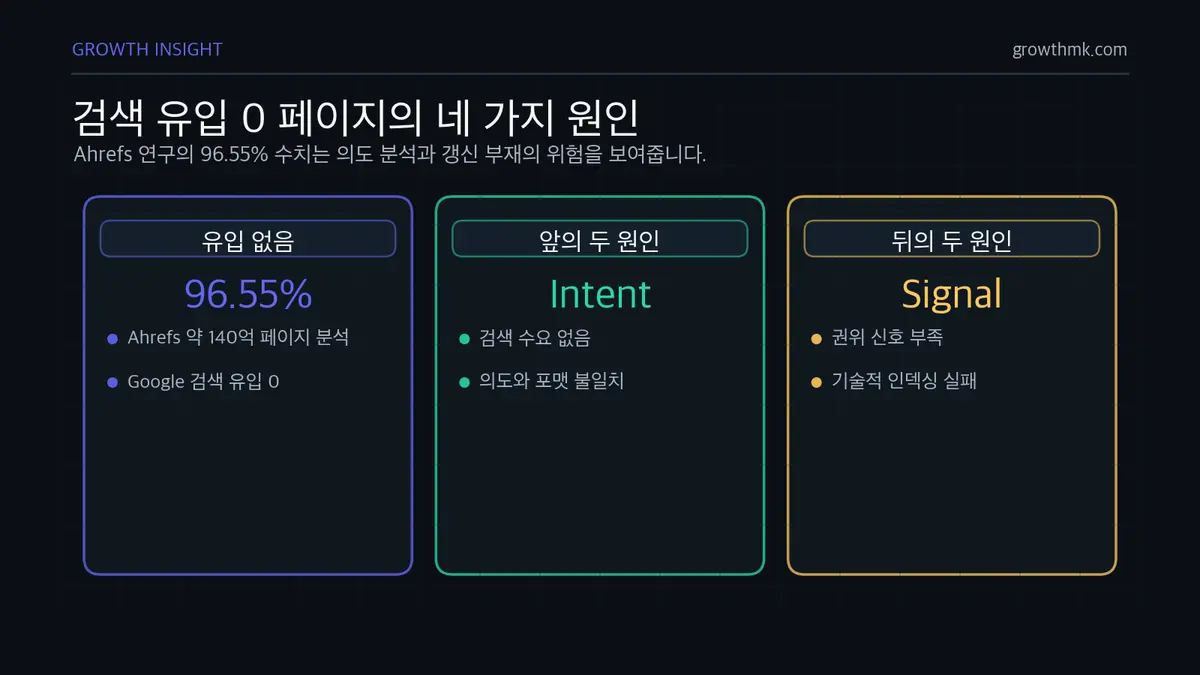
So why does the overwhelming majority of content get zero search traffic? The Ahrefs study cited above points to four causes: covering a topic with no search demand, matching demand to the wrong format for the intent, lacking authority signals (backlinks, brand) relative to competing pages, or simply not being indexed for technical reasons. All four are problems that live outside “writing ability” — and the first two of them are exactly what this guide’s core subject, search intent analysis, addresses.
This is also where Growth’s own standard for content performance comes from. The goal isn’t maximizing visitor count — it’s making sure that the person searching for a problem our service can solve — the one customer who will become revenue — encounters and trusts our content at every touchpoint of their search. Content that draws 10,000 visitors who all bounce is dramatically worse for a business than content that draws 100 visitors, 3 of whom reach out.
The 4 types of customer search intent — intent determines content format
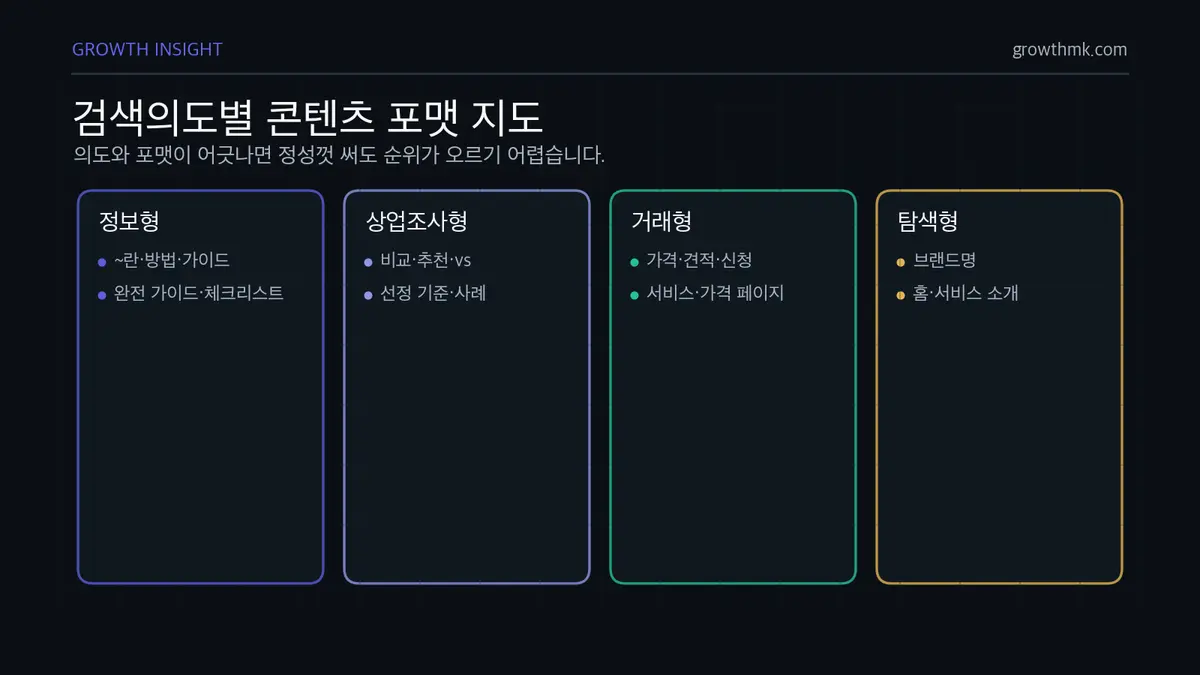
Search intent is the real purpose behind why a user typed a given phrase into a search box. The industry-standard classification is the four types: informational, commercial investigation, transactional, and navigational. What matters isn’t memorizing the taxonomy — it’s that each intent corresponds to a specific stage of the customer journey, which means content format, CTA, and conversion goal all need to change accordingly. Content that mismatches intent and format won’t rank no matter how carefully it’s written, because the very ‘shape’ of the answer Google rewards for that query is different.
| Intent type | Query signals (examples) | What the user wants | Fitting content format | Customer journey stage · conversion goal |
|---|---|---|---|---|
| Informational | “what is,” “how to,” “why,” “guide” e.g., how to write SEO content |
An answer to a question, knowledge to solve a problem | Complete guides, term definitions, how-tos, checklists, statistics roundups | Awareness stage — moving to another article, newsletter signup |
| Commercial investigation | “comparison,” “recommended,” “review,” “vs,” “agency,” “selection criteria” e.g., criteria for choosing an SEO agency |
Objective grounds for narrowing down options | Comparison tables, selection-criteria guides, case studies, honest pros/cons reviews | Consideration stage — traffic to case studies or service pages |
| Transactional | “pricing,” “quote,” “apply,” “buy,” “download” e.g., SEO agency quote |
Taking action right now | Service/product detail pages, pricing info, application forms | Decision stage — inquiry or purchase conversion |
| Navigational | Brand name, service name e.g., Growth marketing blog |
Reaching a specific site or page | Brand homepage, service overview, official documentation | Applies across every stage — consistency of brand experience |
If intent is hard to pin down, the SERP has the answer
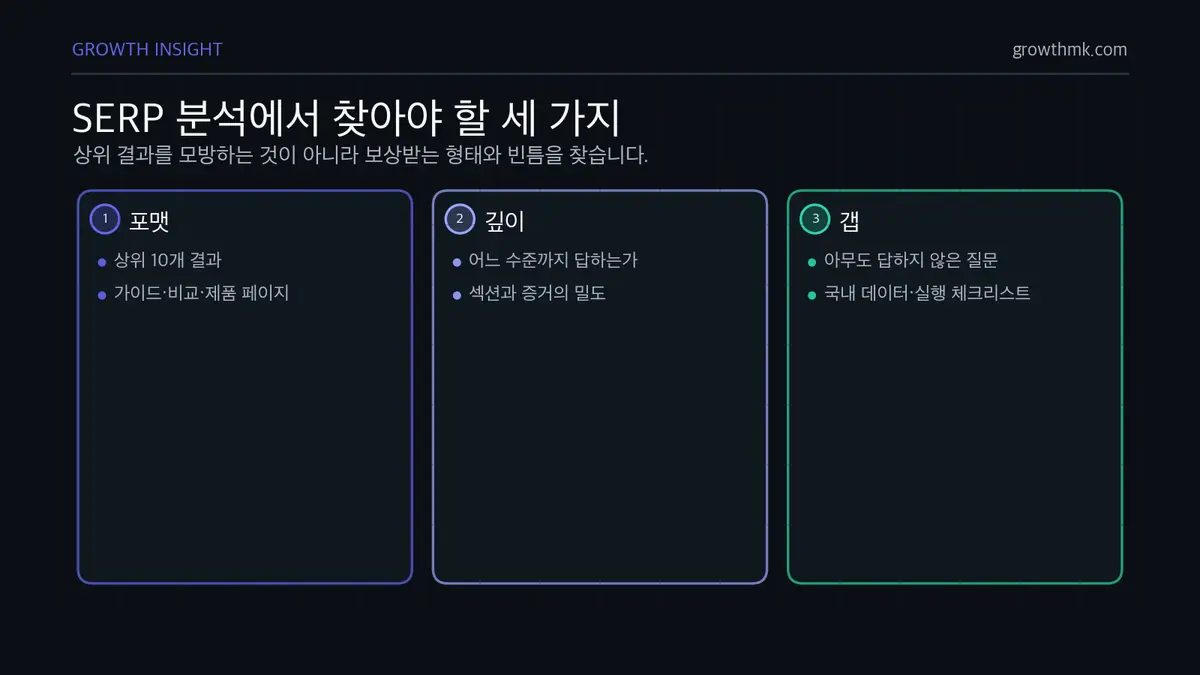
You don’t have to guess a keyword’s intent from your desk — just search the keyword yourself and look at page one. The top results are exactly the ‘shape of the answer people were satisfied with for that query,’ as learned by Google from massive amounts of user behavior data. Check three things: first, the format of the top 10 results — mostly guide articles means informational, mostly comparisons/reviews means commercial investigation, mostly product/service pages means transactional. Second, SERP features — Featured Snippets and AI Overviews signal informational, shopping results signal transactional. Third, the direction of the questions in ‘People Also Ask.’ This same observation is also the starting point for step 2 of the writing process (SERP analysis), covered later.
What if a single keyword mixes multiple intents?
Real keywords often don’t sort cleanly into one of the four boxes. Ahrefs makes this same point in the article cited above — many keywords straddle multiple intents at once. For example, “SEO agency” mixes an informational intent (learning the concept) with a commercial-investigation intent (choosing a provider). In this case, use two rules. First, treat whichever format takes up more real estate on the SERP as the primary intent, and build the content’s skeleton around that. Second, absorb the secondary intent through a section within the body or an internal link. If informational is primary, write it as a guide but include a comparison/selection-criteria section that links out to a commercial-investigation article. The most common failure is trying to satisfy every intent at once in a single piece — and ending up satisfying none of them.
In B2B, the ‘one customer who becomes revenue’ lives in commercial-investigation search
Looking purely at traffic volume by type, informational search is the largest. But informational visitors are far from conversion, and transactional keywords have very low search volume in B2B to begin with. The zone where real revenue gets made, in practice, is the space between the two — commercial investigation. Someone typing “compare agencies,” “selection criteria,” or “agency vs. in-house” has already recognized their problem and is actively choosing between solutions — a prospect likely to make a decision within days. That’s why, when designing a content portfolio, Growth uses informational content to widen search touchpoints, but always maps out the internal-link path from every informational article toward a commercial-investigation article first. Matching search intent isn’t a single-article problem — it’s a design problem for the entire customer journey.
The 7-step SEO content writing process
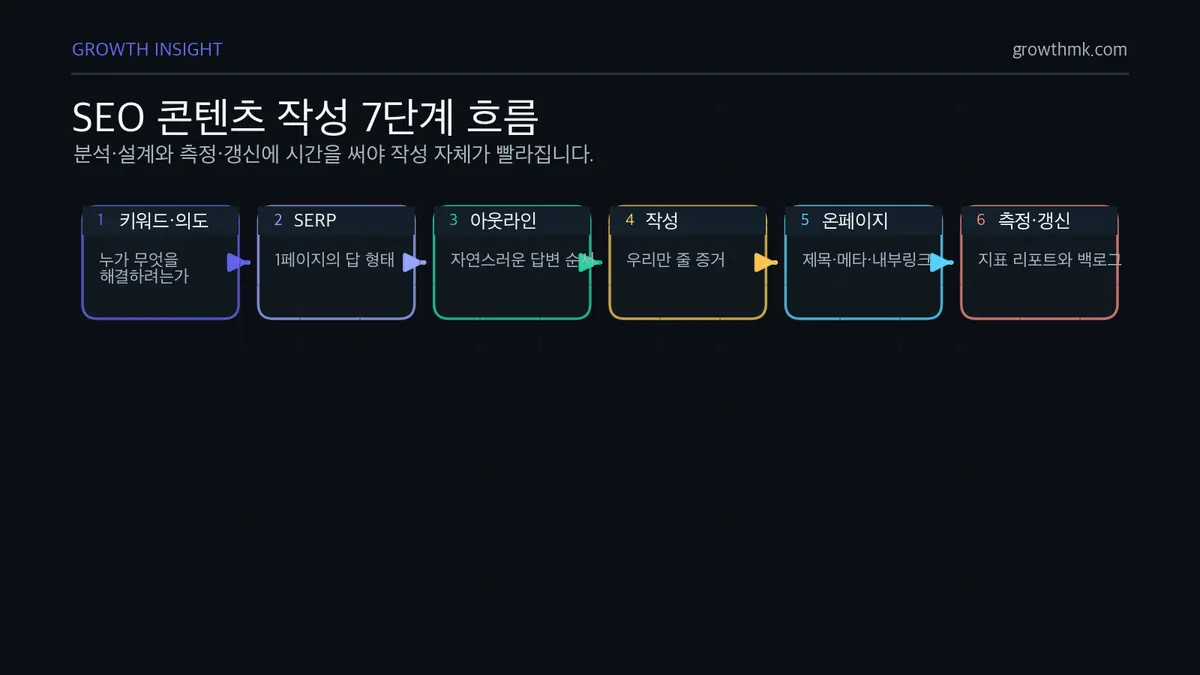
The seven steps below are the standard process Growth applies identically to its own blog and to client content. We’ve attached a key question and a checklist to each step. Even if you can’t check off every item, the rule is: don’t move to the next step without answering that step’s key question. There’s also a common misconception about time allocation worth correcting. Many teams spend most of their total time on step 4 (writing), but the teams with proven results invest more than half their time in steps 1–3 (analysis and design) and step 7 (measurement and refresh). Once you know what you’re answering, writing goes fast — and once measurement data accumulates, choosing the next topic gets more accurate.
| Step | Key question | Deliverable |
|---|---|---|
| 1. Keyword & intent analysis | Who’s searching, and what are they trying to solve? | Target keyword + intent definition doc |
| 2. SERP analysis | What answer does page one currently show? | Format decision + content gap list |
| 3. Outline design | What order of answers feels natural? | H2/H3 structure draft |
| 4. Writing | What evidence can only we provide? | Draft with E-E-A-T evidence placed |
| 5. On-page optimization | How does this appear to search engines and users? | Finished title, meta, internal links |
| 6. Publishing | Has a crawler read it and indexed it? | Live URL with confirmed indexing |
| 7. Measure & refresh | Did it actually satisfy the intent? | Metrics report + refresh backlog |
Step 1 — Keyword and search intent analysis
The starting point isn’t a keyword list — it’s a list of customer problems. Write down, in your customers’ own words, the problems your service solves, verify with a tool that those words are actually being searched, then classify each keyword’s intent type. Here, business relevance — “could this searcher become our customer?” — matters more than raw search volume. Keyword-discovery tools and prioritization methods are covered step by step in our marketing keyword research strategy guide.
- Have you compiled 1 target keyword plus 5–10 supporting keywords (synonyms/sub-questions)?
- Have you documented each keyword’s intent type (informational, commercial investigation, transactional, navigational)?
- Can you explain, in one sentence, the path by which this searcher becomes a customer?
- Have you weighed search volume, competitive difficulty, and business value together?
Step 2 — SERP analysis: look for the ‘gap,’ not the competition
Search the target keyword and actually read the top 10 results. The goal isn’t imitation — it’s gathering three pieces of information: which format gets rewarded (format), how deep the coverage goes (depth), and what’s missing (gap). Differentiation doesn’t come from “writing longer” — it comes from answering the question the top results all failed to cover. If everyone just lists definitions, an execution checklist is the gap; if everyone only covers foreign case studies, domestic data is the gap.
- Have you logged the format, angle, and publish date of the top 10 results?
- Have you collected the ‘People Also Ask’ questions and related searches?
- Have you listed out the sub-topics the top results all cover in common?
- Have you found at least one question that nobody properly answers?
Step 3 — Outline design: your heading structure is a ‘map of intent’
H2/H3 headings aren’t visual decoration — they’re a map that breaks search intent down into sub-questions. Design each H2 to correspond to a single sub-question, and state that question’s answer immediately in the first paragraph of the section. Don’t save the conclusion for later in your introduction — write it in ‘answer-first’ form, summarizing the whole article’s answer in 2–4 sentences. Both human dwell time and AI citation flow from this structure.
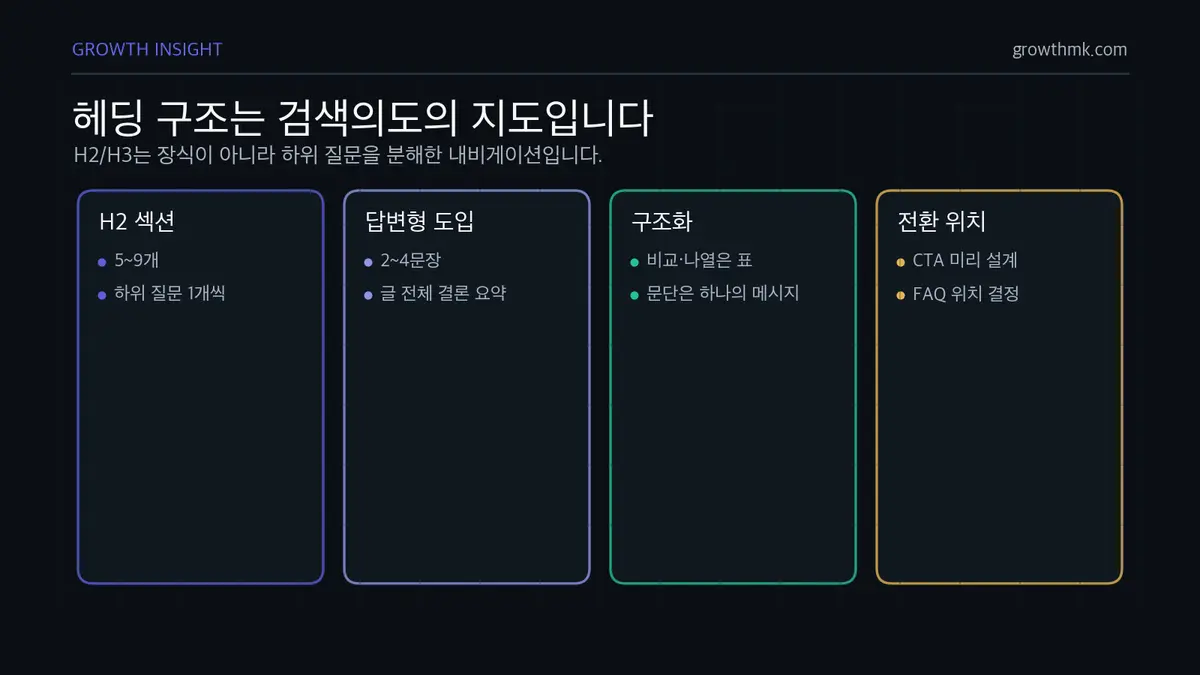
- Are there 5–9 H2 sections, each mapped to a clear sub-question?
- Can a reader learn the article’s overall conclusion from just the first 3–4 sentences?
- Do you plan to structure comparison or list-type information as a table?
- Have you pre-decided where the CTA and FAQ will go?
Step 4 — Writing: place E-E-A-T evidence throughout the body
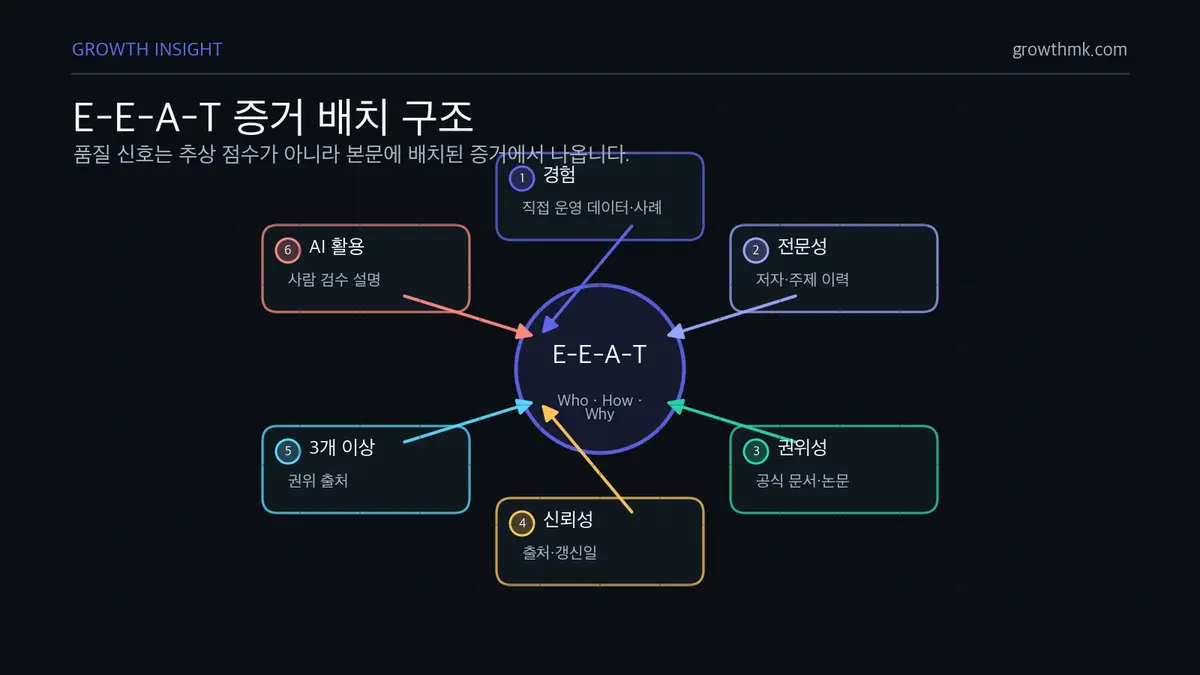
E-E-A-T (Experience, Expertise, Authoritativeness, Trustworthiness) isn’t a scored, direct ranking factor — it’s an umbrella term for the lens Google uses to view content quality. Google’s official documentation breaks this down into three questions: who made it, how was it made, and why was it made. Your job at the writing stage is to deliberately place evidence throughout the text that answers these questions. Evidence of experience is firsthand operational data, failure stories, and process notes; evidence of expertise is a named author with a consistent track record on the topic; evidence of authority is citing official documentation and research papers; and evidence of trust is a source linked to every figure, plus a visible last-updated date and information about who runs the site. Common misconceptions about the concept, and how to apply it in practice, are covered in depth in our explanation of E-E-A-T criteria.
The stylistic principle is ‘answer-first.’ State the conclusion in the first sentence of each section, then unpack the evidence and examples afterward. Each paragraph should cover a single message and stay under 4–5 sentences; don’t spell out list-type information in prose — structure it as a list or table instead. Writing this way lets people grasp the core point even skimming, and lets search engines and AI clearly recognize which unit to extract. Precisely placed answers, not flashy prose, is what writing skill means for SEO content.
- Have you linked a verifiable source to every key claim and figure (3+ authoritative sources)?
- Have you included at least one piece of firsthand experience, proprietary data, or a case study?
- Is the author, publish date, and last-updated date shown on the page?
- If you used generative AI, can you explain the human review process (the ‘How’)?
- Is there a sentence competing articles don’t have — one only you could write?
Step 5 — On-page optimization: title, meta, internal links
On-page work is about accurately ‘displaying’ your finished answer to search engines and users. Following the guidance in Google’s title link documentation, write titles that are descriptive and concise, unique to each page, and avoid keyword repetition. The exact title-writing formula and prompts that determine click-through in search results are laid out in how to write titles that boost search rankings. As Google’s snippet management documentation emphasizes, the meta description should be a page-specific summary — recycling similar phrasing across every page doesn’t help. Design internal links at the cluster level, not the article level. When a pillar guide and its cluster articles link to each other bidirectionally with contextual anchor text, search engines recognize the site’s topical expertise far more clearly.
- Does the title contain the core keyword and this article’s unique value, matching the content exactly?
- Is the meta description written uniquely for this page?
- Is the URL short and does it describe the topic?
- Is it linked to 3–6 articles in the same cluster (with contextual anchor text)?
- Have you written alt text for images?
Step 6 — Publishing: publication isn’t done until indexing is confirmed
Google Search operates in three stages: crawling → indexing → serving in search results. Hitting publish only puts your article at the entrance of this pipeline — publication isn’t truly finished until indexing is confirmed. Use URL Inspection in Search Console to request indexing, and confirm sitemap inclusion and mobile rendering. Notably, half of how difficult this step is gets decided by the system you publish through in the first place. How well a CMS supports sitemaps, structured data, and page speed is evaluated from an SEO angle in our comparison of 6 CMS platforms for marketers.
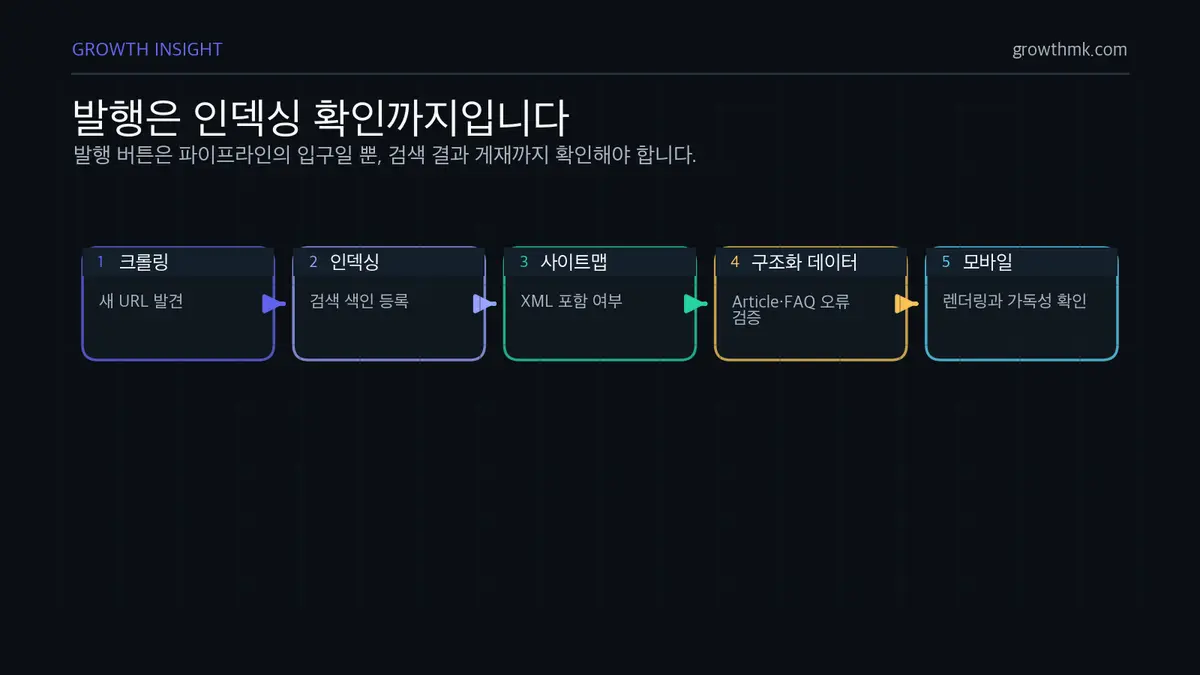
- Have you requested indexing in Search Console and confirmed it went through?
- Is the new URL included in the XML sitemap?
- Does your structured data (Article, FAQ, etc.) validate with no errors?
- Have you checked rendering and readability on mobile?
Step 7 — Measure and refresh: publishing is the start, not the finish
Around four weeks after publishing, check impressions, clicks, average position, and query data in Search Console, and check dwell time, scroll depth, and conversions in your analytics tool. Measurement matters because the value of moving up one rank is nonlinear. In a study analyzing 4 million search results, Backlinko found that position 1 gets a 27.6% click-through rate versus roughly 2.4% for position 10 — a more than 10x difference within the same page one — and only 0.63% of users ever click through to page two. This is exactly why refreshing an article to move from rank 11 to rank 6, or from rank 6 to rank 3, is often more efficient than publishing something new. Growth runs this step as a growth-hacking experiment loop: form a hypothesis from the data (e.g., “CTR is low relative to impressions — the title doesn’t match intent”), edit the title, meta, and introduction, measure the change, and feed the result back into planning the next piece of content.
- Four weeks after publishing, have you confirmed the incoming query data matches your target keyword?
- For pages with low CTR relative to impressions, have you planned a title/meta rewrite experiment?
- Is this article’s conversion goal (inquiry, subscription, moving to another article) actually being tracked?
- Have you logged the improvements you found in a refresh backlog?
Which SEO content does AI cite? — the connection to GEO
As AI Overviews, ChatGPT, and Perplexity take over the front end of the search experience, SEO content competition is expanding from ‘ranking’ to ‘the odds of being cited in an AI answer.’ These aren’t separate jobs. The core essence — structured content that satisfies search intent — stays the same; you’re simply adding a surface treatment optimized for AI citation. The GEO paper from researchers including Princeton University (accepted at KDD 2024) demonstrated experimentally that optimizations like adding cited sources, statistics, and expert quotations can boost visibility within generative engines by up to 40%.
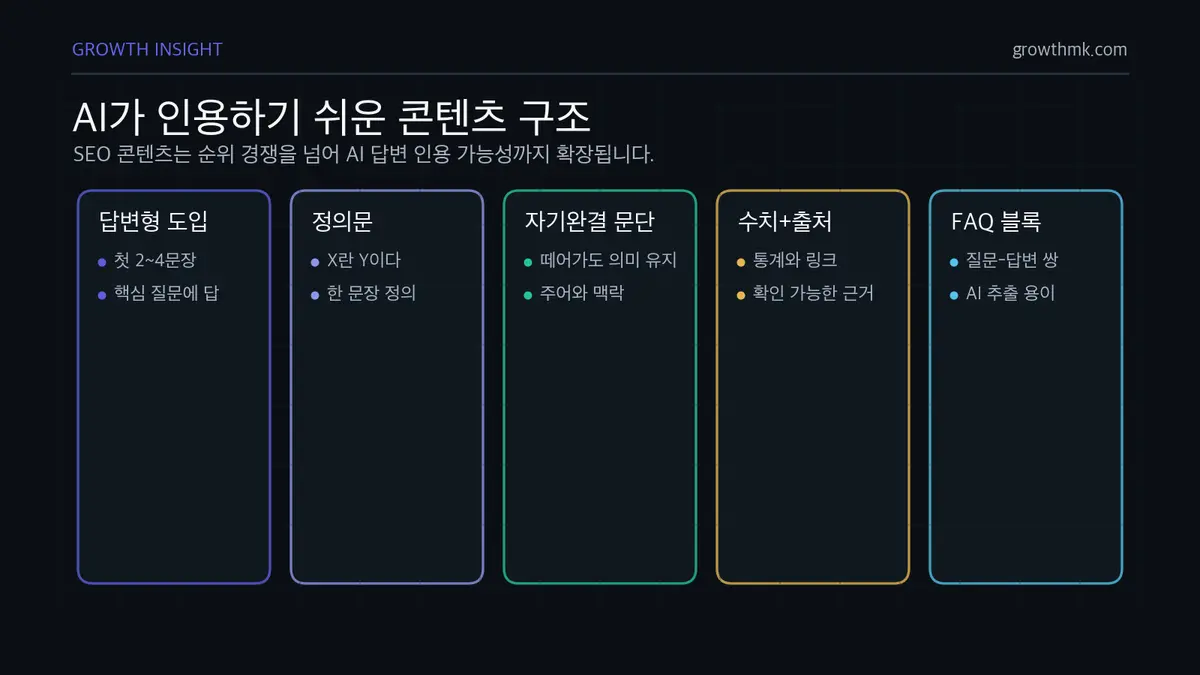
In practice, these five things create a ‘citable structure’:
- An answer-first introduction — the article’s first 2–4 sentences answer the core question self-sufficiently, holding up even if an AI quotes them verbatim
- A clear definition sentence — a single sentence somewhere in the body, in the form “X is Y”
- Paragraph self-sufficiency — any given paragraph keeps its subject and context intact even if pulled out on its own
- Every figure paired with a source — every statistic is linked to a verifiable source
- FAQ blocks — question-answer pairs are the format easiest for AI to extract
There’s one shift worth flagging on FAQs. Google has restricted FAQ rich-result display to authoritative government and health sites, and officially announced it will end FAQ rich results in search altogether in 2026. Even so, the value of the FAQ format hasn’t diminished. Its usefulness was never about decorating a search result — it’s about resolving a user’s follow-up questions and offering a structure AI engines can lift question-and-answer pairs from directly. The complete execution strategy, including how each AI engine actually works and how to measure results, is covered in our complete guide to GEO (generative engine optimization).
Content refresh strategy — find what’s worth reviving before you write something new
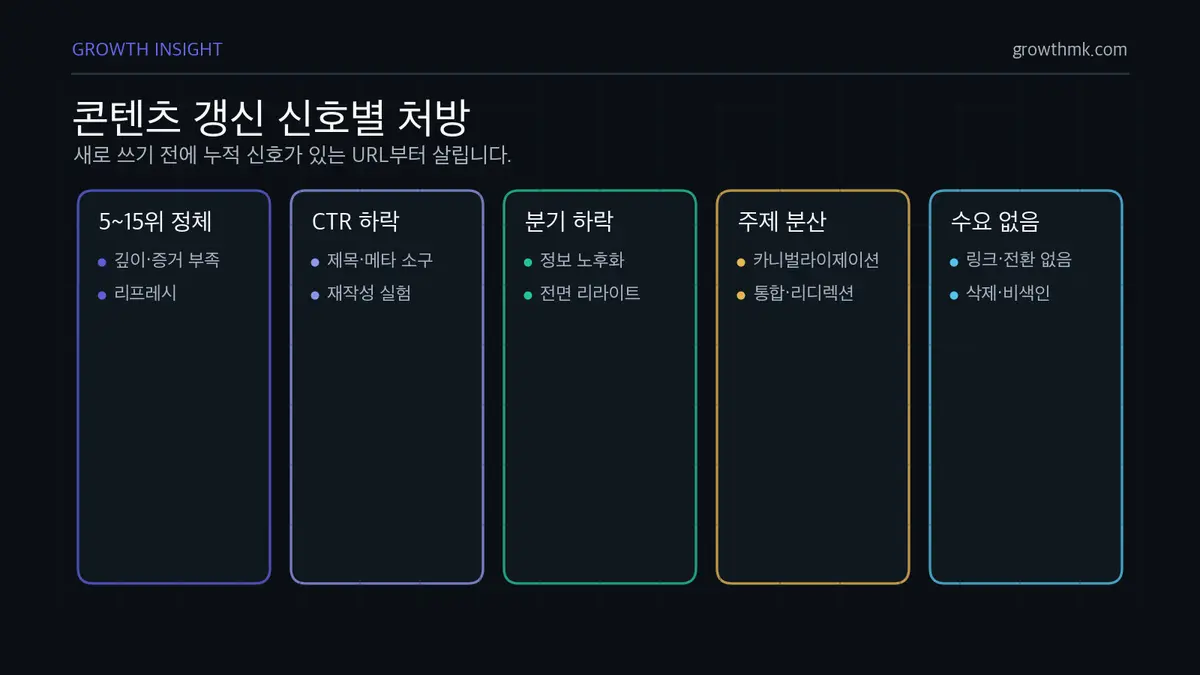
A published URL is an asset with accumulated crawl history, internal links, backlinks, and user behavior data. For the same amount of effort, refreshing on top of that existing asset often produces faster results than publishing something brand new from zero. Per Google’s ranking systems documentation, a freshness system (‘query deserves freshness’) kicks in for queries where recency is expected, surfacing newer content. An article with stale information will slide down in ranking even if you do nothing to it. That said, not every article needs a refresh — the right response depends on which data signal you’re seeing.
| Data signal | Diagnosis | Prescription |
|---|---|---|
| Stuck at ranks 5–15 | Intent was matched, but lacks depth/evidence | Refresh — fill missing sub-topics, replace with current data and sources |
| Impressions climbing but CTR falling | Weak title/meta appeal, or a shift in the SERP environment | Rewrite the title and meta, then measure the change |
| Traffic declining quarter over quarter | Information has gone stale, overtaken by competing content | Full rewrite — re-analyze the SERP and rewrite, show an updated date |
| Several articles scattered across a similar topic | Keyword cannibalization (self-competition) | Consolidate — merge into one article, redirect the rest |
| No demand, links, or conversions at all | Topic selection itself failed | Delete or de-index — for overall site quality management |
The refresh workflow is essentially a condensed version of the new-content process.
- Analyze the URL’s incoming queries in Search Console to confirm actual demand
- Re-research the target keyword’s SERP to check whether intent has shifted
- Update the body — replace stale figures, fill in missing questions, fix broken links
- Show an updated date and realign internal links with the current cluster structure
- Request re-indexing in Search Console and measure the change 4 weeks later
One caution worth flagging: refresh honestly. Leaving the body untouched while just changing the date deceives users and can look like an attempt to fake a freshness signal. An updated-date label only works as evidence of trust when the figures, content, or structure have genuinely, materially changed. Criteria for choosing which articles to revive first, with real examples, are covered in detail in our strategy for recycling old content. We recommend running a full content audit every quarter, building a refresh backlog by the signal categories in the table above, and deciding the ratio of new publishing to refreshing based on data.
An SEO content quality self-check checklist
This is the final gate before hitting publish. Whichever of the 12 questions below gets a ‘no’ is that article’s weakest link. For a more condensed 4-step review flow, also see our 4-step checklist for Google SEO-optimized content.
| Area | Check question | Passing standard |
|---|---|---|
| Search intent | Can you state the target keyword’s intent type in one word? | Documented as one of: informational, commercial investigation, transactional, navigational |
| Search intent | Does it match the same format family as the top 10 results? | Matches the SERP format, or has a deliberate reason for differentiating |
| Introduction | Does reading just the first 3–4 sentences give you the core answer? | Self-sufficient, answer-first introduction |
| E-E-A-T | Is there a sentence competing articles don’t have — one only you could write? | At least 1 piece of firsthand data, experience, or case study |
| E-E-A-T | Is every figure linked to a source? | 3+ authoritative sources cited inline |
| On-page | Does the title accurately describe the content? | No exaggeration or keyword repetition, unique per page |
| On-page | Is the meta description a summary unique to this page? | Uniquely written, under 150 characters |
| Structure | Is comparison or list-type information organized as a table? | At least 1 table for comparison-type content |
| Internal links | Is it linked to articles in the same cluster? | 3–6 contextual anchors, bidirectional pillar↔cluster links |
| AI citability | Does any given paragraph still make sense pulled out on its own? | Self-sufficient paragraphs + a one-sentence definition present |
| Measurement | Is this article’s conversion goal defined? | CTA placed + tracking set up |
| Refresh | Is the next review date scheduled? | 4-week post-publish review + logged in the quarterly audit backlog |
From search intent analysis, to content design, to building E-E-A-T evidence, to the post-publish measure-and-refresh loop — designing this entire process around ‘the one customer who becomes revenue’ rather than traffic volume is Growth’s SEO content methodology. If you need a diagnosis of where to start attacking your business’s search demand, take a look at Growth’s SEO service, or tell us about your specific situation via consultation.
Execution guides in this cluster
- A 4-step checklist for Google SEO-optimized content
- Boosting SEO by recycling old content
- Does higher keyword density mean better content?
- How to write titles that boost search rankings (+ prompts)
- Read this before choosing a website CMS! 6 CMS platforms compared for 2025
Frequently asked questions (FAQ)
How many characters should SEO content be?
There’s no fixed length. Google explicitly states in its official documentation that “there’s no word count Google prefers.” The standard isn’t length — it’s whether the search intent is satisfied, meaning: is this a sufficient enough answer that the searcher stops searching? For the same keyword, a term definition might only need 1,500 characters, while a comparison or guide-style intent might need 10,000. Decide length by looking at how deep the top SERP results go, matched to intent.
How many times should a keyword appear in the body?
There’s no correct ratio for keyword density. It’s enough for the core keyword to appear naturally in the title, introduction, and a few headings — within the body, it’s better to use synonyms and related concepts the way a person would speak. Google’s language-understanding systems recognize topical relevance even across different phrasing, while mechanical repetition is exactly the keyword stuffing its official documentation warns against.
Isn’t AI-written content bad for SEO?
Google’s evaluation criteria are about the quality and purpose of the output, not the production method. If it’s genuinely helpful content made to benefit people, using AI isn’t itself a problem — but mass production aimed purely at gaming rankings falls under spam policy regardless of production method. The practical standard is clear: use AI as a drafting and structuring tool, but a human should own firsthand experience, data verification, and source checking, and you should be able to explain the production process transparently.
When do SEO content results start showing up?
Crawling and indexing usually finish within days, but rankings and traffic typically take several months to stabilize — with wide variance depending on the site’s existing authority, keyword competitiveness, and internal-link structure. That’s why we recommend a two-cadence measurement schedule: first check incoming queries, impressions, and CTR in Search Console 4 weeks after publishing to confirm you’re on the right track, then evaluate ranking and conversion trends quarterly.
Is it better to delete or fix an old article?
Decide based on data. An article that still has impressions or backlinks should be refreshed first, since it recovers faster on top of accumulated signals. If several articles on a similar topic are cannibalizing each other’s rankings, consolidate them into one and redirect the rest. Only articles with zero search demand, links, and conversions should be deleted or de-indexed, as part of managing overall site quality signals.