The 90-Day Brand Launch Playbook
 임재복
임재복
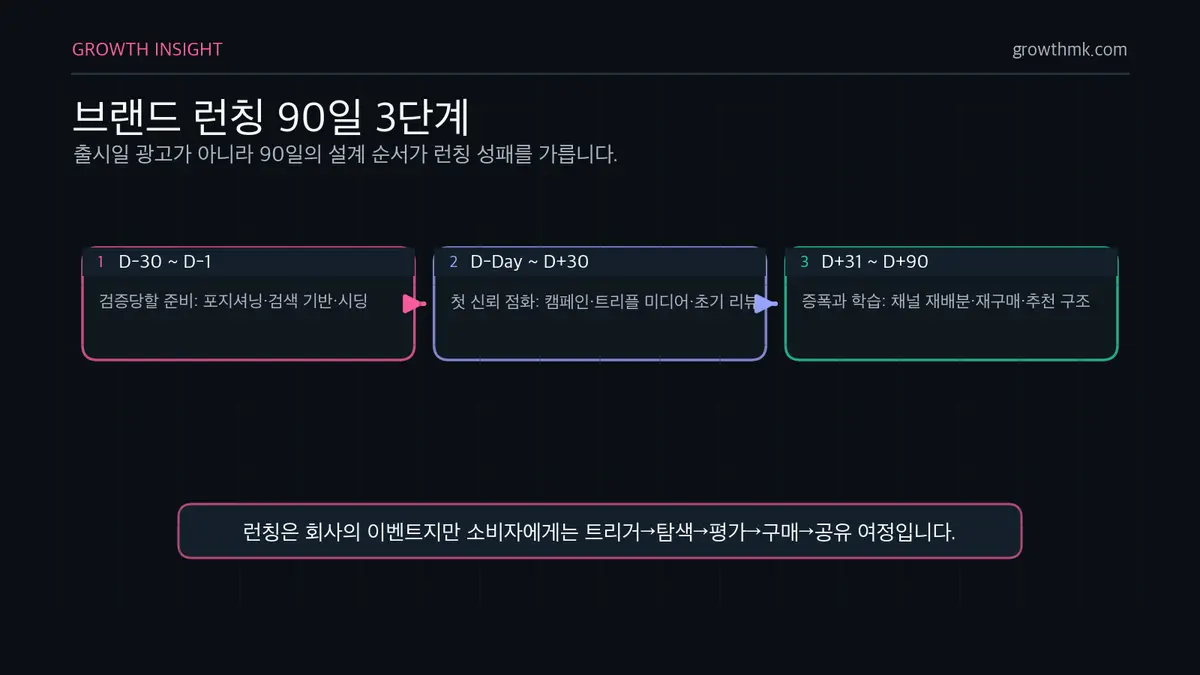
Whether a brand launch succeeds or fails isn’t decided by how much ad spend fires on launch day — it’s decided by the design sequence across 90 days. In the 30 days before launch (D-30), you build “readiness to be scrutinized” through positioning, search foundations, and seeding. In the first 30 days after launch (D-Day to D+30), you ignite awareness through the launch campaign, triple media, and early reviews. From D+31 to D+90, you use data to reallocate channels and build repeat-purchase and referral structures. Follow this sequence and the same budget creates a path where “someone who heard of the brand” becomes “someone who buys it with confidence.” Skip the sequence, and the impressions stick around, but the revenue doesn’t. This article breaks the 90 days into three stages and lays them out as an execution playbook — tasks, checklists, budget structure, and metrics for each stage, all in table form.
Why Do Launches Fail? — It’s Not the Product, It’s the Absence of “First Trust”
Picture a typical launch planning meeting agenda: launch date, ad budget, influencer outreach, opening event. All of it is a “plan to get the word out.” But one question almost never shows up: “What does someone see when they search for our brand for the first time?” Most launch failures start in that gap.
Joan Schneider and Julie Hall, who have run a product-launch consultancy for years, describe a familiar pattern among the founders and brand managers who come to them, in their Harvard Business Review piece Why Most Product Launches Fail: overflowing conviction that the product is “innovative,” but when asked what research backs that conviction, the answer is usually “we haven’t researched it yet, but we just know it’ll work.” All the energy goes into building the product, while the work of making the market believe in it gets pushed off until right before launch — and that’s the most common shape a failed launch takes.
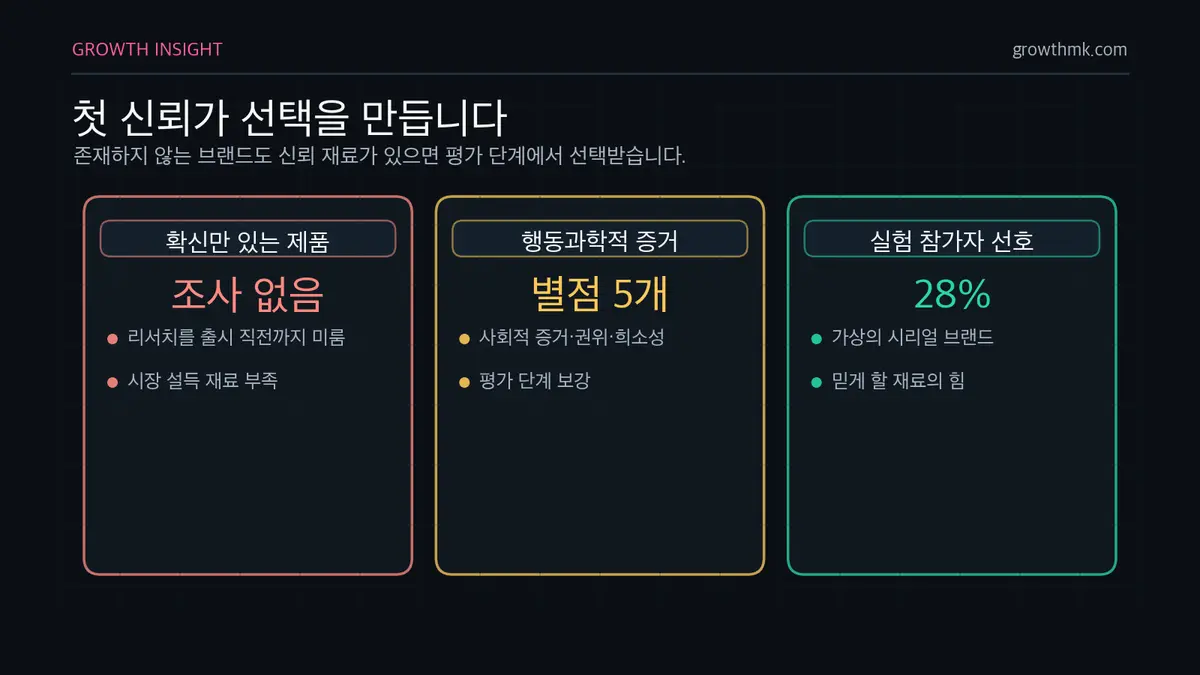
There’s a distinction worth making explicit here: getting the word out and making people believe are two different jobs. Advertising creates awareness. But awareness isn’t a purchase. Google’s “messy middle” research, produced with a behavioral science consultancy, finds that between the purchase trigger and the actual purchase, consumers move through a complex middle zone of repeated exploration and evaluation, and that “customers are won and lost in this space.” That’s exactly where a new brand’s structural weakness lies. Ads can create the trigger, but when the brand gets compared during evaluation, it has no evidence to offer — no reviews, no third-party mentions, no consistent information showing up in search.
The same study’s experimental results put a number on just how powerful this zone is. Even a fictional cereal brand that doesn’t actually exist in the market captured 28% of experiment participants’ preference once it was reinforced with behavioral-science evidence (social proof, authority, scarcity, and the like) — things like five-star reviews. That means even a nonexistent brand gets chosen if it has the “material to be believed” — and, conversely, even a genuinely good product gets eliminated at the evaluation stage without that material. The essence of launch marketing isn’t executing ads — it’s building the raw material for first trust in advance.
So this playbook designs the 90 days around three stages.
| Stage | Timeframe | One-sentence goal | Key question | Representative deliverables |
|---|---|---|---|---|
| Foundation-building | D-30 to D-1 | Finish getting “ready to be scrutinized” before you start getting the word out | “What shows up when someone searches our brand name?” | Positioning document, brand search assets, seeded reviews, media kit |
| Ignition | D-Day to D+30 | Create awareness and convert it into first trust | “Does the person who heard of us come to believe us?” | Three-act launch campaign, triple media activation, early review pool |
| Amplification and learning | D+31 to D+90 | Reallocate channels using data and build repeat-purchase structures | “Which channel’s one customer becomes revenue?” | Channel reallocation plan, repeat-purchase/referral flow, next quarter’s plan |
One perspective runs through all three stages: a launch is an event for the company, but for the consumer, it’s a journey. They hear about it first (trigger), search (exploration), compare (evaluation), buy (purchase), and talk about it (sharing). Every task at every stage exists to get the customer through a specific point of that journey without friction. We’ve covered how customers actually arrive at a decision separately in The Customer Decision Journey (CDJ).
D-30 (Pre-Launch) — Foundation-Building: Get “Ready to Be Scrutinized” Before You Start Getting the Word Out
The first thing that happens the moment a launch ad gets seen isn’t a purchase — it’s a search. And today’s search isn’t limited to a single search bar. Google’s latest consumer behavior research declares that “the traditional funnel marketers have relied on for decades no longer explains the full picture,” finding that consumers now do their pre-purchase verification not just through search engine queries, but through conversations with AI like Gemini, AI Overviews summaries, and YouTube reviews. The goal of the D-30 stage is clear: put the brand in a state where it passes at every one of these verification touchpoints.
1. Lock your positioning and message into a single sentence
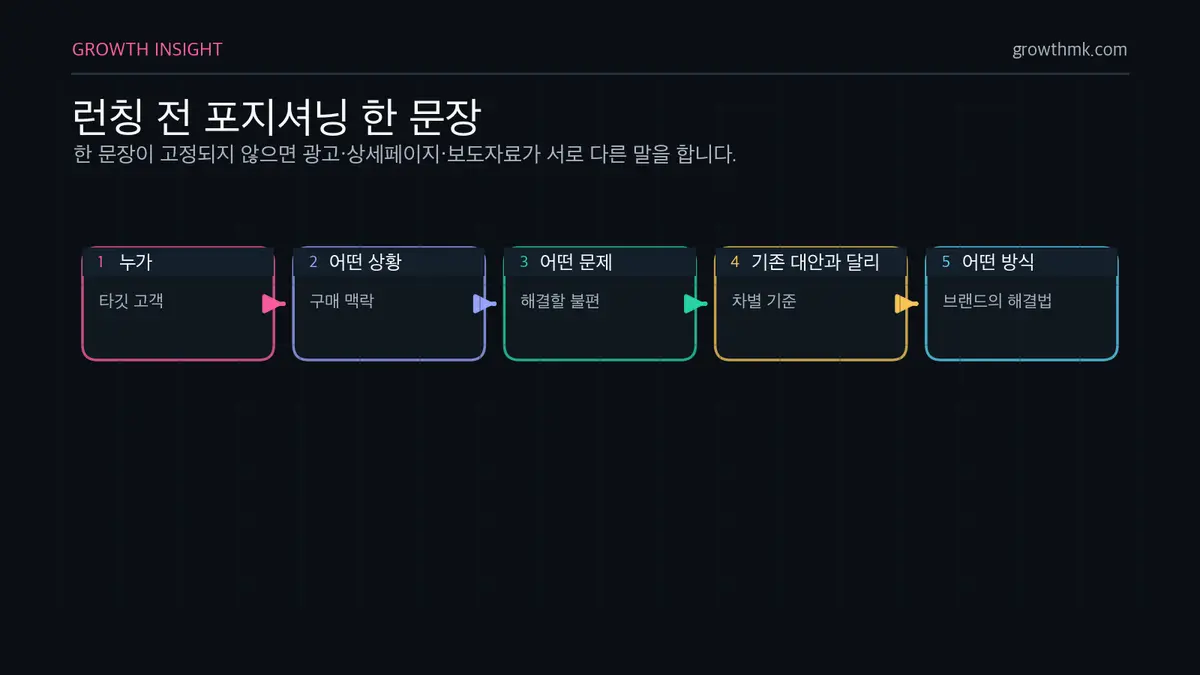
This precedes every other asset you’ll produce. The format is simple: “[Who], facing [what situation], solves [what problem] — unlike [existing alternatives] — through [what approach].” If the blanks in this sentence aren’t filled in, your ad creative, your product page, your press release, and your seeding guide will all end up saying different things, and the messages will collide right at the customer’s evaluation stage. Fixing this sentence after launch costs dozens of times more than fixing it before.
You also need to decide your category entry angle at this point. There are two options: compete on differentiation within a category consumers already search for (“protein shake”), or define an entirely new category (“meal-replacement solution”). Entering an existing category lets you absorb search demand immediately, but comparison competition starts right away too. Defining a new category avoids that competition, but you carry the cost of teaching people “what this even is” for the entire 90 days. For a new brand’s first launch, the existing-category route is usually safer — enter using language consumers already understand, build share, and redefine the category later. That sequence bills the market the least for the education cost.
Once the sentence is locked, structure it as a “message house” — the reference document for every piece of content you produce.
| Component | Content | Example items |
|---|---|---|
| Roof — the core promise | The single promise the brand makes (one sentence) | The value proposition sentence, verbatim |
| Pillars — three pieces of evidence | The grounds for believing the promise | Ingredients/technology/certifications / the founder’s reason for building it (story) / early user results |
| Floor — tone and off-limits list | Voice, phrases to avoid, claims not to overstate | No disparaging competitors, no unverified efficacy claims, etc. |
The key thing to remember is that positioning shouldn’t come out of a conference-room whiteboard — it needs to come out of prospective customers’ own mouths. The right sequence is to interview 10-20 target customers before launch to find out “what they currently use to solve this problem, and what frustrates them about it,” and only then lock the sentence. We’ve covered how early validation actually plays out in practice in Startup Marketing Case Studies.
2. Search foundation — what shows up when someone searches your brand name?
The real shelf space on launch day isn’t ad inventory — it’s page one of the brand-name search results. When interest built with ad spend flows into a search, and what comes back is a blank page or inaccurate information, that interest evaporates right there. Here’s what to get in order by D-30.
| Asset | What to prepare | Completion criteria |
|---|---|---|
| Official site / product page | Structure: core promise → evidence → path to purchase. Tune metadata to capture brand-name searches | Official site ranks first for brand-name searches |
| Naver Smart Place / maps | If you have an offline touchpoint, register business name, address, hours, photos; keep info consistent across channels | Zero inconsistencies across map search results |
| Wiki entry | New brands often don’t meet listing criteria (independent sourcing) — understand the criteria and process before forcing a listing attempt | Eligibility assessment complete; if eligible, written in neutral tone |
| Official social accounts | Build up an activity history 4-8 weeks before launch (an empty account undermines trust) | 8+ pieces of content on 1-2 core channels |
| AI search responses | Prepare structured official information (about page, press releases) for AI Overviews and chatbots to reference when describing the brand | No wrong answers or gaps when major AI search engines are asked about the brand |
Wiki listing has notoriously strict criteria and procedures, which we’ve covered separately in How to List and Edit a Business’s Wikipedia Page, and for preparing how generative AI cites and answers questions about your brand, see the GEO (Generative Engine Optimization) Guide. The check itself is simple: search “brand name” and “brand name reviews” directly in incognito mode and screenshot page one. Zero results isn’t the worst outcome. Inaccurate or contradictory information is the worst outcome.
3. Seeding — pre-build “what the first users say”
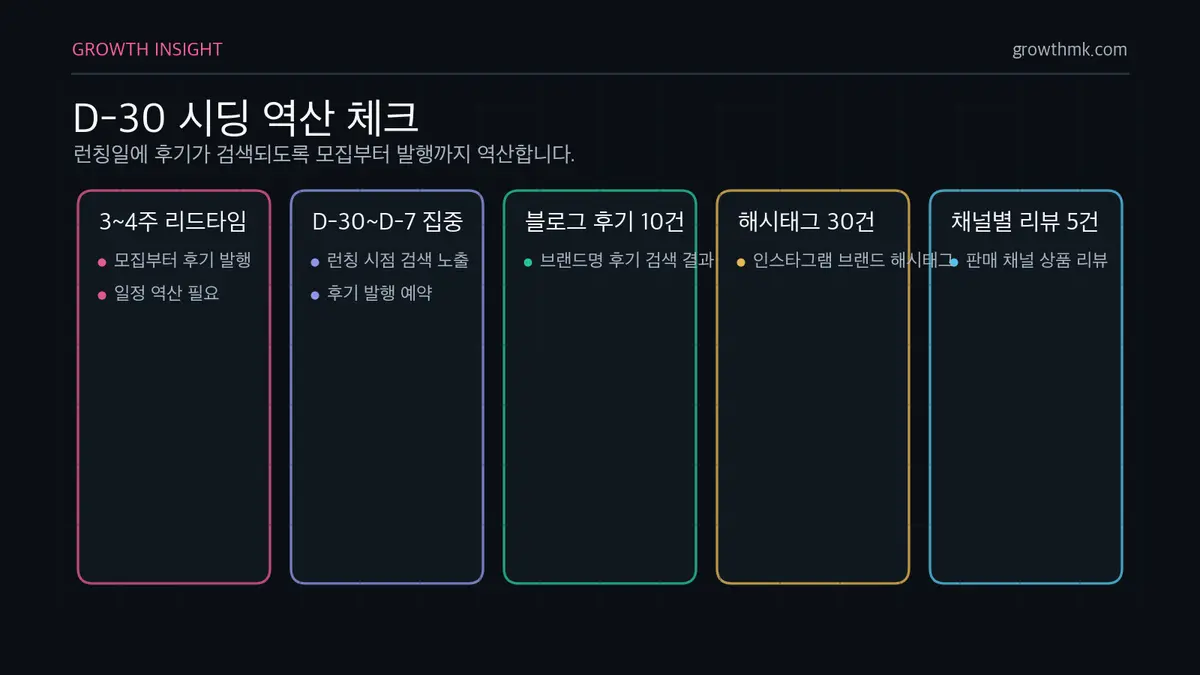
A new brand’s weakness at the evaluation stage is obvious: nobody has used it yet. Seeding is the work of building an initial pool of usage experience and reviews, in a controlled way, before launch — and it’s the task with the longest lead time in the D-30 stage (typically 3-4 weeks from recruitment announcement to published reviews). The main vehicles are trial groups and supporter programs, and since they have different purposes and outputs, design them separately.
| Category | Trial group | Supporter program |
|---|---|---|
| Purpose | Mass-produce usage review content — seed “what the first users say” across search and purchase channels | A friendly group that stays engaged over a set period — content production + early community + feedback loop |
| Duration | Short-term (product delivery → review published within 2-3 weeks) | Medium-term (4 weeks to 3 months, run in cohorts) |
| Deliverables | Blog/social reviews, photo reviews | Ongoing content, UGC, improvement feedback, organic advocates at launch time |
| Right timing | Concentrated D-30 to D-7 — worked backward so reviews are searchable at launch | Recruit at D-30 → keep running through ignition and amplification |
| Common failure | Filling a quota with no selection criteria, producing a mass of low-quality reviews | Left unattended without guides or reward design, engagement rate collapses |
Operational details — recruitment, selection, guide design, and settlement — are covered in The Complete Guide to Trial-Group Marketing, and what to check before launching a supporter program is covered in 5 Checklists for Running a Supporter Program.
Set seeding volume through reverse-engineering your exposure target, not gut feel. First list where reviews need to be visible on launch day — Naver “brand name reviews” search results, Instagram brand hashtags, product reviews on your sales channels — then set a minimum content count per spot (e.g., 10 blog reviews, 30 hashtag posts, 5 reviews per channel), and factor in that typically only 60-80% of participants publish within the deadline when setting your recruitment target. Selection criteria should prioritize audience fit over follower count — a review from a 1,000-follower account that genuinely experiences your product’s problem carries more weight at the evaluation stage than one from an unrelated 100,000-follower account.
Two principles are non-negotiable. First, any review that received compensation must clearly disclose that relationship (a legal requirement under advertising disclosure law). The moment an undisclosed sponsored review gets caught, all the trust built through seeding turns into backlash. Second, the purpose of seeding is not rating manipulation — it’s producing genuine usage experience ahead of time. Northwestern University’s Spiegel Research Center found an interesting paradox in its study on review influence: purchase probability peaks in the 4.0-4.7 rating range and actually declines as it approaches 5.0. A perfect rating creates suspicion in consumers, not trust. What you need isn’t a perfect score — it’s genuine reviews grounded in specific usage context.
4. Media assets — pre-build the ammunition you’ll need in the first 30 days
The ignition stage is a race against response time, so starting production after launch always means you’re behind. Here’s the asset list to complete by D-30.
- Press release and media kit — the core promise, founding story, product specs, high-res images, and contact info packaged together. The bar is: a journalist or editor should be able to write the story without any follow-up questions.
- Product visuals and video — shoot on the assumption you’ll transform this into ad creative (vertical/horizontal, 15-second/6-second cuts, with and without captions). You need enough source footage to swap creative quickly during ignition.
- FAQ and customer-service scripts — 20 anticipated questions and answers on pricing, shipping, refunds, ingredients, and the like. Response quality during the post-launch inquiry surge shapes the first impression.
- UGC guide — hashtags, regram policy, and the consent process for reusing customer content.
- Measurement infrastructure — get conversion tracking, your UTM system, and dashboards running before launch (covered in detail in the amplification stage).
Here’s the checklist to review as you close out the D-30 stage.
| Area | Check question | Completion criteria |
|---|---|---|
| Positioning | Does everyone on the team describe the product with the same single sentence? | One-page message house finalized and shared |
| Search foundation | Does official information show up when you search the brand name in incognito mode? | Site, place listing, and social info consistent; zero wrong answers |
| Seeding | Do search results for “brand name reviews” exist by launch day? | 80%+ of target review volume secured and scheduled for publication |
| Media assets | Can you run the campaign for the first 30 days without additional production? | Creative variation set, press release, and FAQ all complete |
| Measurement | Is the path tracked from first visit through purchase? | Conversion events and UTM system tested and confirmed |
D-Day to D+30 — Ignition: The First 30 Days Are the Entire First Impression
If you set the ignition stage’s goal as “maximize revenue,” every decision gets short-term. The real goal of this stage is opening the path where awareness converts into first trust — revenue follows as a result of that path working. The design breaks into three axes: campaign structure, media mix, and review acquisition.
1. Design the launch campaign as three acts
| Act | Timeframe | Goal | Representative execution |
|---|---|---|---|
| Teasing | D-7 to D-1 | Build anticipation and pre-launch demand | Countdown content, pre-registration/notify-me perks, supporter early access |
| Reveal | D-Day to D+7 | Concentrate reach and make news | Press release distribution, main campaign goes live, launch events (live, pop-up) |
| Amplification | D+8 to D+30 | Amplify high-performing creative and build up reviews | Increase spend on top creative, regram UGC, run review campaigns |
The budget-allocation principle isn’t even distribution — it’s concentrating in reveal week. Spread evenly across 30 days at the same intensity, and you never hit critical mass at any point. Reaching the same person across multiple touchpoints in a short window, building that “I keep seeing this lately” feeling, is the core of building awareness for a new brand.
An execution step often missed at this stage is defending your brand search ads. The brand-name search demand your launch campaign generates is also the cheapest traffic for a competitor to intercept — if a competitor bids on your brand keyword, the interest your ad spend created flows straight to their landing page instead. During reveal week, run your own bids — even small ones — directly on your brand name and “brand name + reviews” keywords to secure the top spot in search results. Category (problem) keywords, on the other hand, tend to have higher CPCs due to competitive bidding, so it’s safer to keep their share low during reveal week, before you have review and conversion data, and scale them up once you’ve confirmed efficiency in the amplification stage.
2. Triple media — run ads, owned channels, and third-party word-of-mouth together as one set
Media at the ignition stage should be designed as one integrated set across three axes: paid (ads), owned (your own channels), and earned (third-party word-of-mouth). We’ve covered the general definitions in the Triple Media Guide — here we’ll just cover how the roles split during a launch.
| Media | Role in a launch | Representative execution | Common mistake |
|---|---|---|---|
| Paid | Buy reach and speed with money — create the trigger | Meta, YouTube, Naver display ads; search ads (brand keywords + problem keywords) | Relying on ads to build trust — ads can’t make people believe |
| Owned | Where verified traffic lands — present the promise and the evidence | Official site, product page, social channels, newsletter | A mismatch between the ad message and the landing page message |
| Earned | The source of trust — evidence that passes the evaluation stage | Reviews, press coverage, UGC, community mentions | Left undesigned because “you can’t control it” |
The flow is simple to remember: Paid brings them in, Owned explains, Earned makes them believe. If any one of the three is missing, the other two lose effectiveness together. Increasing Paid spend while Earned stays empty, in particular, is like pouring more flow into a leaky funnel — the more you spend on ads, the more people you get who “search, look around, and leave.” We’ve covered this structural failure pattern in performance marketing in detail in the Performance Marketing Guide.
3. Early review acquisition — the top KPI for the first 30 days
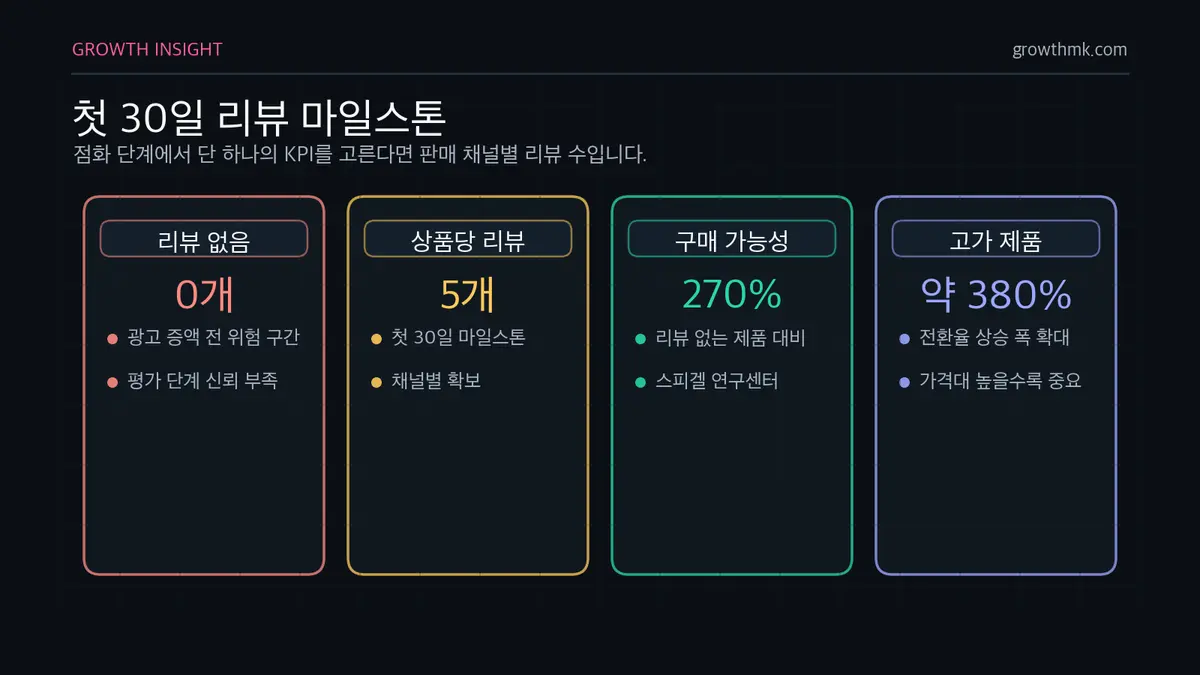
If you could only pick one KPI for the ignition stage, it wouldn’t be revenue — it would be review count per sales channel. The evidence is clear. According to the Spiegel Research Center’s study, a product displaying five reviews sees a 270% higher purchase likelihood than one with no reviews, and the conversion lift grows to around 380% for higher-priced products. The effect is felt after the first five, so the goal isn’t “lots of reviews” — it’s the specific milestone of “five reviews per product on every sales channel you operate.”
Reviews are both a conversion mechanism and an entry filter. In BrightLocal’s 2026 Consumer Review Survey, 97% of consumers said they read business reviews, 49% said they trust reviews from strangers as much as a friend’s recommendation, and 31% said they only consider businesses rated 4.5 or higher (sharply up from 17% the year before). A brand with no reviews, or unmanaged ones, can’t even get into the comparison stage in this environment.
There are four things to execute for review acquisition in the first 30 days.
- A request flow right after purchase — an app notification or email review request timed to delivery confirmation. If you don’t ask, satisfied customers stay silent and only unhappy ones write in.
- Connect seeded reviews to your sales channels — don’t leave trial-group and supporter reviews sitting only on blogs; design them to flow into reviews on the channels where purchases actually happen (your own store, marketplace listings), keeping compensation disclosure intact.
- Photo and usage-story review incentives — reviews with photos and context contribute more to conversion than plain text. Offer rewards like store credit alongside a condition for honest writing.
- A negative-review response principle — not deletion attempts, but a public response within 24-48 hours. A negative review isn’t a reputation crisis; it’s product-improvement data, and the act of responding itself signals trust to the next buyer.
The concrete process for requesting, collecting, and using reviews is covered in The Customer Review Marketing Guide.
Finally, here are the four mistakes most commonly repeated at the ignition stage.
- Burning through the budget in a single launch-day spike and leaving the amplification window (D+8 to D+30) empty-handed
- Increasing ad spend while sitting at zero reviews — doubling the cost while conversion stays flat
- Changing the positioning message at D+10 because there’s no response yet — resetting all your measurable learning
- Swinging with daily revenue and rewriting strategy every three days — the first 30 days is a data-collection period, not a verdict
D+31 to D+90 — Amplification and Learning: Data, Not Gut Feel, Decides Channels
Only after the first 30 days do you actually have “your brand’s data” — who’s buying from which channel, who’s responding to which message, who’s coming back. Marketing from D+31 onward shifts from running campaigns to a growth-hacking loop of hypothesis → experiment → measurement → reallocation, repeated. We’ve covered the AARRR funnel and experiment design methodology in detail in the Growth Hacking Guide — here we’ll just cover applying it in a launch context.
1. The day-30 data review and channel reallocation
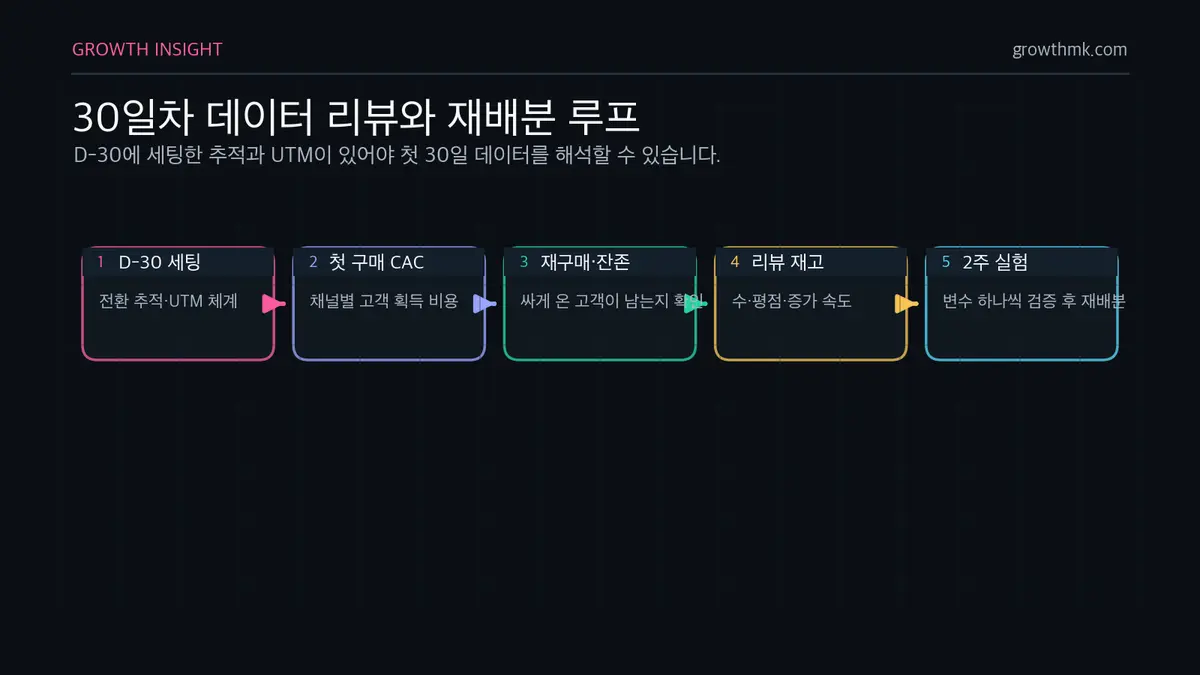
Start by confirming the precondition: conversion tracking and your UTM system need to be set up by D-30 for a day-30 review to be possible. Thirty days of data lost without proper tracking can never be recovered — that’s exactly why measurement infrastructure is a pre-launch task (see Why Tracking Tool Setup Matters). Here’s what to look at, and what to decide, in the day-30 review.
| Review item | Key question | Decision |
|---|---|---|
| First-purchase CAC by channel | Which channel brings customers in at the lowest cost? | Increase spend on high-efficiency channels, cut low-efficiency ones — but cross-check against the “quality” metrics below |
| Repeat purchase / retention by channel | Which channel’s customers stick around? | Cut channels that are cheap but don’t retain — allocate by quality, not volume |
| Brand search volume trend | Is awareness accumulating as an asset? | If search volume stalls relative to ad spend, reinforce Earned (reviews, content, PR) |
| Review count, rating, growth rate | Is your trust inventory building up? | Prioritize review campaigns on channels with fewer than 5 reviews |
| Response by creative / message | Which promise drives clicks and purchases? | Expand variants of top creative, replace underperformers — experiment in two-week cycles |
Run operations after reallocation as a two-week experiment cycle. Test one variable per cycle — change the creative and hold the audience fixed, or change the audience and hold the creative fixed. Change multiple variables at once, and even when you get a result, you can’t tell what caused it — you spend money without learning anything. Record a hypothesis, timeframe, and evaluation criterion for every experiment, and by the end of the 90 days you’ll have something more valuable than any report: a list of what actually works for your brand.
The biggest trap to watch for during reallocation is deciding based on ROAS alone. Right after launch, ROAS often gets inflated because people who were already going to buy — via brand search or a friend’s recommendation — end up credited to the last-click ad. If you increase spend based on that number alone, budget flows to channels that actually delivered no real performance. We’ve covered this distortion separately in The Trap of ROI and ROAS. In the same spirit, Les Binet and Peter Field analyze the tension between short-term activation and long-term brand-building in their IPA report The Long and the Short of It, warning about the danger of measuring performance using only short-term online metrics. Judge channels at the 90-day mark using short-term conversion metrics alone, and the activities that were just starting to build brand assets — search volume, reviews, repeat-purchase intent — get cut first.
2. Designing repeat purchase and referral — the second purchase is the real launch success
The first purchase can be bought with advertising. But only the product and the experience create the second purchase. That makes repeat-purchase rate the most honest indicator of launch success, and an early signal of product-market fit. Scaling new-customer acquisition while nobody repeat-purchases is pouring water into a leaky bucket — so half of the D+31-90 window should go toward building this structure.
- Post-purchase onboarding — send usage tips and how-to content as a sequence right after purchase. Only customers who’ve actually “used the product properly” come back for more.
- Reminders timed to the repurchase cycle — work backward from the consumption cycle (6-8 weeks for cosmetics, 4 weeks for health supplements, etc.) to reach out right before it runs out.
- Buyer-exclusive perks — cross-sell and bundle designs that lower the barrier to a second purchase.
- Referral program — a two-sided reward for both referrer and referee is the standard model. But referral is a consequence of satisfaction, so measuring satisfaction (repurchase intent, NPS) has to come first. Ask unhappy customers to refer people, and you just burn through the reward budget.
- A buyer community — convert supporters into buyer cohorts and keep the UGC and feedback loop running continuously.
Measure repeat purchase at the cohort level (grouped by purchase month), not as an overall average. “60-day repeat purchase rate is 18% for launch-week buyers, 9% for second-month buyers” drives decisions in a way “overall repeat purchase rate is 12%” never does — the gap between early and later cohorts reflects a difference in acquisition channel and expectations, not the product, which means it’s a difference marketing created. When repeat-purchase rates start diverging across cohorts, the first thing to examine isn’t the product — it’s “what did we promise the customers who came in later?”
Here’s what “done” looks like at D+90: one or two reproducible acquisition channels, an accumulated review asset on every sales channel, and a measured repeat-purchase baseline. With all three in place, next quarter becomes a “scale” problem, not a “launch” problem. If any one is missing, the 90 days of data will tell you exactly where the gap is so you can reinforce it from there.
90-Day Checklist — A Combined Table by Stage
Here’s every stage’s tasks gathered into one table by area. We recommend using this table as the baseline at your launch task-force kickoff to fill in owners and deadlines.
| Area | D-30 Foundation-Building | D-Day to D+30 Ignition | D+31 to D+90 Amplification and Learning |
|---|---|---|---|
| Positioning / message | 10-20 customer interviews, one-sentence value proposition, message house finalized | Maintain message consistency across every channel — no mid-course changes | Experiment with sub-messages using response data (keep the core promise fixed) |
| Search foundation | Prepare site, place listing, wiki, social, AI responses; check in incognito mode | Monitor “brand name reviews” search results, correct errors immediately | Track brand search volume, expand into problem keywords via content SEO |
| Seeding / Earned | Recruit and select trial group, prepare guides, launch supporter cohort 1, prepare press release | Distribute press release, hit peak review-publishing volume, regram UGC | Convert supporters into buyer cohorts, reinforce PR/content |
| Paid | Produce creative variation set, set up ad accounts/pixels, run small pre-tests | Execute the three-act structure — concentrate on reveal week, amplify top creative | Reallocate channels using day-30 data, run two-week creative experiments |
| Owned | Complete product page, FAQ, and CS scripts | Check message consistency between ad and landing page, run inquiry response SLA | Activate onboarding/reminder sequences, build up content hub |
| Reviews | Design request flow and incentives, establish disclosure standard for compensated reviews | Hit the 5-review milestone per channel, respond to negative reviews within 48 hours | Manage review rating and velocity, feed review insights back into the product |
| Data / measurement | Set up and test conversion tracking, UTM, dashboard | Monitor daily (but withhold judgment) | Day-30 review → reallocation, measure repeat-purchase baseline |
Budget Scenarios — It’s About Structure, Not the Absolute Number
There’s no single right answer to “what’s an appropriate launch budget?” The right absolute amount depends on industry, average order value, and competitive intensity. But the structure — how you allocate across stages, and what you cut first — does have real principles. Here are three scenarios by scale.
| Category | Compact (minimum budget) | Standard | Aggressive scale-up |
|---|---|---|---|
| Stage split (foundation:ignition:amplification) | Roughly 40 : 35 : 25 | Roughly 25 : 45 : 30 | Roughly 20 : 50 : 30 |
| Top investment priority | Seeding (trial groups) and search foundation — areas where you spend time instead of money | Seeding + concentrated Paid during reveal week | Major Earned (PR, top-tier influencers) + multi-channel Paid |
| Paid operating approach | Minimize always-on spend beyond a short reveal-week burst | Concentrate reveal week + increase spend on top creative during amplification | Run 3+ channels simultaneously, but hold spend increases until review milestones are hit |
| First thing to cut | Paid reach (replace with organic/community) | Always-on ads on low-efficiency channels | Scale of experiments on unproven new channels |
| Best fit | Early-stage startups, niche products, validation-first | A typical new product launch | Entering a competitive category, products with a short seasonal window |
| Main risk | Delayed ignition from insufficient reach — compensate by running a longer timeline | The mid-scale trap — doing a little of everything and falling short of critical mass everywhere | Paid moving too fast before Earned is ready — amplifying the leak |
Four principles hold regardless of scenario.
- Never zero out seeding and search foundation, in any scenario. You can cut ad spend, but skipping “readiness to be scrutinized” degrades the efficiency of every dollar you do spend.
- Don’t increase ad spend before hitting the 5-review milestone. This is a window where the same ad spend can produce nearly double the conversion difference.
- Keep the amplification-stage budget earmarked as “reallocation reserve.” If you have no money to move once you see the day-30 data, learning never turns into action.
- Set aside 10-15% of the total as experiment budget. This is money for validating new creative and new channels, separate from the main campaign.
What Should You Actually Measure? — Not Impressions, But “the One Person Who Becomes Revenue”
If a launch results report is filled with impressions, reach, and view counts, that’s a warning sign. Those numbers are the metrics furthest from revenue, and since they always go up when you spend more on ads, they give you zero decision-useful information. We track two core axes across a 90-day launch.
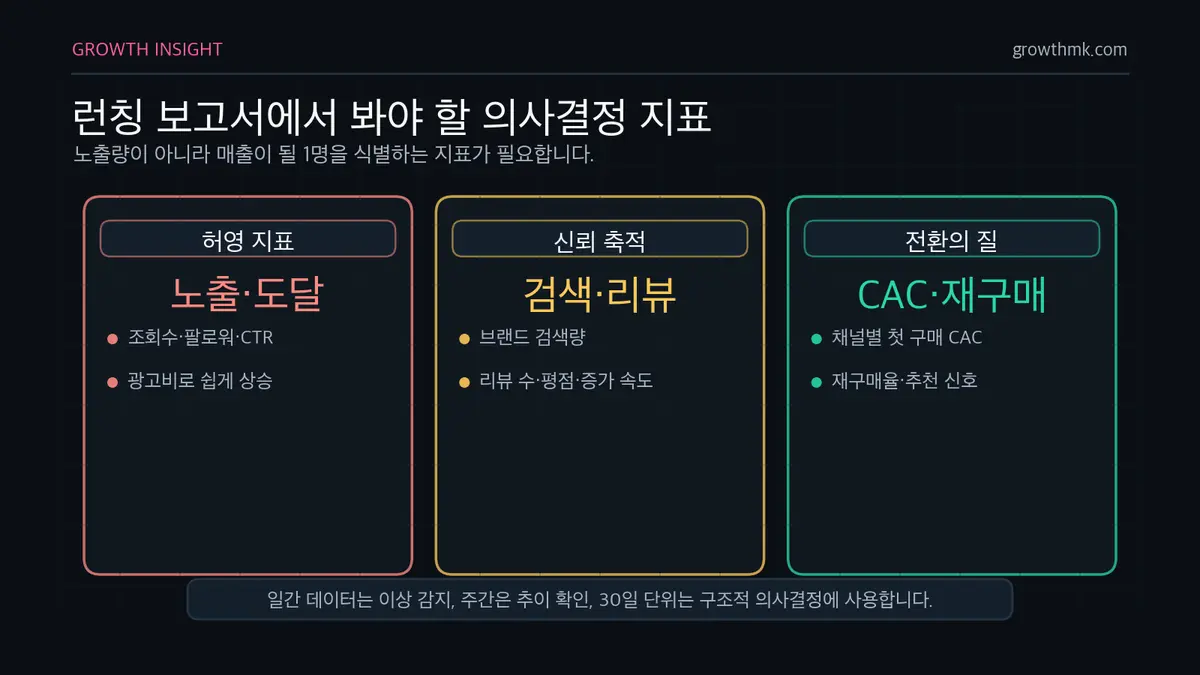
First, brand search volume. This is the count of people who saw an ad and actually acted on it (searched) — the most honest indicator of the “quality” of your awareness. You can track it weekly through Google Search Console’s brand query impressions and clicks, and through Naver’s keyword tool and DataLab search trends. If brand search volume isn’t rising relative to ad spend, it means you reached people but weren’t memorable.
Second, conversion quality. First-purchase CAC by channel, repeat-purchase rate, review rating and growth rate — these are the metrics that answer “is the one person who came in the one person who becomes revenue?” You can buy the volume of traffic with ad spend, but quality is only ever created by design. Here’s a reference table distinguishing vanity metrics from decision metrics.
| Commonly reported metric (vanity) | What to look at instead (decision) | What it tells you |
|---|---|---|
| Impressions / reach | Brand search volume trend | Did awareness convert into action |
| Follower count | Review count, rating, and growth rate by channel | Is a trust asset accumulating |
| Clicks / CTR | First-purchase CAC by channel | The real cost of bringing in one person |
| Daily revenue spikes | Repeat-purchase rate / cohort retention | Did the product keep its promise |
| Total traffic | Conversion rate and on-page behavior by channel | Which channel’s one customer becomes revenue |
Measurement needs rhythm, too. Use daily data only for anomaly detection (ad account blocked, out of stock, a sudden spike in negative reviews) — not for strategic decisions. Look at brand search volume, review trends, and CAC by channel on a weekly basis, and make structural decisions like channel reallocation only on a 30-day basis. Reacting to day-to-day swings by changing strategy is paying money for noise. The purpose of measurement is decision-making, not data collection, so every metric on your dashboard should have a pre-defined action attached: “if this number moves this way, here’s what we change.”
Once these metrics accumulate over 90 days, next quarter’s plan comes from data, not gut feel in a conference room. This is exactly how Growth designs launches — we find where the customer journey breaks down, tie seeding, triple media, reviews, and measurement into a single structure, and report based on the one person who becomes revenue, not impression volume. If you have a new product launch ahead of you, see how we operate at each launch stage in Growth’s services, or reach out if you need a 90-day design built for your brand.
Execution guides in this cluster
- Designing Your Launch Channel Mix — What to Turn On First, Stage by Stage
- The Complete Guide to Trial-Group Marketing — Design, Channel Selection, Operations, and Measurement
Frequently Asked Questions (FAQ)
Is 30 days enough time to prepare for a launch?
D-30 is the minimum baseline for marketing execution. It’s the schedule that’s possible when you overlap positioning interviews, the trial-group lead time (typically 3-4 weeks from recruitment to published reviews), and creative production. If you include research and product readiness, we recommend starting 60-90 days out. The key isn’t the number of days — it’s the sequence. The principle that “what shows up when someone searches your brand name” and “the first users’ reviews” need to be ready before you run ads doesn’t change even on a shorter timeline.
My budget is very small. What should I do first?
Follow the sequence that spends time instead of money. ① Lock a one-sentence positioning statement through customer interviews. ② Clean up brand search results (site, place listing, social — nearly free). ③ Secure your first reviews through small-scale trial-group seeding. ④ Hit five reviews on your sales channels. ⑤ Only then, build reveal week with a small amount of ad spend. As the compact scenario suggests, cutting paid reach and compensating with a longer timeline beats skipping steps in the sequence.
This is a brand-new product with zero reviews. Can I just run ads first?
We don’t recommend it. Based on Spiegel Research Center data, a product displaying five reviews has about 270% the purchase likelihood of one with none, and the gap widens further for higher-priced products. Increasing ad spend at zero reviews means buying less than half the conversion for the same cost. The right sequence, cost-efficiency-wise, is to generate your first reviews through pre-launch trial-group and supporter seeding, hit five reviews per sales channel, and only then increase spend.
If revenue in the first month after launch is lower than expected, is that a failure?
First-30-day revenue isn’t the verdict metric. What you should be watching at that point is whether brand search volume is rising alongside ad spend, whether reviews are accumulating and the rating is holding up, and whether early buyers are showing repeat-purchase and referral signals. If these leading indicators are moving, revenue follows during the amplification stage. Call it a failure at D+90 only if there’s not a single reproducible acquisition channel and no repeat purchases occurring — and even then, the 90 days of data will tell you which point (awareness, trust, or product) is the actual problem.
Can I run a launch with in-house staff, without an agency?
Yes, it’s possible — with conditions: someone who can be dedicated to it full-time for 90 days, experience running trial groups, ads, and reviews, and the capability to set up measurement. The first 30 days of a launch never come back, so the cost of trial and error is higher than in an ordinary campaign. If fully outsourcing feels like too much, a reasonable middle ground is to hand off just the areas with long lead times and heavy dependence on operational know-how (seeding operations, measurement setup) and keep the rest in-house.