Designing a Launch Channel Mix: What to Turn On First, at Every Stage
 임재복
임재복
In launch marketing, the channel question isn’t “which channels do we turn on” — it’s “which channel do we turn on first, and in what order.” Turning on every channel simultaneously on launch day scatters a limited budget so thin that no single channel produces a meaningful signal, and the launch ends without anyone knowing what actually worked. In practice, there’s a proven, safe order — use D-30 to lay the groundwork with owned channels you directly control and word-of-mouth seeding, ignite paid on D-Day to amplify the earned trust you’ve built, and from D+30 onward, reallocate budget based on the data that’s come in. In other words, the core question in launch channel mix isn’t “which channel is good” — it’s “what does this channel need to do at this specific stage.”
This is a practical guide built for marketers launching a new product or brand, so you can design for yourself which channels to invest your limited budget and time in, why, and in what order. We already covered the definition of the owned / earned / paid triple media framework in our Triple Media strategy guide, so this article focuses on translating that concept into a stage-by-stage ignition order under the time constraint of a “launch.” Because Growth measures success by “the one person who becomes revenue” rather than traffic volume, we design launch channels around whether a channel structure that keeps bringing in revenue-generating customers survives after launch — not around how much exposure exploded in the first few days.
Why does “turning on every channel at once on launch day” almost always fail?
The picture most people preparing a launch imagine is a “big bang” — concentrating all firepower on a single D-Day. Ads go live, a press release goes out, influencers post simultaneously, and an event launches, all at once. It’s intuitively appealing, but for a new product with a limited budget, it almost always leads you astray. There are three reasons why.
1) Budget gets scattered so thin that no channel gets validated
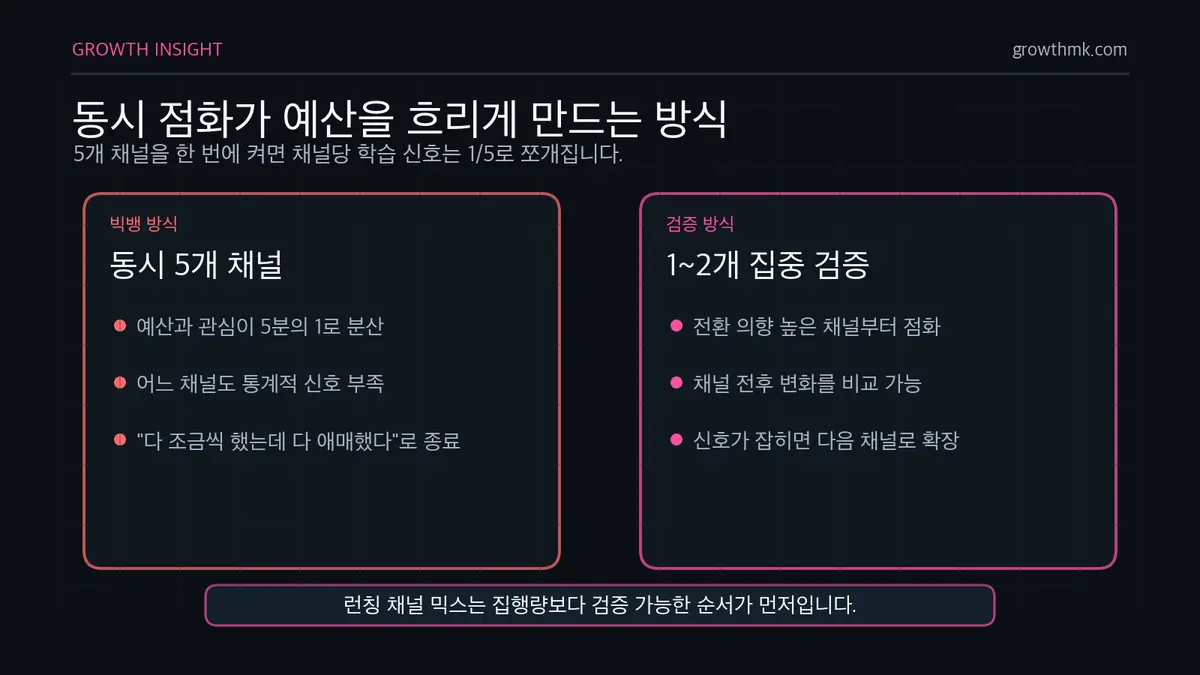
Turn on five channels at once, and the budget and attention going into each one gets cut to a fifth. Too little money flows into each channel to produce a statistically meaningful signal anywhere, and you end up “doing a little of everything, learning nothing clearly from any of it.” This is the launch-day version of a failure pattern we keep flagging in our complete guide to performance marketing — scaling execution before you’ve validated anything. A launch is exactly when budget is tightest and learning data is scarcest, so this mistake costs far more than it would at any other time.
2) Simultaneous ignition permanently obscures “what actually worked”
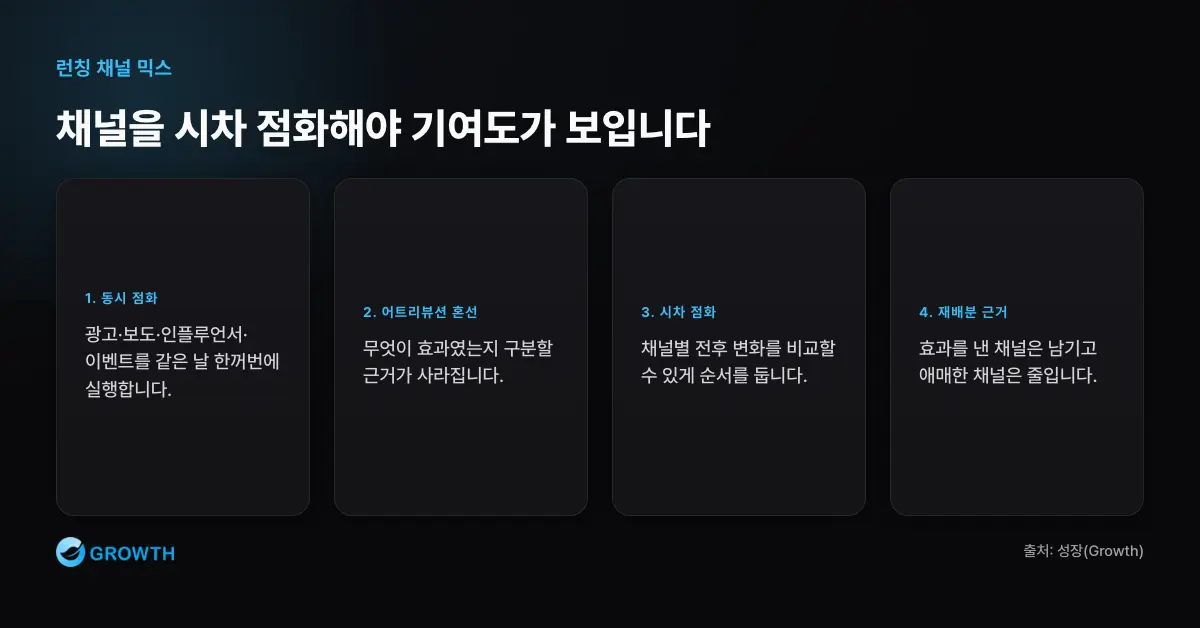
Turn every channel on the same day, and when revenue comes in, you can’t tell whether it’s thanks to the ads, the press coverage, or word of mouth. Attribution gets tangled, and the “basis for reallocation” simply disappears. Stagger your channels instead, and you can compare the change before and after each one goes live to read contribution far more clearly. Figuring out which channel is genuinely working is half the job of a launch — and simultaneous ignition gives up on that half from the start. For a deeper look at how to compare and judge channel effectiveness, see Which marketing channel actually works? A channel mix analysis.
3) Without a “landing spot” ready for it, ad traffic just leaks away
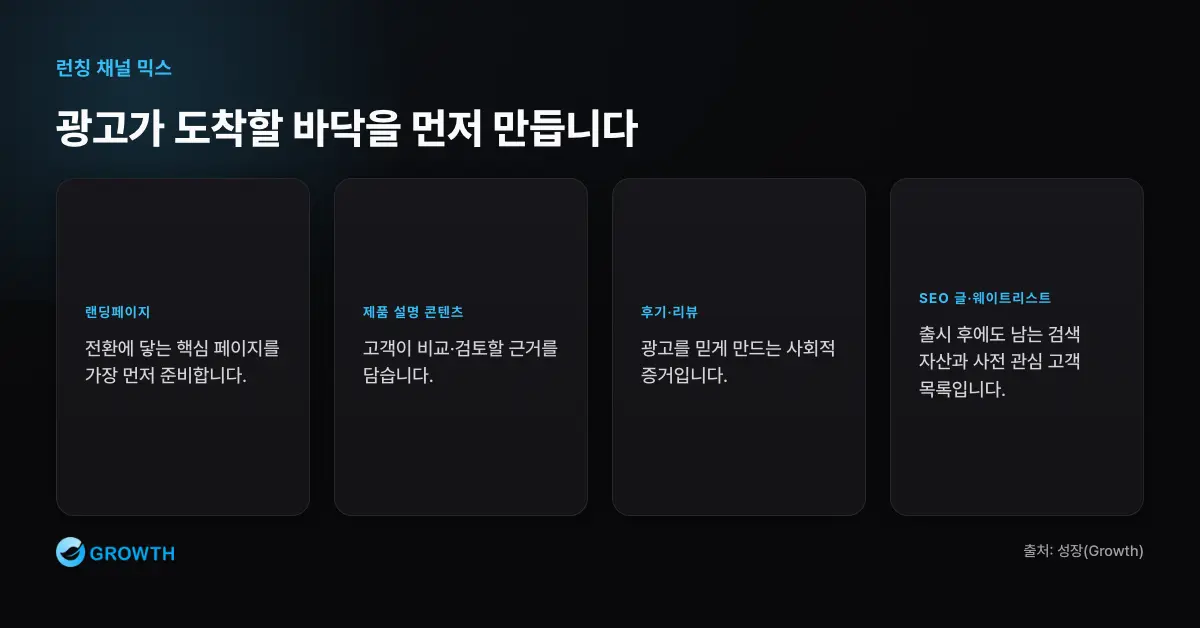
This is the most expensive mistake of all. Turn on ads before your own pages, content, and trust signals (reviews, testimonials) are ready, and the visitors you worked hard to acquire have nowhere to confirm “can I trust this brand” — so they simply bounce. Traffic you paid for leaks away like water poured into a cracked jar. Even marketing practice built around the PESO (triple media) framework recommends establishing owned media as the campaign’s central axis first, then layering earned and paid outward to expand and validate it — meaning you need to build “somewhere to send people” and “a reason to trust you” before you buy traffic. Get the order backwards, and the more you spend, the more you lose.
Splitting channels into three buckets reveals the order — owned / earned / paid
To design an ignition order, you first need to sort channels by their nature. Marketing channels split into three groups based on how much control you have and where trust comes from. We covered the definitions of these terms themselves in Marketing channel mix and our Triple Media strategy guide, so here we’ll only cover the role each group plays from a launch perspective.
| Type | Definition | Representative channels | Strengths | Role in a launch |
|---|---|---|---|---|
| Owned | Channels you own and control | Website/landing pages, blog/SEO content, email/newsletter, your own social accounts | Reusable at no cost, 100% control over messaging, accumulates as an asset | The foundation — where all traffic lands and converts. Prepare this first |
| Earned | Exposure and reputation a third party creates voluntarily | Press coverage/PR, reviews/testimonials, word of mouth/virality, unprompted influencer mentions | Third-party validation → maximum credibility, more persuasive than advertising | Trust — the social proof that makes ads believable. Plant the seeds in advance through seeding |
| Paid | Exposure you pay for | Search ads (SA), display/social ads, paid influencers, affiliate ads | Can be switched on/off instantly, precise control over targeting and budget, fast reach | Ignition and amplification — quickly pulls in traffic on top of the foundation and trust you’ve already built |
The principle running through this table is: “turn off owned and it stays; turn off paid and it goes to zero.” Paid advertising is closer to renting — traffic only flows in while you’re paying for it — while your own content and search assets are an asset that keeps bringing in customers at no additional cost once they’re established. That’s why, counterintuitively, the smaller your launch budget, the more you need to lay down owned first, not later. Earned sits in between, borrowing trust that advertising alone can’t buy. This difference in character across the three is exactly what justifies the ignition order — start with what takes longer to build and doesn’t disappear when switched off (owned), and move toward what can be switched on and off instantly (paid).
The stage-by-stage channel ignition order — D-30 → D-Day → D+30
So what order should you actually turn things on in? Growth’s recommended base structure is a 3-stage ignition built around launch day (D-Day). The key is that each medium’s job changes at each stage. What follows isn’t a rigid rule — it’s the logic behind the sequence. The exact timeframes (D-30 vs. D-60) will vary by product and market, but the shift in center of gravity — “foundation → ignition → reallocation” — stays the same.
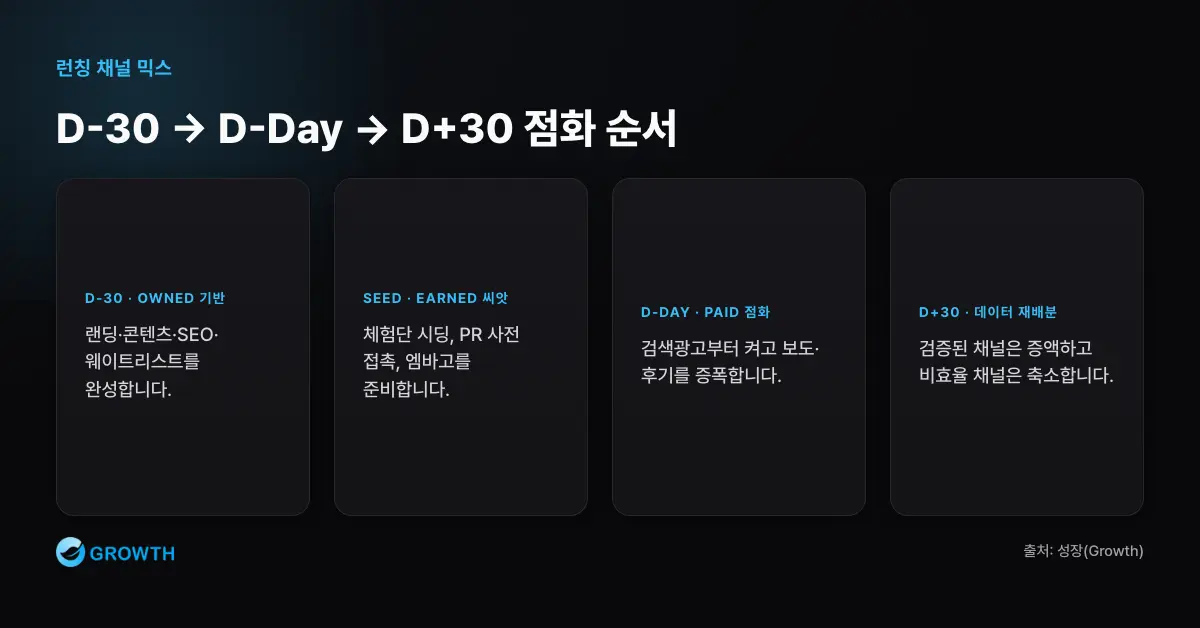
D-30 (pre-launch): lay the foundation with owned, plant earned’s seeds
About a month before launch, ads are still off. The goal at this stage is preparation, not reach. First, finish the owned channels every visitor will land on — a landing page built for conversion, core content that explains the product, SEO articles ready to capture search traffic, and an email list (waitlist) collecting interested prospects in advance. Second, plant earned’s seeds early. If you have zero reviews on launch day, there’s nothing to make an ad believable, so you need seeding that gets people to experience the product early and builds genuine reviews beforehand. Experience-group marketing is the classic way to build early trust for a new product through word of mouth, and reviews accumulated before D-Day become the social proof that “makes D-Day’s ads believable.” At the same time, this is also when you handle PR and press outreach, lining up embargoed coverage for launch day.
D-Day (launch): ignite with paid, amplify earned
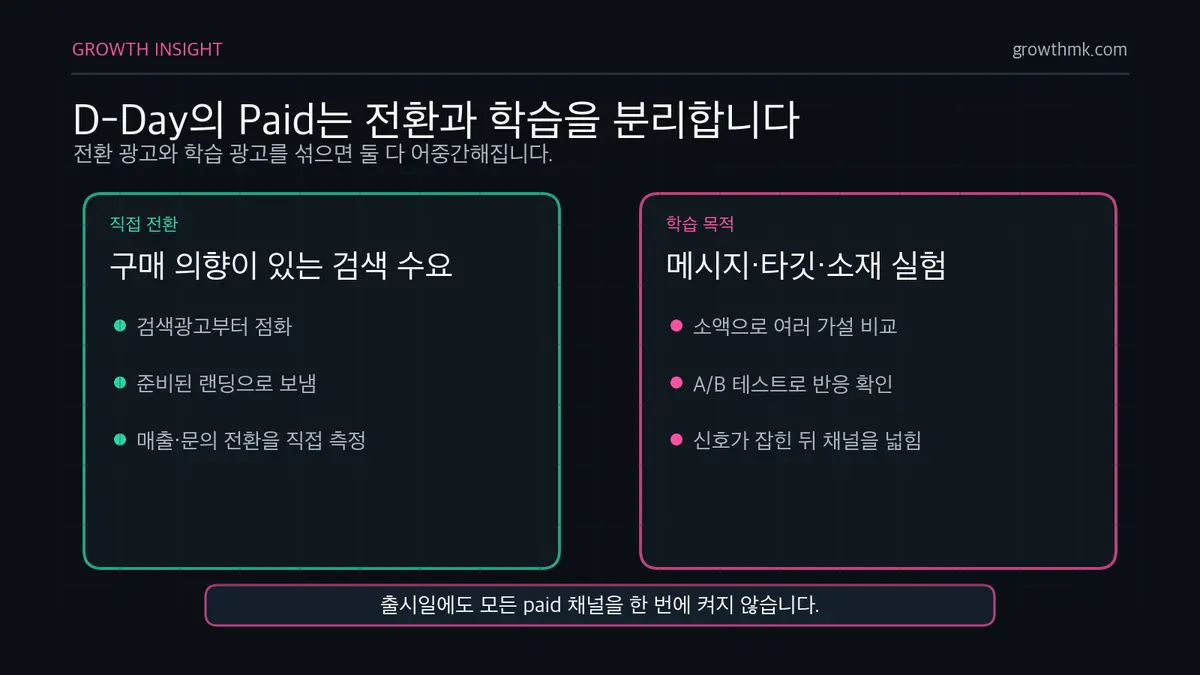
On top of the foundation and trust you’ve built, it’s now time to turn on paid channels. Search and social ads quickly pull in traffic and send it to the landing page you built at D-30, while embargoed coverage drops on launch day to amplify earned. Paid’s purpose splits into two here — ads aimed directly at conversion (search ads that capture demand from people who already have purchase intent) and ads aimed at learning (small-budget experiments comparing which messages, targets, and creative resonate). Fail to separate the two, and you end up with ads that are mediocre at both conversion and learning. Systematically comparing multiple creative variants and targets is exactly what A/B testing is designed for. The key thing to remember even at this stage is: don’t turn on every paid channel at once here either — ignite the 1–2 channels with the highest conversion intent first (usually search ads), and expand to the next channel once you’re seeing signal.
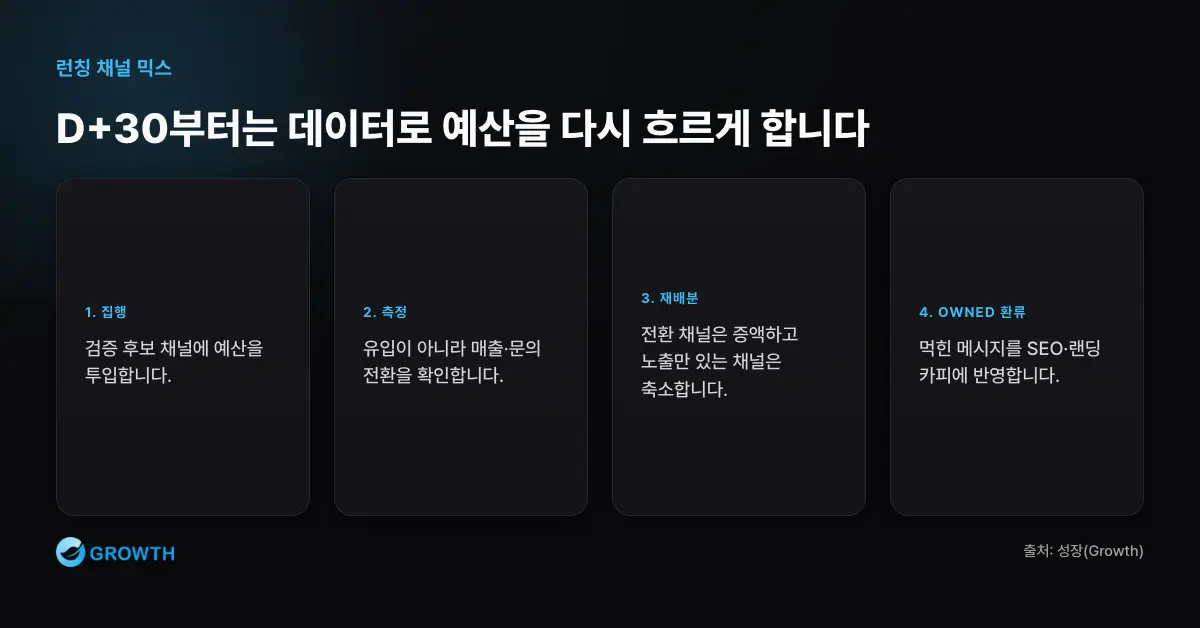
D+30 (expansion): reallocate channels based on data
About a month after launch, real data has finally accumulated for the first time. You look at which channel brought in customers who converted to revenue or inquiries, not just visits, and whether each channel’s customer acquisition cost (CAC) is sustainable. Then you shift budget toward validated channels — increase spend on channels that produced conversions, and cut or turn off channels with lots of impressions but no conversions. This “execute → measure → reallocate” cycle isn’t a one-time event — it needs to be a continuous loop. At the same time, you feed the results from D-Day’s paid channels back into the owned foundation you laid at D-30 — folding the messaging that resonated most in ads into your SEO content and landing copy, so a structure remains that keeps bringing customers in through search even after you turn the ads off. A launch’s success or failure isn’t decided by the traffic explosion on D-Day — it’s decided by whether a channel structure that keeps bringing in revenue-generating customers survives past D+30.
The stage × channel matrix — the ignition order at a glance
Pull each medium’s job across these three stages into a single table, and “what to turn on right now” becomes obvious at a glance.
| Stage | Owned | Earned | Paid | Signal of success at this stage |
|---|---|---|---|---|
| D-30 (pre-launch) | Core — preparation Finish landing page, content, SEO, waitlist |
Plant seeds Experience-group seeding, PR outreach and embargo |
Standby (mostly off) Only install retargeting pixels in advance |
Interested prospects (list) accumulate, real reviews go from 0 to N |
| D-Day (launch) | Receive conversions Landing page and email capture and convert traffic |
Amplify Coverage goes live, reviews and word of mouth spread |
Core — ignition Start with search ads, separate conversion and learning ads |
Traffic and conversion by channel are measured separately, and which creative/messaging resonates becomes visible |
| D+30 (expansion) | Feedback loop Fold resonating messages back into content and SEO |
Maintain Respond to reviews, encourage more |
Reallocation Increase spend on validated channels, cut inefficient ones |
CAC by channel becomes clear, and budget shifts to channels that convert |
Read the bolded cells in the table diagonally, not vertically — the center of gravity moves from owned at D-30, to paid at D-Day, to reallocation at D+30. That’s exactly what sets this apart from “simultaneous ignition.” Where a big bang crams all three media into a single slot (D-Day), stage-by-stage ignition assigns each medium the job it’s best at, at the moment it makes the most sense. For this flow to actually work, you need to understand “which touchpoint does a customer enter through, and how do they arrive at a purchase” — and the tool that structures that flow is the customer decision journey (CDJ). Google’s own analysis finds that a real purchase decision isn’t a clean funnel at all — it’s a non-linear process where people cycle between exploring and evaluating in the “messy middle” between a trigger and a purchase. Google recommends that, in this zone, “brands should strategically build presence so they come to mind while the customer is exploring.” This is exactly why preparing owned and earned at D-30 matters so much in a launch — before you pull the trigger with advertising, the “reason to trust you” that a customer will encounter while exploring and evaluating needs to already be in place.
How does the order change by product type? — B2C, B2B, and apps
The 3-stage skeleton above stays the same, but which medium gets the most weight shifts depending on product type — because purchase decision structures differ. B2C consumer goods hinge on impulse, emotion, and word of mouth; B2B hinges on multiple decision-makers and a long review process; apps hinge on immediate installs and early retention. We cover the fundamental differences between B2B and B2C channels in more depth in B2B marketing channels: how they differ from B2C.
| Product type | Purchase decision traits | Media given the most weight | Variation on the ignition order | Core conversion definition |
|---|---|---|---|---|
| B2C consumer goods | Impulse and emotion, short review process, strong word-of-mouth influence | Earned + Paid | Make seeding (experience groups, reviews) the thickest layer. Amplify quickly with social ads at D-Day. Review volume drives ad efficiency | Purchase (first order), repeat purchase rate |
| B2B | Multiple decision-makers, long review process, trust- and evidence-driven | Owned + Earned | Make owned (materials, case studies, content) the thickest layer. Keep paid centered on search ads and LinkedIn. Nurture leads over a long horizon even after launch | Qualified leads (MQL), consultation/demo requests |
| Apps | Immediate install, early retention is make-or-break, dependent on app stores | Paid + Owned (ASO) | Handle store optimization (ASO) as owned first. Ignite UA (user acquisition) ads at D-Day, but reallocate based on retention, not installs | Key post-install behavior, D7 retention |
What this table is really saying is: “when the definition of conversion changes, channel priority changes with it.” Where B2C chases “first purchase” and weights earned and paid, B2B chases “qualified leads” and weights owned and earned, and apps chase “post-install retention” and pair ASO with UA advertising. Same three stages — but which cell gets painted thicker changes completely. That’s why the starting point for channel design isn’t a list of channels — it’s “what action does the one person who becomes revenue take with this specific product.” Define that action (conversion) first, and which channel to turn on first follows naturally.
How much should you spend on each channel? — thinking in terms of a minimum validation budget
There’s no fixed dollar figure for “how much per channel.” But there is a fixed way of thinking about it — early launch channel budgets shouldn’t be set as “some percentage of a revenue target.” They should be set as “the cost of collecting the minimum data needed to judge whether this channel works.” In other words, the purpose of turning on a channel isn’t revenue at first — it’s “a signal strong enough to judge by” — so the minimum amount needed to buy that signal is that channel’s validation budget.
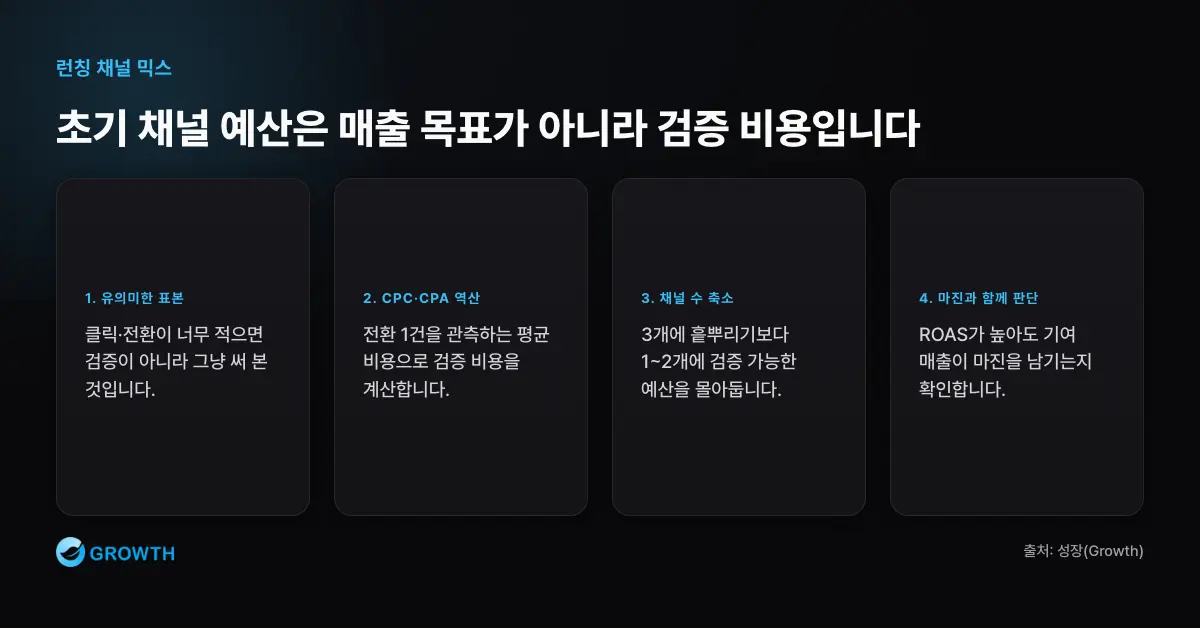
- Just enough for a meaningful sample — but genuinely enough — Spend too little for clicks, impressions, or conversions to carry statistical meaning, and you haven’t “validated” anything — you’ve just tried something. A channel’s budget needs to sit above a floor where you can observe at least a few conversions. If your budget can’t clear that floor, it’s better not to turn that channel on for this launch at all.
- Work backward from a channel’s CPC/CPA to find its validation cost — Estimate “how much it costs on average to observe one conversion” for each channel, and you get “how much you need to spend to see at least N conversions.” How cost-per-click determines your validation cost starts with the structure of CPC (cost per click).
- Cut the number of channels before you cut the budget per channel — When budget is tight, choose “a few channels done properly” over “every channel a little bit.” Scattering a sub-validation budget across three channels teaches you far less than concentrating a validation-worthy budget on 1–2 channels to secure real signal.
- Look at ad efficiency metrics alongside margin — A high ROAS can look great, but without looking at margin and payback period together, you can end up “failing efficiently.” We cover this trap in depth in the ROI and ROAS trap — when reallocating launch channels, move budget toward the channel where attributed revenue actually leaves margin, not simply the channel with the highest ROAS.
In short, the first principle of an early launch channel budget is: “an unvalidated channel is a learning tool, not a revenue channel.” During validation, an ad’s real value isn’t revenue — it’s the speed of learning. That’s why splitting a budget into smaller pieces and learning multiple times teaches you far more, for the same money, than burning a large budget all at once.
What needs to be in place before you turn on any channel? — UTMs and conversion definitions
There’s something you need to lay down before the ignition sequence even starts — a measurement setup. Without measurement, every stage above is meaningless. If you don’t know which channel actually drove a conversion, reallocation at D+30 becomes guesswork with no basis. There are two things you absolutely need to finish before turning on any ads.
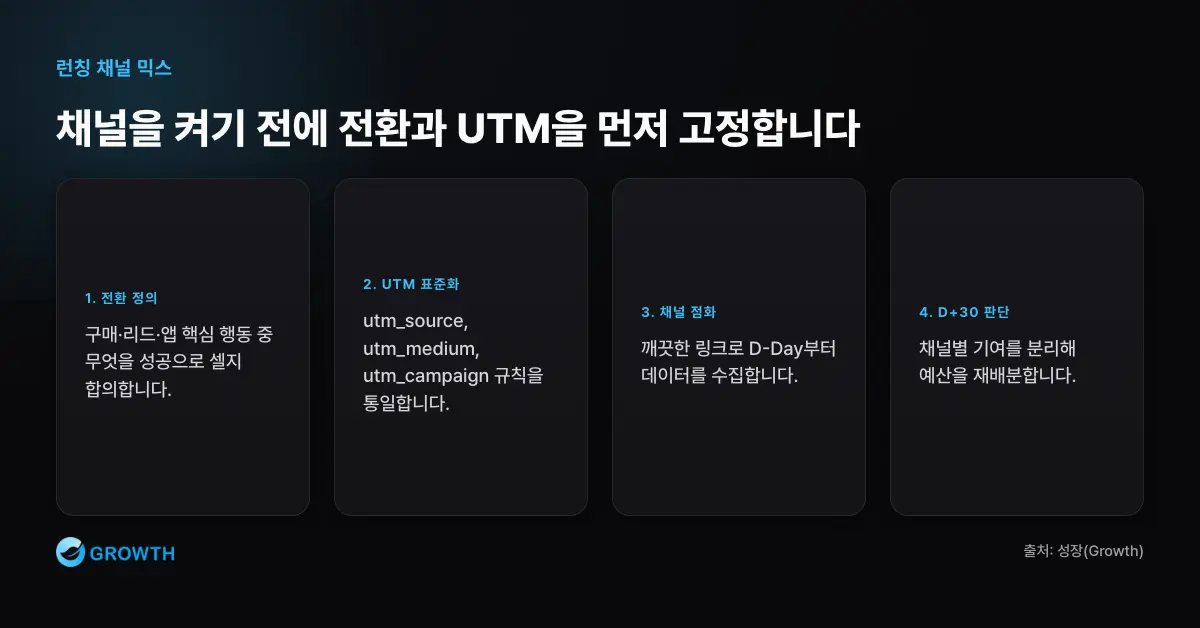
First, define “conversion” before anything else. Agree on what counts as success — a purchase, a lead (consultation or demo request), or a key post-install action for an app — before you turn on any channels. Without a conversion definition, you end up chasing vanity metrics like impressions and clicks, which runs directly counter to Growth’s standard that 10 people who become revenue matter more than 10,000 visitors. Your conversion definition is essentially “the action of the one person who becomes revenue” — and as the product-type table above showed, this definition is what determines channel priority.
Second, standardize the UTMs you’ll use to measure channels separately. Attach consistent campaign tags to every link, and you can separate “which channel and creative actually drove a conversion.” Google Analytics recommends always using the three core parameters (utm_source, utm_medium, utm_campaign) on campaign URLs, noting that missing them causes traffic to get bucketed as “(not set)” in reports, breaking your measurement — utm_source is the traffic source (e.g., naver, newsletter), utm_medium is the medium type (e.g., cpc, email), and utm_campaign is the campaign name. Set your per-channel UTM rules in a table before launch begins, and the data flowing in from D-Day onward stays cleanly separated from the start. We cover why measurement infrastructure is a precondition for marketing in more depth in why proper tracking setup matters for marketing.
The order is clear — define conversion, standardize UTMs, then turn on channels. Push measurement to later, and your most expensive launch data disappears forever into “(not set).”
Not sure where to even start with launch channel design?
The hard part of launch channel mix isn’t “knowing” the channels — it’s designing the sequence and reallocating with data under a limited budget and timeline. Growth helps companies define the right conversion for their product type first, design an owned→earned→paid ignition sequence, and build a channel structure that keeps generating revenue after launch — measured by “the one person who becomes revenue,” not traffic volume. You can learn more at Growth’s marketing services, and if you’d like to figure out the right channel sequence for your product launch, tell us about your situation via consultation inquiry.
You can see the full picture of this topic at a glance in “The 90-Day Brand Launch Playbook — A Stage-by-Stage Design for New Product Launch Marketing.”
Frequently asked questions
How many channels should we start with at launch?
There’s no fixed number, but the principle is “validated budget per channel,” not “number of channels.” If budget is tight, it’s better to concentrate a validation-worthy budget on the 1–2 channels with the highest conversion intent (usually search ads) to secure real signal, rather than spreading a little across every channel. If you can’t clear the floor budget needed to observe even a few conversions per channel, it’s wiser to leave that channel out of this launch entirely.
Can’t we just turn on paid ads right at launch?
You can, but the “landing spot” the ads point to needs to be ready first. Turn on ads before you have a landing page built for conversion, reviews that provide a reason to trust you, and content ready to capture search traffic, and the traffic you worked hard to buy simply bounces. That’s why we recommend finishing owned at D-30 and planting earned’s seeds (reviews), then igniting paid at D-Day. Advertising is ignition — it’s not the foundation.
How is this article different from the Triple Media article?
Our Triple Media strategy guide covers the concept of what owned, earned, and paid each are and how you typically combine them. This article takes that concept and translates it into a practical application under the time constraint of a “launch” — a stage-by-stage ignition sequence across D-30 → D-Day → D+30. If you want to understand the concept first, read the Triple Media guide; if you’re designing what to turn on first around a launch timeline, this is the one to use.
How do you compare and judge the effectiveness of different channels?
Two things matter most. First, don’t turn channels on simultaneously — stagger them so you can compare the change before and after each one goes live. Second, standardize your UTMs and define “conversion” first, so you can measure each channel’s contribution separately. From there, judge channels by whether attributed revenue leaves margin — not by impressions or clicks. We go deeper into how to analyze channel effectiveness in Channel mix analysis.