Entity Authority — the AI-Era Brand Trust Standard After E-E-A-T
 임재복
임재복
This article is chapter 7 of 20 — Ch.5 Entity Authority — in Growth’s GEO whitepaper series. You can find the full table of contents and the complete PDF on the whitepaper page.
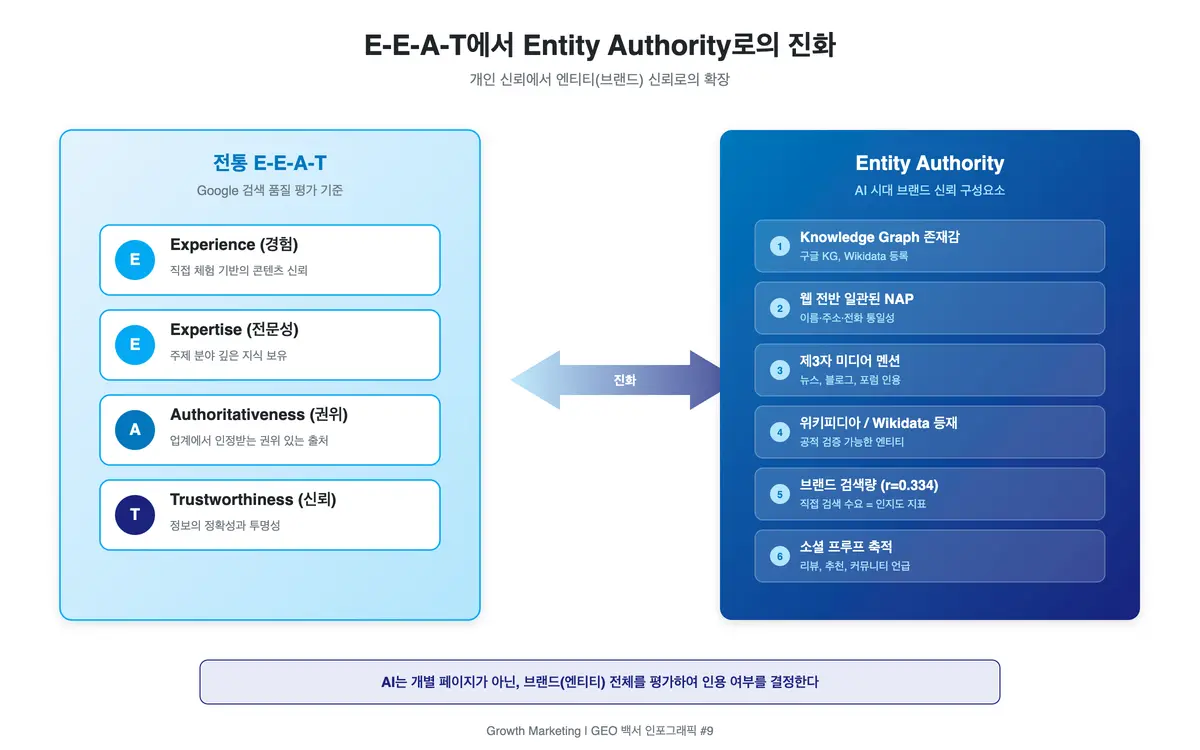
Answer-First: AI doesn’t judge trust based on a single website’s content quality alone. It evaluates whether a brand is consistently recognized as one clear “entity” across the entire web. This is Entity Authority — the evolved form of E-E-A-T.
E-E-A-T: the trust standard Google built
Before we talk about trust in the AI era, it’s worth revisiting how trust has traditionally been evaluated in search. Understanding that history makes clear why a new standard became necessary.
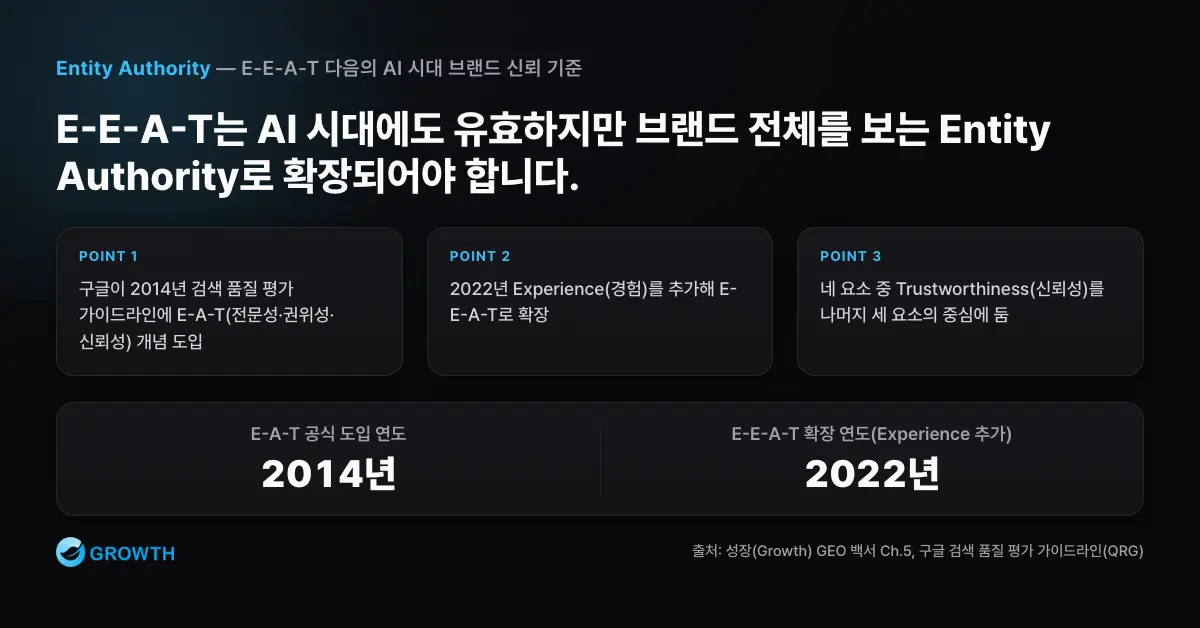
Google formally introduced E-A-T (Expertise, Authoritativeness, Trustworthiness) into its Search Quality Rater Guidelines (QRG) in 2014, then added Experience in 2022 to form E-E-A-T. This framework isn’t just Google’s internal rating criteria — it’s the most comprehensive framework for systematically judging the trustworthiness of web content, and it has underpinned SEO strategy worldwide.
Briefly, the four elements of E-E-A-T are: Experience, which asks whether the content creator has real first-hand experience with the topic; Expertise, which asks whether they hold specialized knowledge in the field; Authoritativeness, which asks whether they’re a recognized authority in that field; and Trustworthiness, which asks whether the information is accurate, safe, and honest. Google places Trustworthiness at the center of the other three, making clear that “without trust, expertise and authority mean nothing.” We cover a detailed explanation and practical application of each of the four elements in a separate Google E-E-A-T guide, so this article will focus on why this standard alone has become insufficient in the AI era.
E-E-A-T has served as the gold standard for content quality evaluation for over a decade, and it’s been a core metric shaping SEO strategy. But the emergence of generative AI has created a new environment where this standard alone isn’t enough. Why?
Why E-E-A-T alone isn’t enough for AI
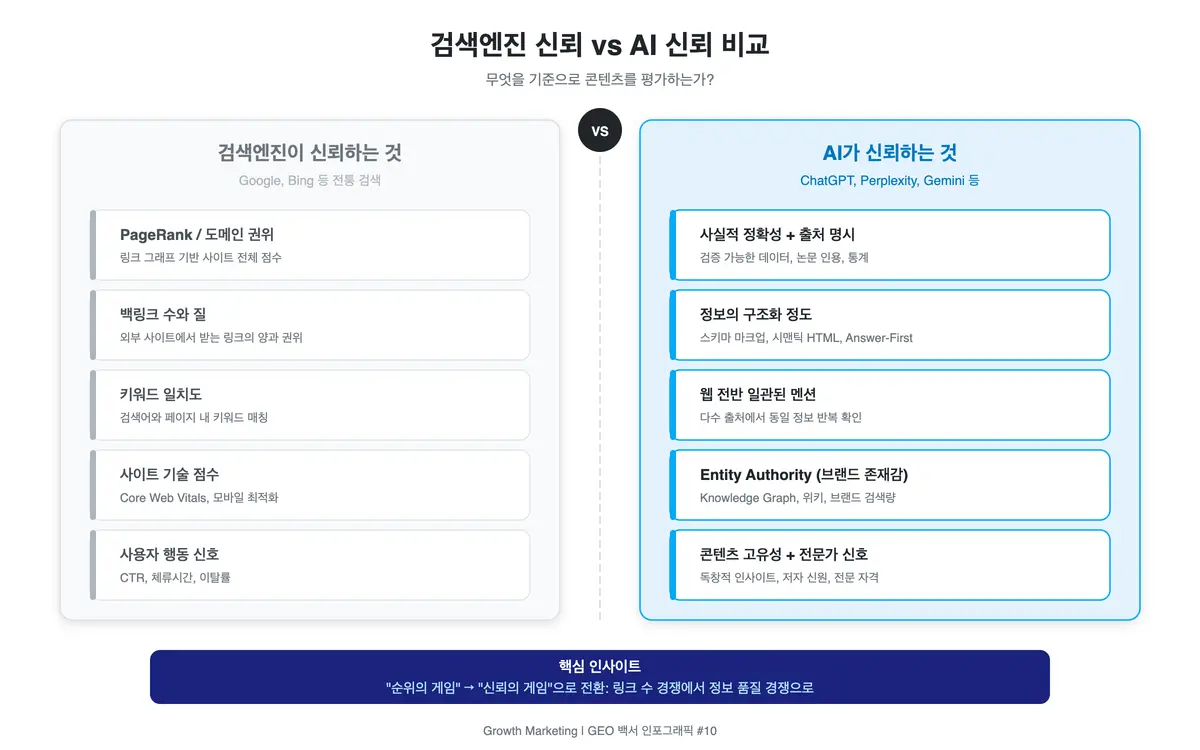
There’s a fundamental difference in how traditional search engines and generative AI judge trust. Google’s search algorithm evaluates E-E-A-T at the level of an individual web page — it measures trustworthiness based on who authored a specific page, the domain authority of that site, and how many backlinks it has. This is like judging “is this one book trustworthy?”
Generative AI, by contrast, reviews dozens or even hundreds of sources simultaneously to answer a single question. In this process, AI comprehensively evaluates not just the quality of an individual page, but how the brand (or author) behind it exists across the entire web. TrustLLM (ICML 2024), which evaluated 16 major LLMs across roughly 30 datasets, found that a model’s general performance and its trustworthiness tend to rise together — meaning the more sophisticated a model becomes, the more strictly it treats untrustworthy information. And AI’s trust judgment extends beyond a single page to ask “how trustworthy is the entity behind this information, as a whole?” To put it in an analogy: AI isn’t asking “is this one book trustworthy?” — it’s asking “considering this author’s entire body of work, career, and how other experts have evaluated them, can this person be trusted?”
Research by Pan et al. (IEEE TKDE, 2024) showed that combining LLMs with knowledge graphs reduces hallucination and strengthens entity recognition. Pons et al.’s research, presented at ISWC 2024, likewise demonstrated that leveraging the hierarchical structure of knowledge graphs improves entity disambiguation performance. These studies provide academic support for the fact that AI judges trust in structured units called “entities,” not individual pieces of text. In other words, for AI, trust isn’t created on a single page — it’s built across the entire web.
Entity Authority — the new trust standard for the AI era
Entity Authority refers to a state in which a specific brand, organization, or individual is recognized as one clear, consistent “entity” across the entire web ecosystem, and is evaluated by AI as an authoritative source in its field. This isn’t a rejection of E-E-A-T — it’s a concept that expands E-E-A-T to fit how AI actually works.
Where E-E-A-T asks “is this content trustworthy?”, Entity Authority asks “does the entity behind this content exist as a trustworthy entity in this field?” The difference sounds subtle, but the strategic implications are enormous. Where an E-E-A-T-centered strategy focused on raising the quality of individual pieces of content, an Entity Authority-centered strategy focuses on managing how the brand itself is perceived across the entire web. You can see where this concept fits within the overall GEO strategy in our complete guide to AI engine optimization (GEO).
It’s worth emphasizing that this isn’t just theory — it’s backed by empirical evidence. Digital Bloom’s report, which analyzed over 680 million AI citations, found that Brand Search Volume is the single strongest predictor of AI citation (correlation coefficient r=0.334). Brand search volume refers to how often users directly search for a brand’s name on Google. In other words, the more a brand is already known and searched for, both online and offline, the more often AI cites it too.
We cover this in more depth in a separate article on off-page GEO, but large-scale AI citation analysis shows that AI overwhelmingly favors earned media (third-party mentions) over a brand’s own content. AI trusts what other people say about you far more than what you say about yourself.
The reality for global brands versus niche brands
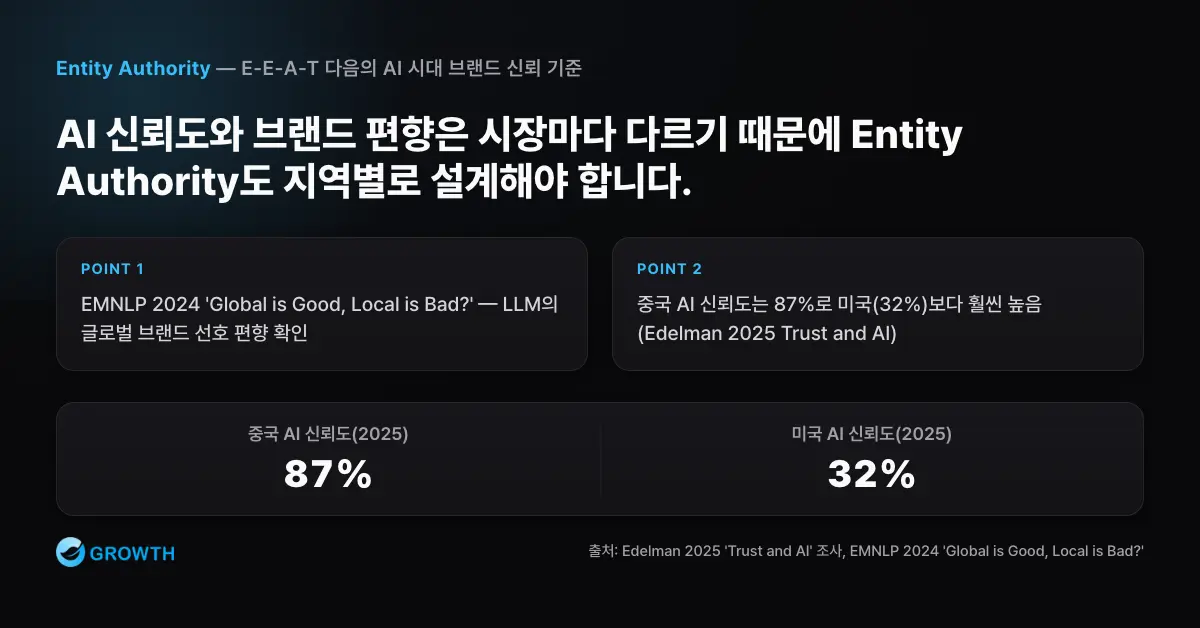
We also need to face the uncomfortable reality that the concept of Entity Authority raises. Research presented at EMNLP 2024, titled “Global is Good, Local is Bad?”, found that LLMs carry a systematic bias favoring global brands. Because global brands are mentioned overwhelmingly more often in AI’s pretraining data, new brands and niche-market players are structurally disadvantaged.
Research by Rienecker et al. (2026) using the ChoiceEval framework analyzed this bias even more systematically, confirming that LLMs carry a systematic bias toward over-representing certain brands. That may sound discouraging for later-entering brands, but it’s also an opportunity — because most global brands haven’t yet executed GEO systematically, this is exactly the moment when strategically building Entity Authority can capture a first-mover advantage.
Edelman’s 2025 “Trust and AI” survey data offers another interesting insight: trust in AI varies dramatically by country. In China, 87% of people trust AI, while in the US, that figure is only 32%. This suggests that Entity Authority strategy needs to be differentiated market by market. In Korea specifically, there’s a dual challenge of accounting for both the Naver search ecosystem and the global AI search ecosystem at the same time.
The Entity Authority roadmap — a four-stage journey
Entity Authority isn’t built overnight. It’s a long-term project that has to be built through systematic stages, where each stage forms the foundation for the next. You can see the full context of these four stages, along with the rest of the chapters, in the complete GEO whitepaper.
Stage 1: Establish entity identity
Everything starts with the question: “what entity do we want our brand to be recognized as?” At this stage, you define your brand’s core area of expertise, its unique value proposition, and consistent naming and description across the web. Your brand name, key personnel, and core products/services need to be represented the same way across every channel. The first task is checking that brand information is consistent across your Google Business Profile, LinkedIn company page, your own website’s About page, and every social media profile. AI uses this kind of consistency as a key signal for entity disambiguation.
Stage 2: Tell AI through structured data
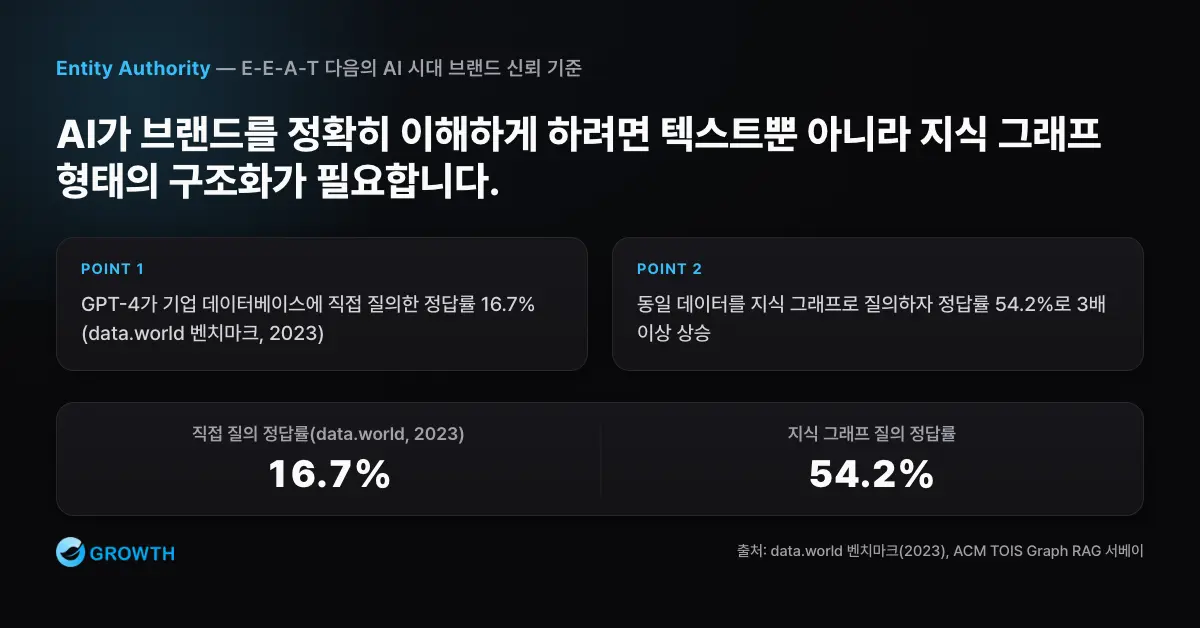
Once your entity identity is defined, you need to structure it in a form AI can mechanically understand. Apply Schema.org’s Organization, Person, and Product markup across your site, and use the sameAs attribute to link to Wikipedia, Wikidata, and official social profiles. Registering a brand entry on Wikidata is especially important, because many AI systems use Wikidata as their reference database for entity identification. The impact of structuring shows up in the numbers too. In data.world’s research team benchmark (2023), when GPT-4 queried a corporate database directly, its accuracy was only 16.7% — but when the same data was queried through a knowledge graph representation, accuracy jumped more than threefold to 54.2%. A Graph RAG survey published in ACM TOIS likewise concludes that graph-structured knowledge representation enables more precise retrieval and more accurate responses. This is evidence that structured entity data has a decisive impact on how AI processes information.
Stage 3: Secure authority through third-party validation
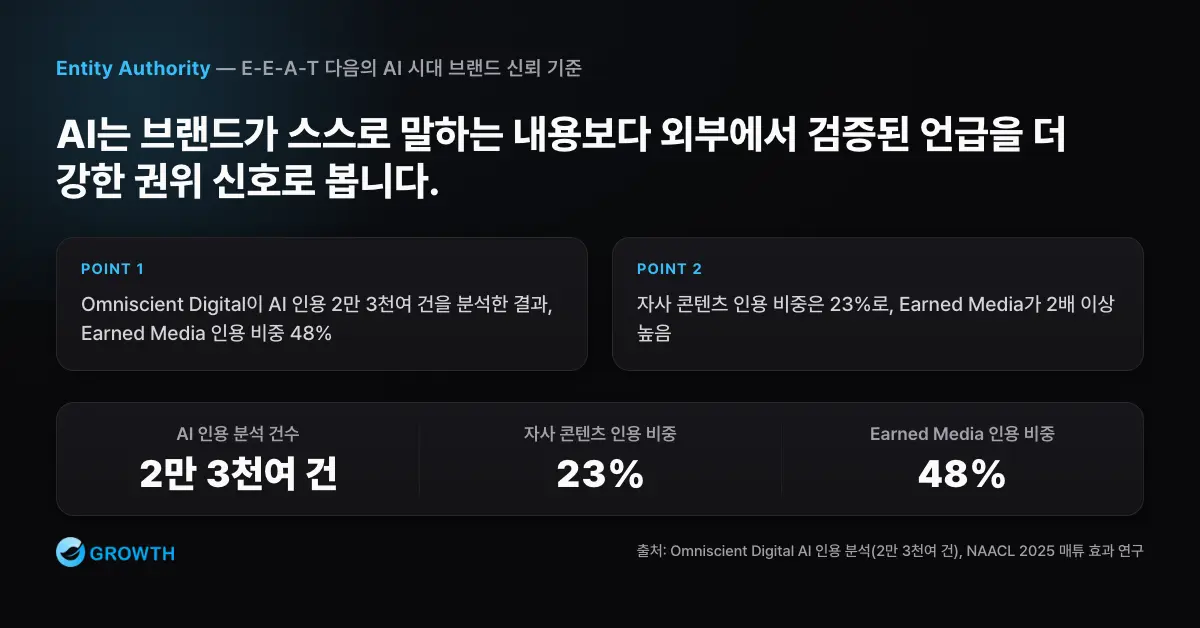
No matter how strongly you claim expertise on your own site, Entity Authority isn’t complete without third-party validation. At this stage, systematically pursue industry media contributions, academic papers or whitepapers, conference presentations, a Wikipedia entry, and active participation as an expert in relevant communities. As Omniscient Digital’s analysis of roughly 23,000 AI citations shows, for brand-related questions AI cites earned media (48% of citations) more than twice as often as a brand’s own content (23%). Research by Algaba et al. (NAACL 2025) also found that LLMs tend to reflect human citation patterns — and amplify them. In other words, a “Matthew effect” is at play, where sources that are already cited frequently get cited even more by AI. That means the earlier you start pursuing third-party validation, the more you benefit from that compounding effect. If you’re using generative AI to produce contributed articles, whitepapers, and similar content, refer to our generative AI content marketing guide to set your quality bar together.
Stage 4: Continuous monitoring and consistency
Entity Authority isn’t something you build once and forget. You need to continuously monitor whether the way your brand is mentioned across the web stays consistent, whether new media exposure aligns with your existing entity identity, and how AI is actually citing your brand in practice. The most direct method is to regularly ask major AI engines (ChatGPT, Perplexity, Google AI Overview) brand-related questions and track how your brand is represented in the responses. Use brand mention monitoring tools to analyze mention frequency and tone across the web, and build a process to correct inaccurate information the moment it’s found.
| Category | Search engines (E-E-A-T-centered) | AI engines (Entity Authority-centered) |
|---|---|---|
| Evaluation unit | Individual web page | The whole entity (brand/author/organization) |
| Evaluation scope | The site itself + direct backlinks | Mentions, reviews, and community activity across the web |
| Core signal | Domain authority, backlink count, page quality | Entity consistency, third-party validation, brand search volume |
| How trust is built | Accumulating high-quality content + earning links | A consistent presence across the entire web ecosystem |
| Update cycle | Crawl cycle (daily to weekly) | Pretraining (monthly to yearly) + RAG (real-time to daily) |
| Strategy for latecomers | Can target niche keywords | Requires long-term investment in building the entity |
Key Takeaway: In the AI era, brand trust is evaluated not just by the quality of individual pieces of content, but by whether the brand exists as a consistent entity across the entire web. E-E-A-T is still valid, but it’s no longer enough on its own. Systematically building Entity Authority is the key strategy for being recognized by AI as a “source worth citing.”
If you’re curious how your brand currently shows up in AI answers, get in touch about an AI answer share diagnosis. You can also request the full GEO whitepaper PDF.
Frequently asked questions (FAQ)
What is Entity Authority?
It’s a state in which a specific brand, organization, or individual is recognized as one clear, consistent entity across the entire web ecosystem, and is evaluated by AI as an authoritative source in its field. It’s E-E-A-T — which evaluates individual page quality — expanded to fit how AI actually works.
What’s the difference between E-E-A-T and Entity Authority?
E-E-A-T asks “is this content trustworthy?” at the level of an individual page, while Entity Authority asks “does the entity behind this content exist as a trustworthy entity in this field?” at the level of the entire web. The key difference is that the evaluation unit expands from a single page to the whole brand.
Can new or niche brands build Entity Authority too?
Yes. The structural bias where LLMs favor global brands is real, but because most global brands haven’t yet executed GEO systematically, this is a first-mover opportunity for later-entering brands. The earlier you start third-party validation, the more you benefit from the compounding advantage of the Matthew effect.
Where should you start when building Entity Authority?
The first step is establishing entity identity — checking that your brand name, key personnel, and core services are represented consistently across every channel. From there, expand to structured data (Organization schema and sameAs links), third-party validation (media contributions and a Wikipedia entry), and monitoring AI answers, in that order.
GEO whitepaper series: ← Previous chapter · Full table of contents · Next chapter →