How AI Generates Answers — The 4-Stage Citation Mechanism Marketers Need to Know
 임재복
임재복
This article is part 6/20 of Growth’s GEO Whitepaper series — Ch.4, How AI Generates Answers. The full table of contents and the complete PDF are available on the whitepaper page.
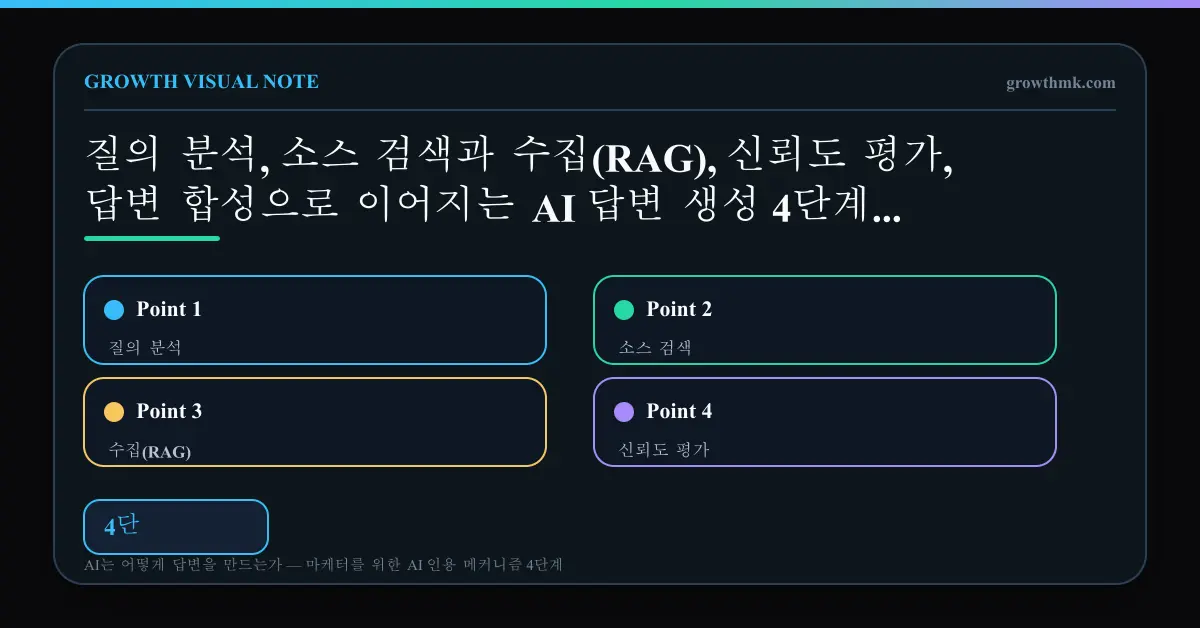
AI analyzes a query, retrieves relevant sources from the web (RAG), evaluates the credibility, structure, and authority of those sources, and then synthesizes a final answer. Understanding at which stage of this pipeline your content gets filtered out is the starting point of any GEO strategy.
From a question to an answer
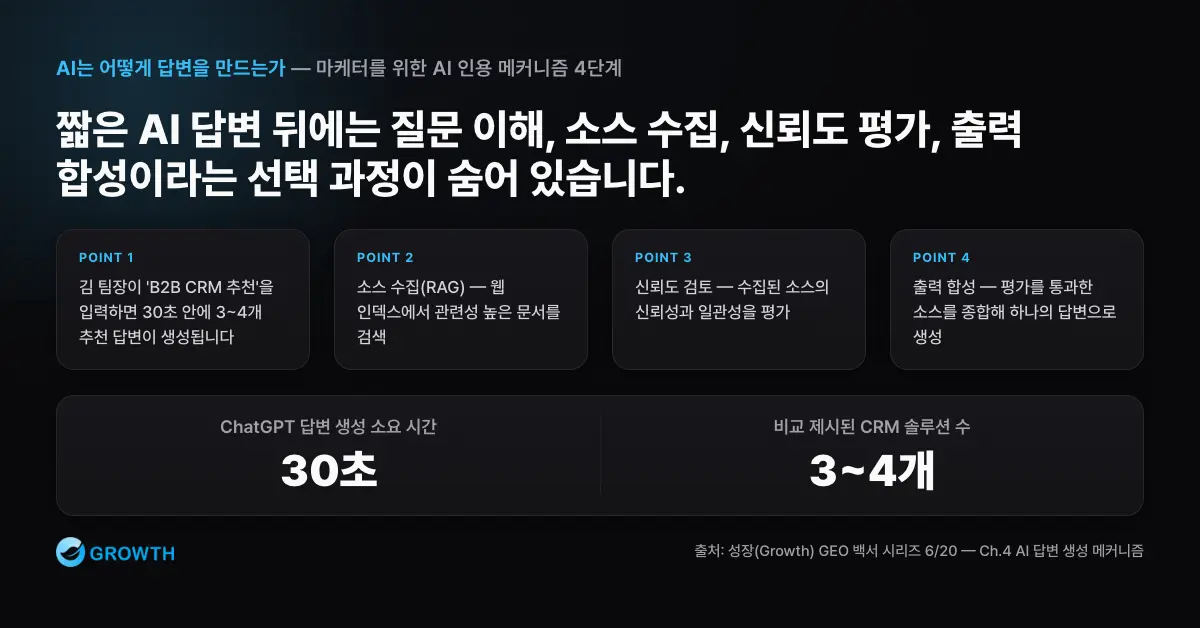
Imagine a marketing director, Ms. Kim, preparing for an afternoon meeting, types into ChatGPT: “Recommend some CRM software suitable for a B2B company.” Within 30 seconds, a polished answer appears on her screen. Three or four CRM solutions are compared, with pros and cons, and each recommendation comes with a source attached. Behind this seemingly simple process, a language model with billions of parameters is running a complex pipeline. The reason this pipeline matters to marketers is straightforward: you can only build a GEO (AI engine optimization) strategy once you understand at which stage of this process your content gets selected — or filtered out — and why.
The 4-stage pipeline of AI answer generation
Let’s break down how AI generates an answer into four stages. We’ll keep the technical details accurate while focusing on what’s practically meaningful for marketers.

Stage 1: Query analysis and intent detection
When Ms. Kim types “recommend B2B CRM software,” the AI isn’t simply matching keywords. It reads the word “recommend” as a signal that comparative analysis is needed, reads “B2B” as context indicating an enterprise use case, and determines what type of information is needed to answer the question. Where traditional search engines started from keyword matching, AI starts from understanding the intent and context of the query. What this means for marketers is clear: what matters now isn’t whether your content contains a specific keyword, but how accurately it answers the intent behind a specific question.
Stage 2: Source retrieval and gathering (RAG)
Once the AI has identified the intent of the query, it goes looking for the information it needs to answer it. This process is called RAG (Retrieval-Augmented Generation). Introduced by Lewis et al. (2020) at NeurIPS, this concept has become the core architecture behind nearly every AI search service today. Think of how RAG works as an AI acting as a librarian in a massive digital library. When Ms. Kim’s question comes in, the AI librarian instantly scans countless shelves in the library and pulls together an armful of the most relevant documents. In this analogy, the “shelves” correspond to the web index, and the “documents pulled” correspond to the retrieved sources.
There’s a crucial point marketers need to understand here: AI doesn’t search every webpage on the internet in real time. It selects the most relevant sources from among what’s already been collected into its own index. So the first gate your content has to pass through is whether it’s properly registered in that index. The AI-crawler access settings and llms.txt adoption covered in Technical GEO are exactly the strategy for not getting filtered out at this stage, and the step-by-step allow/block procedures for individual crawlers — GPTBot, ClaudeBot, and others — are laid out in practical detail in the AI crawler robots.txt guide. Meanwhile, large-scale analyses comparing the citation domains of major AI engines consistently show that the domains cited in common across engines are relatively few, and that the sources each engine cites vary significantly. That’s exactly why it’s essential to be technically prepared to be indexed by multiple AI engines at once.
Stage 3: Evaluating credibility, relevance, and quality
Not every source gathered through RAG actually gets used in the answer. AI rigorously evaluates the documents it retrieves. To understand this stage, let’s return to the library analogy. Picture the AI librarian spreading the books pulled from the shelves out on a table, going through them one by one, and asking: “Is this book reliable? Does this information actually answer the question accurately? Is it consistent with the other books?”
The ALCE benchmark study (Gao et al., EMNLP 2023) exposed the limits of this evaluation process. Even top-performing LLMs were found to produce results on the ELI5 dataset where 50% lacked complete citation support. The GhostCite (2026) study offers an even more startling figure — analyzing 375,440 citations across 13 LLMs, it found hallucination rates (citing sources that don’t exist or are incorrect) ranging from 14% to 95% depending on the research domain. By contrast, the RAG-based system OpenScholar (Asai et al., 2024) achieved citation accuracy comparable to human experts — while, in the same study, the purely generative GPT-4o hallucinated 78–90% of its citations. What this means for marketers is clear: the more your content is fact-based, clearly sourced, and consistent with other credible sources, the higher your odds of surviving AI’s evaluation stage.
The TrustLLM study (Huang et al., 2024) made an important discovery while evaluating the trustworthiness of 16 LLMs across six dimensions: there’s a positive correlation between trustworthiness and model capability. That means the more capable a model is, the higher a bar it applies for trustworthiness — and it also means that as AI technology advances, low-quality content gets filtered out more ruthlessly, not less.
Stage 4: Answer synthesis and citation decisions
In the final stage, AI combines the information from sources that passed evaluation into one coherent answer. What matters here is that AI isn’t “copying and pasting” content from a source — it’s reconstructing and synthesizing information from multiple sources. In this process, whether a given source ends up marked as a citation depends on how directly and specifically it contributed to the answer.
The “Lost in the Middle” study by Liu et al. (TACL, 2024) found an interesting pattern in this synthesis process: AI pays more attention to information located at the top and bottom of a set of retrieved documents, and shows a U-shaped attention pattern that relatively neglects information in the middle. Kumar & Lakkaraju (2024) from Harvard went a step further, demonstrating empirically that strategically written text can meaningfully shift the probability an LLM recommends a given product. These studies show that a piece of content’s structure and placement directly affects whether AI cites it — and they form the theoretical basis for Contents GEO.
Pre-training and RAG — what they mean for your marketing strategy
AI’s knowledge is formed through two paths. The first is pre-training — the knowledge an AI model internalizes by learning from a massive body of text data on the internet. Think of this like the foundational medical knowledge a doctor spends six years learning in medical school. The second is RAG (Retrieval-Augmented Generation) — a method that searches the web in real time for the latest information every time a question comes in, and folds it into the answer. This is like a doctor consulting the most recent medical papers during a consultation.
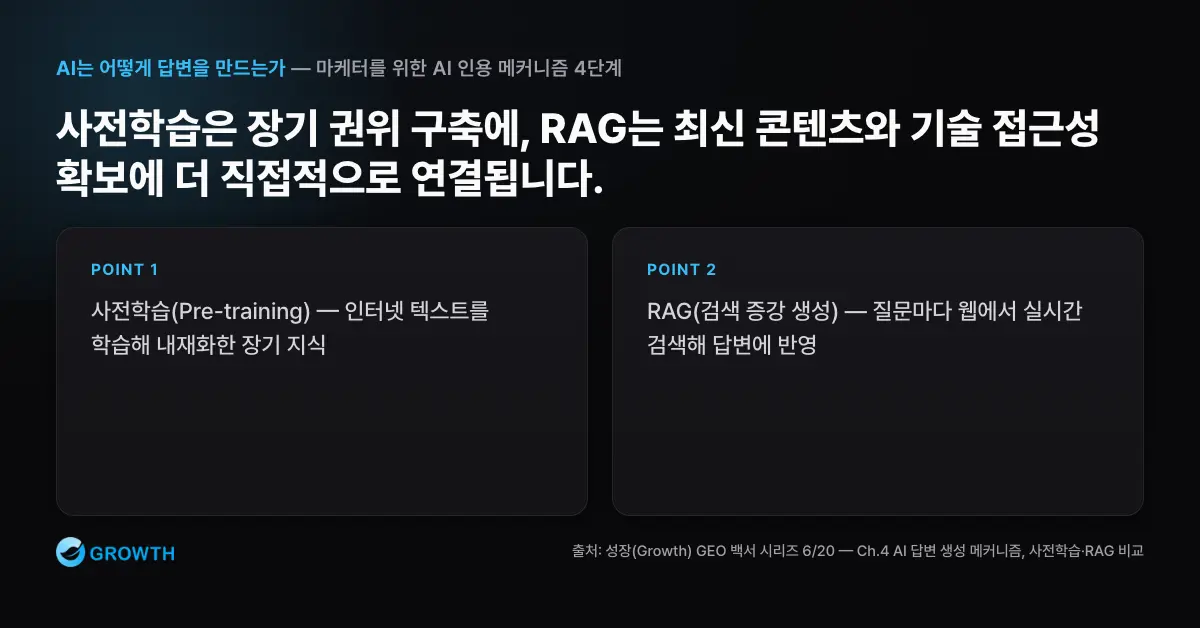
From a marketing strategy standpoint, these two paths operate on different timeframes. To be reflected in pre-training, your content needs to be recognized as an authoritative source across the web over a long period of time — being listed on Wikipedia, cited in academic papers, or consistently mentioned by major media all fall into this category. This is a long-term brand-building strategy, and it falls within the domain of Off-Page GEO and Entity Authority.
Being reflected in RAG, on the other hand, can be approached as a relatively short-term strategy. The key is building the technical environment that lets AI crawlers regularly visit your site and index fresh content (Technical GEO), and consistently publishing content that includes structured answers to specific questions (Contents GEO). The RA-RAG study (Hwang et al., 2024) proposed a method that cross-validates information across multiple sources to estimate source-level reliability, then weights information from more reliable sources more heavily when synthesizing an answer. In other words, information mentioned consistently across multiple credible sources is more likely to be adopted than information mentioned in just one source. Concrete execution strategies for both timeframes are covered systematically in Part III of the GEO Whitepaper.
10-question self-assessment: how citable is your content?
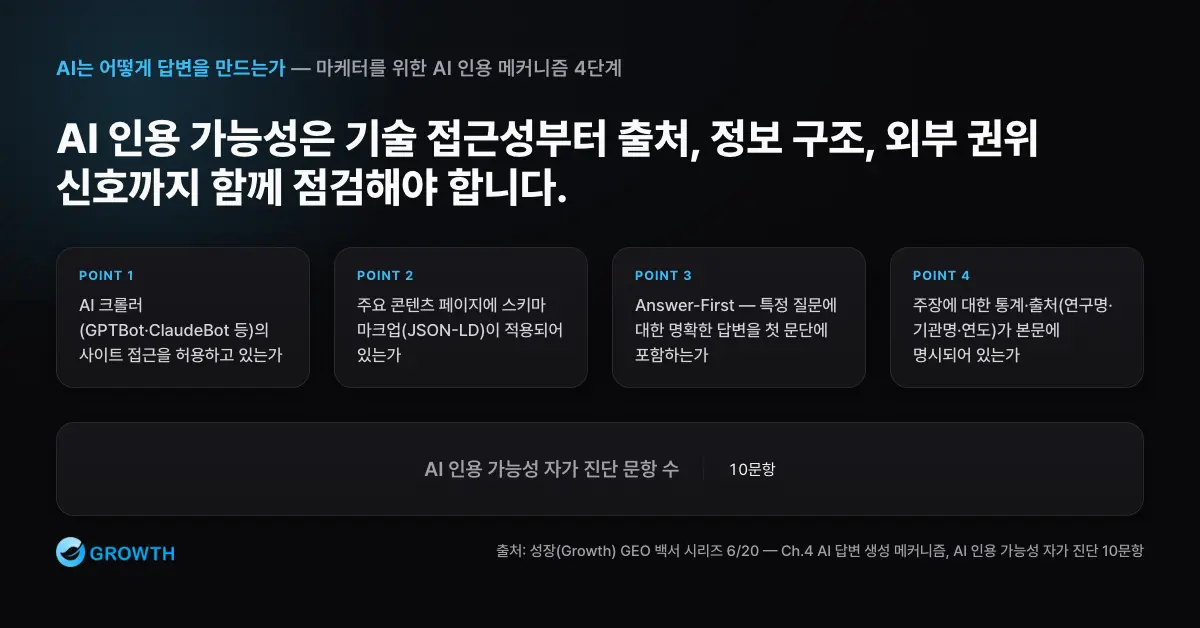
Now that we’ve walked through each stage of the AI answer generation pipeline, check whether your content can survive each stage and reach the final citation. This checklist is written from a marketer’s perspective, not a technical expert’s. 7 or more “yes” answers means your GEO readiness is solid; 4–6 means improvement is needed; 3 or fewer means urgent action is required.
| # | Item | Related pipeline stage |
|---|---|---|
| 1 | Does your site allow access to AI crawlers (GPTBot, ClaudeBot, etc.)? | Stage 2: Source retrieval |
| 2 | Is schema markup (JSON-LD) applied to your key content pages? | Stage 2: Source retrieval |
| 3 | Does your content include a clear answer to a specific question in the first paragraph? | Stage 3: Relevance evaluation |
| 4 | Does the body include statistics, data, or numerical evidence to support your claims? | Stage 3: Credibility evaluation |
| 5 | Are the sources of cited information (study name, institution, year) clearly stated? | Stage 3: Credibility evaluation |
| 6 | Does it include quotes from industry experts or professional opinions? | Stage 3: Authority evaluation |
| 7 | Is your content structured into self-contained information blocks of roughly 200–400 characters? | Stage 4: Answer synthesis |
| 8 | Is your brand listed on third-party knowledge platforms like Wikipedia? | Pre-training path |
| 9 | Has your brand been mentioned in industry media, news, or communities in the last 6 months? | RAG path + Off-page |
| 10 | When you ask the same question on ChatGPT or Perplexity, is your brand mentioned? | Final verification |
Key Takeaway: AI answer generation happens across four stages — query analysis → source retrieval (RAG) → credibility evaluation → answer synthesis. To avoid getting filtered out at any stage, you need technical accessibility, content structure, factual grounding, and brand authority all working together. Understanding this pipeline is a prerequisite for building any GEO strategy.
If you’re curious how your brand currently shows up in AI answers, reach out for an AI answer share assessment. You can also request the full GEO Whitepaper PDF.
Frequently Asked Questions
What is RAG (Retrieval-Augmented Generation)?
It’s a method where, instead of relying solely on pre-trained knowledge when answering a question, AI retrieves relevant sources from a web index in real time and folds them into its answer. Proposed by Lewis et al. (2020) at NeurIPS, this architecture is now the core structure behind most AI search services today, including ChatGPT Search and Perplexity.
What should I check first to get cited in AI answers?
It’s most efficient to check things in pipeline order. First, confirm AI crawlers can access your site (the retrieval stage). Next, confirm your content provides a clear answer to the question along with statistics and sources (the evaluation stage). Finally, confirm it’s structured into self-contained information blocks of roughly 200–400 characters (the synthesis stage). Start with the 10-question self-assessment above.
What happens if I block AI crawlers?
Blocking AI crawlers like GPTBot or ClaudeBot removes you from the index used in the RAG stage — meaning no matter how good your content is, it never even becomes a citation candidate. The strategic criteria and setup steps for allowing or blocking individual crawlers are covered in the AI crawler robots.txt guide.
Should I focus on pre-training or RAG first?
Short-term results come from the RAG path. Allowing AI crawlers and publishing structured content can raise your citation odds within a relatively short timeframe. The pre-training path (getting listed on Wikipedia, accumulating media mentions) is more effective as a parallel, long-term brand-asset investment.
GEO Whitepaper series: ← Previous chapter · Full table of contents · Next chapter →