
The GEO Three-Axis Execution Strategy: Technical x Contents x Off-Page
 임재복
임재복
This article is chapter 8/20 of Growth’s GEO Whitepaper series — Part III, Sub-Pillar (HOW). You can find the full table of contents and the complete PDF on the whitepaper page.
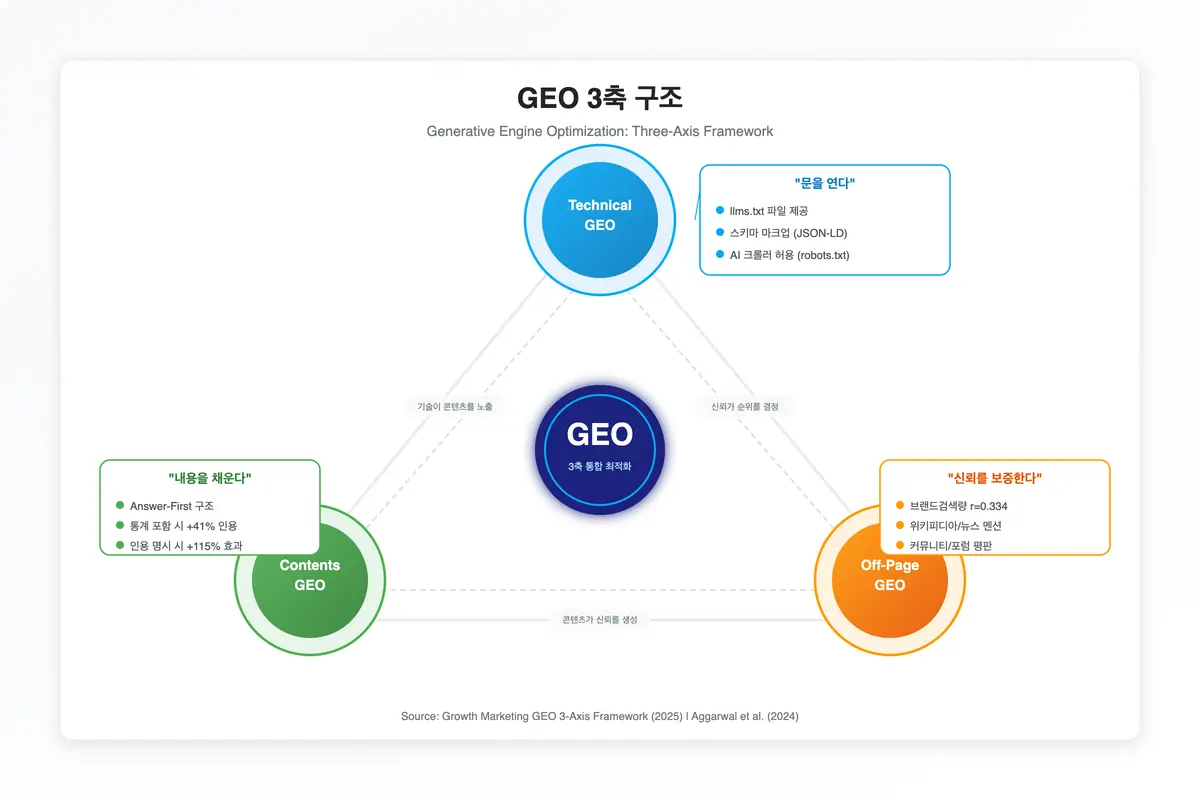
Answer-First: Executing GEO presupposes that three axes — Technical, Contents, and Off-Page — operate simultaneously. If any single axis is zero, your total GEO performance is also zero — the relationship between the three axes is multiplicative (×), not additive (+). This article covers each axis’s role, how they depend on one another, the expected timeline for each, and the recommended execution order, charting the path from theory to practice.
If you’ve grasped GEO’s strategic framework, there’s one crucial question left: “So how do we actually execute it?”
As we saw in How AI Generates Answers, AI doesn’t just match keywords — it builds its answer through a sophisticated pipeline: source retrieval → structure parsing → trust evaluation → answer synthesis. To keep your brand from getting eliminated at any stage of this pipeline, three axes need to operate simultaneously: Technical GEO, Contents GEO, and Off-Page GEO. These three axes form the execution skeleton of GEO — the core framework running through this article and the three chapters that follow it.
How the three axes relate — an urban transportation analogy
To make the relationship between these three axes intuitive, let’s compare it to a city’s transportation system.
Technical GEO is the road infrastructure. Just as roads need to be properly built before vehicles can reach their destination, the technical foundation that lets AI crawlers read your website and understand its structure needs to be in place first. llms.txt is the road sign, schema markup is the lane markings, and allowing AI crawlers is opening the tollgate. If the road is blocked, nothing happens at all.
Contents GEO is the vehicle driving on that road. No matter how good the road is, if the vehicle is old and its destination unclear, the passenger — AI — takes a different car. High-quality, structured content that precisely answers questions is exactly the vehicle AI chooses. An Answer-First structure is the vehicle’s destination sign, statistics and sources are its safety certification, and chunk-level design is the precision transit system that stops exactly at the passenger’s intended station.
Finally, Off-Page GEO is the traffic signal system and navigation. Brand mentions, reviews, and community activity on external platforms send AI a cross-verification signal that “this brand is trustworthy.” Just as a navigation app prioritizes recommending the route with higher ratings, AI also gives priority in its answers to brands that are mentioned frequently and evaluated positively elsewhere.
Why the three axes are interdependent
This analogy matters for a specific reason: if even one of the three axes is missing, the whole system collapses.
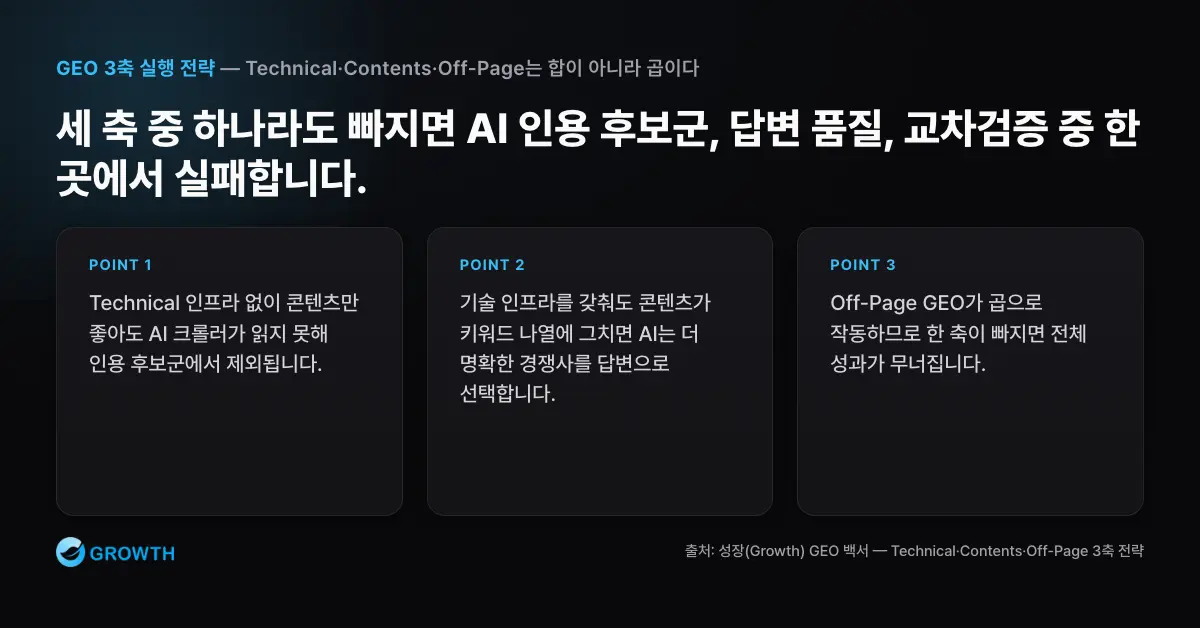
No matter how good your content is, without technical infrastructure, if AI crawlers can’t read that content, it never even enters the citation candidate pool — it’s like parking a brand-new electric car where there’s no road. Conversely, even with perfect technical infrastructure, if your content is just a list of keywords, AI will choose a competitor with a clearer answer — that’s like building an eight-lane highway and putting nothing but broken-down cars on it. And even with both axes perfect, without external reputation, AI will pick a competitor that’s mentioned more often on Wikipedia or Reddit over your brand at the cross-verification stage.
Real research data demonstrates this interdependence. The ACM TOIS Graph RAG survey we covered in the Entity Authority article found that when knowledge connected in a graph structure is combined, both AI’s retrieval precision and answer accuracy improve together. Similarly, BrightEdge’s data from tracking AI Overview citations over 16 months found that more than half (roughly 54%) of cited pages overlap with pages that already rank in organic search — evidence that GEO strategy needs to be built on top of an existing SEO technical foundation, not instead of it.
It’s also worth knowing the typical failure patterns companies fall into when they focus on just one axis. The “Technical-Only” trap: the IT team perfectly builds out llms.txt and schema, but the content itself is still SEO-era keyword repetition, so AI never cites it. The “Contents-Only” trap: a company mass-produces excellent content, but because AI crawlers are blocked or structured data is missing, none of it ever shows up in AI’s search results. The “Off-Page-Only” trap: aggressive PR gets the brand mentioned in plenty of news articles, but because the company’s own website content is thin, AI mentions the brand without citing it as an in-depth information source.
Realistic priorities and expected timelines for the three-axis execution
The principle that the three axes need to operate simultaneously doesn’t change, but in practice, “time to meaningful results” differs across each axis. Understanding this time difference lets you make realistic decisions about resource allocation. The full execution framework, including per-axis checklists, is laid out in the complete GEO Whitepaper.
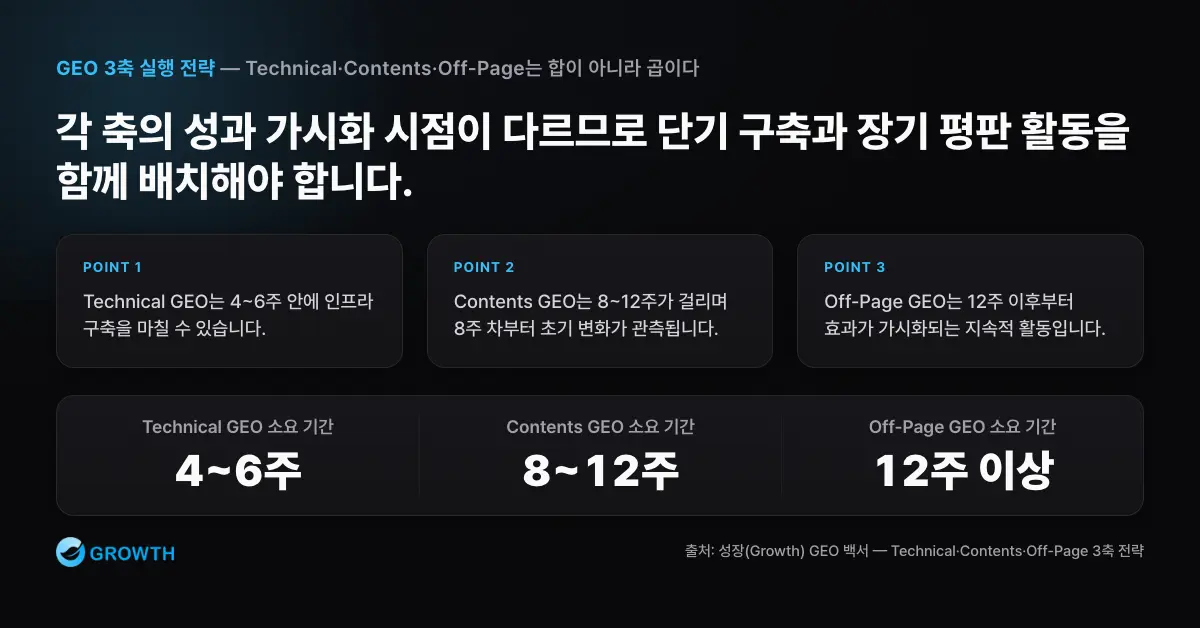
Technical GEO: 4–6 weeks. Writing llms.txt, applying core schema markup, and configuring AI crawler permissions are governed less by technical difficulty than by decision-making speed. Once GEO tasks get absorbed into the IT team’s sprint, the technical implementation itself moves fast. But at many companies, securing priority in the IT team’s backlog is the biggest bottleneck — early involvement from the steering committee is the key variable that shortens this timeline.
Contents GEO: 8–12 weeks. Auditing existing content (1–2 weeks) and setting priorities (1 week) wrap up quickly, but actual refactoring and new content production take considerably longer. Converting to an Answer-First structure, embedding statistics and sources, and redesigning for chunk-level structure average 2–4 hours per piece — for large enterprises with hundreds of existing articles, a realistic strategy is to tackle the top 20–30 priority pieces first. You’ll typically start to see early shifts in AI citation around the 8-week mark.
Off-Page GEO: 12+ weeks, ongoing. Securing brand mentions and earned media on external platforms takes the longest of the three axes and is a continuous activity with no end point. Factor in campaign planning for digital PR (2–3 weeks), building media and community relationships (4–8 weeks), and the lag before actual mentions get reflected in AI’s training data (weeks to months), and effects only become visible starting at 12 weeks at the earliest. That said, external authority accumulated through Off-Page work compounds over time, so starting early determines your long-term outcome.
The recommended execution order
So how should you sequence execution? The recommended order is clear: Technical → Contents → Off-Page. Build the road first, put the vehicle on it, and finally turn on the traffic system.
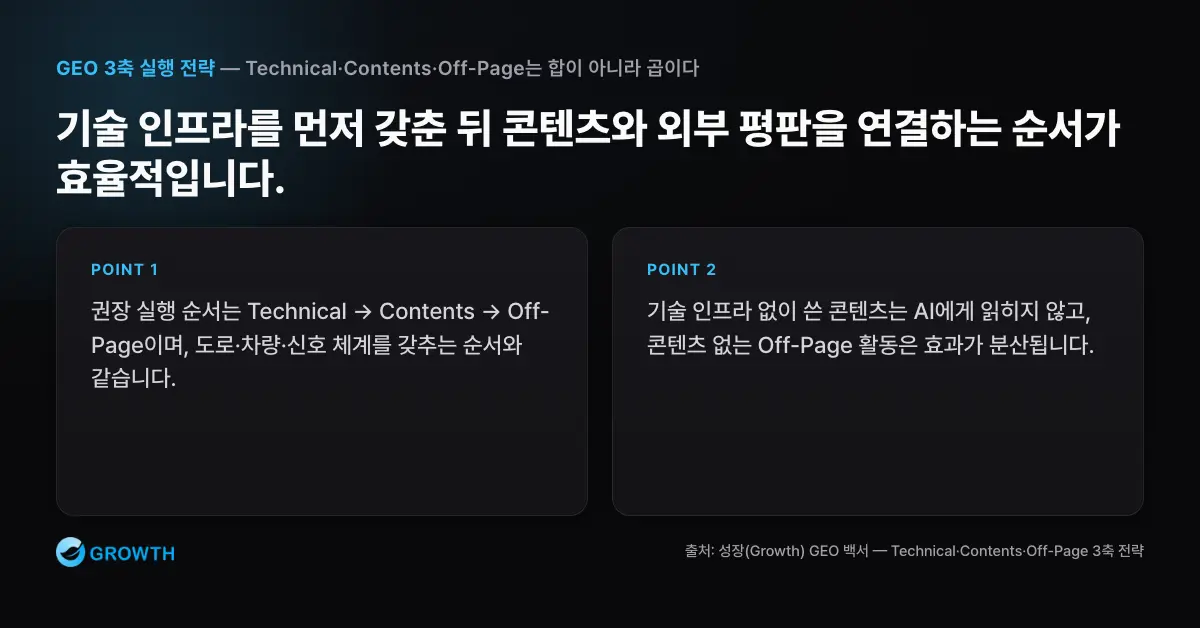
Of course, in practice, companies often run all three axes in parallel. Especially at large enterprises where IT, content, and PR teams can move simultaneously, parallel execution is possible — and often recommended. But if resources are limited and you have to proceed sequentially, the order above is the efficient one. The reason is simple: if you write content before technical infrastructure is in place, that content never gets read by AI crawlers, and the effort is wasted. If you run Off-Page activity without content, there’s no owned content hub for those mentions to connect back to, and your entity ends up fragmented.
Here’s a brief recommended timeline for a large-enterprise context: Technical GEO, led by IT, can build out basic infrastructure — writing llms.txt, applying core schema, configuring crawlers — within 2–4 weeks. Contents GEO has the content team run an audit of existing content (1 week) alongside refactoring (4–8 weeks), while new content production continues on an ongoing basis. Off-Page GEO, the longest-running of the three axes, has PR planning a digital PR campaign and community strategy (2 weeks) and then executing it (8+ weeks). If you need a hands-on, tactical-level checklist right now, see the AI Search Optimization Execution Guide alongside this article.
Where the execution chapters go from here
This series covers each axis in depth in its own dedicated article: technical infrastructure in Technical GEO, content design strategy in Contents GEO, and external reputation building in Off-Page GEO. Each article includes an actionable checklist and concrete examples, and closes by identifying the owning team for that axis (IT, content, or PR) — so we recommend reading them alongside GEO Organizational Design.
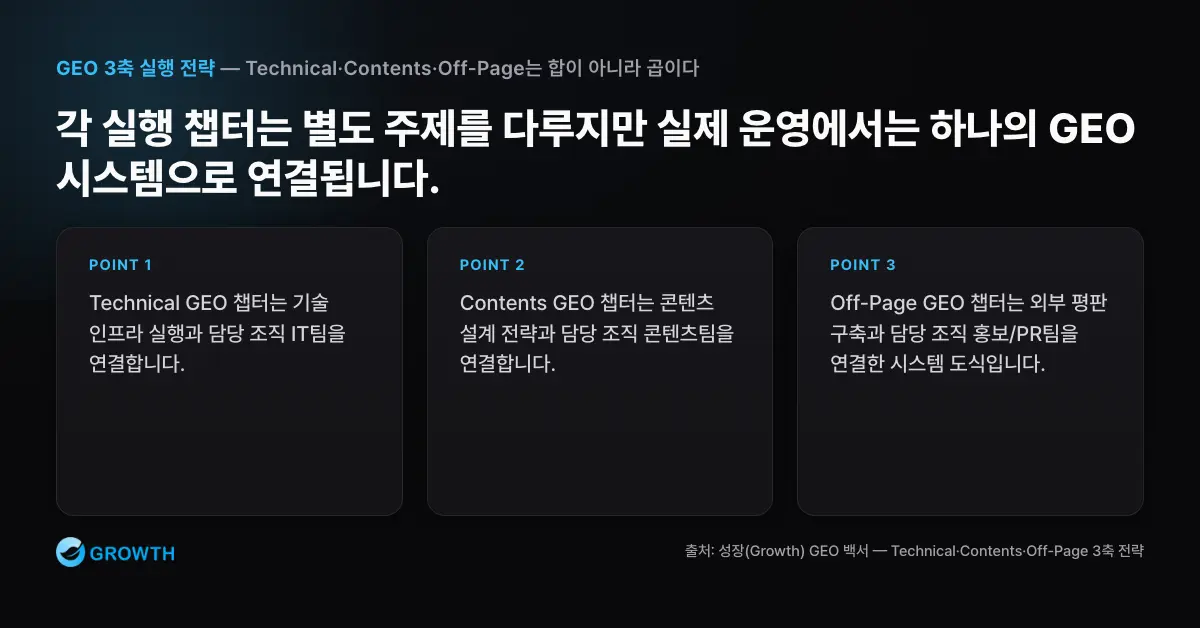
Here’s the core idea in one sentence: GEO is a product of its three axes, not a sum. Technical × Contents × Off-Page — if any one is zero, the result is zero too.
Curious how your brand currently shows up in AI answers? Request an AI Answer Share diagnostic. You can also download the full GEO Whitepaper PDF.
Frequently Asked Questions
What are GEO’s three axes?
Technical GEO, which gets AI crawlers to read your site; Contents GEO, which produces content AI can cite; and Off-Page GEO, which builds trust signals on external platforms. All three axes need to operate simultaneously for your brand to be cited in AI answers.
Which of the three axes should you start with?
If resources are limited, the efficient order is Technical → Contents → Off-Page. Content built without technical infrastructure never gets read by AI, and external activity without content has no hub for mentions to connect back to, which disperses the effect. If you’re a large enterprise with separate teams, parallel execution is also possible.
How long does it take before results appear?
Technical GEO takes 4–6 weeks, Contents GEO takes 8–12 weeks (with early shifts observable around week 8), and Off-Page GEO effects become visible starting at 12 weeks at the earliest, as an ongoing activity with no end point. External authority built through Off-Page work compounds over time.
Is it worth doing well on just one axis?
Only to a limited extent. Because the three axes are multiplicative, not additive, if any one is zero, total performance converges toward zero. The classic failure patterns are “Technical-Only” (perfect infrastructure, weak content), “Contents-Only” (a flood of content nobody can crawl), and “Off-Page-Only” (plenty of PR exposure but a thin content hub).
GEO Whitepaper series: ← Previous chapter · Full table of contents · Next chapter →