
ESG Content Marketing Case Studies and a Realistic Strategy
 임재복
임재복
If you work in marketing, you can’t not know the term “ESG.” Across manufacturing and retail, and even among major Korean entertainment companies with global fandoms like HYBE and JYP, ESG management is being adopted as part of the push toward sustainable growth.
Have you ever thought, “ESG is premature for a small or mid-size company like ours”? It’s worth reconsidering. Even a company that’s just starting out, or still growing, can use ESG content to communicate its positive values, build trust with stakeholders, and lay the groundwork for sustainable growth.
In this article, instead of an abstract, intimidating version of ESG, we’ll introduce realistic ESG content marketing strategies you can start right now, along with some compelling success stories. See what makes ESG content marketing worthwhile, and build a competitive edge for the future.
Before diving into ESG content marketing, it can help to first understand basic content marketing strategy through Growth’s guide to content marketing, from definition to strategy.
Myths and Truths About ESG Content Marketing
Does the phrase “ESG content marketing” alone make you think “complicated and expensive”? That’s a completely understandable reaction if you’re a decision-maker or a hands-on marketer at a small or mid-size company without the resources of a large enterprise.
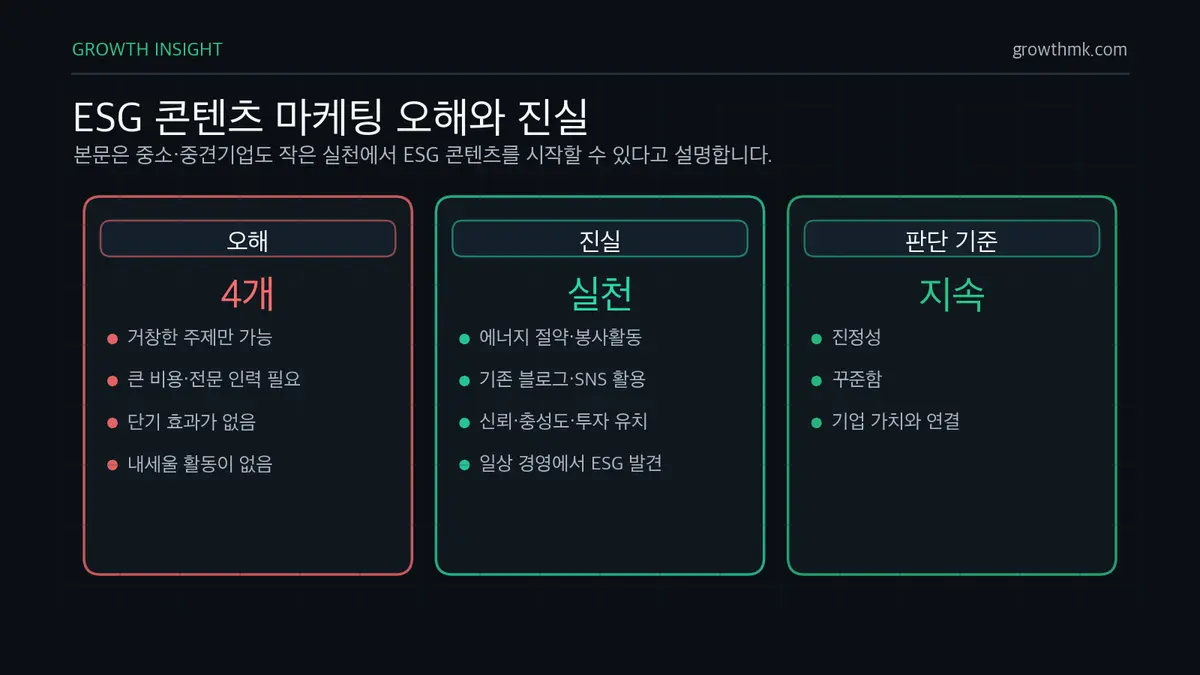
But once you clear up a few common misconceptions, you’ll likely find that ESG content marketing can actually become a positive driver of your company’s sustainable growth.
Myth 1: ESG Content Has to Cover Grand, Highly Technical Topics?
ESG content doesn’t have to be complicated or technical. You can start by sincerely showing the small but meaningful things your company is actually doing.
Something like a card-news post or a short video about an office energy-saving campaign, community volunteer work, or an effort to introduce eco-friendly products can easily become great ESG content. The key is authenticity and consistency.
Myth 2: Producing ESG Content Requires a Big Budget and Specialized Staff?
Expensive equipment and specialized staff aren’t strictly necessary. You can use your existing blog and social channels to create content around internal news or footage of employees getting involved.
Free design tools or simple video editing software are enough to create genuinely effective content. What matters is having ideas and following through on them.
When producing ESG content with limited resources, it’s also worth considering whether using generative AI for content marketing is a good fit — it can be an efficient way to get more done.
Myth 3: ESG Content Marketing Has No Visible Effect Right Away?
ESG content marketing contributes to your company’s image and credibility from a long-term perspective, rather than delivering a short-term revenue bump. That, in turn, can lead to stronger customer loyalty, better talent acquisition, more investment interest, and other positive outcomes. In fact, a joint study by NielsenIQ and McKinsey, which analyzed five years of data across 600,000 products in the U.S., found “a clear and substantive link” between ESG-related messaging and consumer spending across a majority of categories.
To run ESG content marketing effectively, you need an accurate understanding of your target customers’ needs. Understanding the difference between customer needs and wants can help you deliver more effective ESG messaging.
And as social interest in ESG management continues to grow, ESG content can become a genuine source of differentiated competitive advantage.
Myth 4: Our Company Doesn’t Have Any ESG Activities Worth Highlighting?
Even the smallest company has a direct or indirect impact on society and the environment. You can find ESG elements within everyday operations — energy conservation, waste reduction, improving employee welfare, engaging with your local community. Consistently documenting and sharing these activities is, in itself, the starting point of ESG content marketing.
Why ESG Content Marketing Fails
ESG content marketing isn’t some insurmountable wall. Start with small actions, deliver an authentic message consistently, and small and mid-size companies can absolutely create meaningful, positive change too.

Of course, in reality, there are absolutely cases where things fail to deliver the expected impact. Companies with limited resources and expertise, in particular, tend to fall into a few common traps.
Let’s dig deeper into why ESG content marketing fails to drive real results, beyond simply showcasing “good deeds.”
Superficial, “For Show” Content
One of the most common causes of failure is producing content that looks good on the surface without any real ESG management effort behind it.
This includes things like promoting photos from a one-off volunteer event, or overusing eco-friendly-sounding language, while the company’s actual operations or product manufacturing process show little real effort toward sustainability.
This kind of “greenwashing” or “social-washing” can actually deepen consumer distrust and hurt your company’s image. The United Nations defines greenwashing as “misleading the public to believe that a company is doing more to protect the environment than it is,” warning that it also erodes trust in genuine environmental efforts.
A Missing Core Message and a Failure to Define the Target Audience
If you can’t clearly define what value your ESG content delivers, and who it’s meant to reach, it’s likely to end up as noise nobody hears.
For example, emphasizing environmental initiatives is unlikely to land if your core customer base doesn’t actually care much about environmental issues. It’s important to set an ESG message that fits your company’s identity and core values, and to clearly define the target audience you’re genuinely trying to reach with it.
One-Off Content Production and a Lack of Communication
ESG management isn’t a short-term event — it’s an ongoing effort that requires sustained, long-term action and communication. If you stop at a single piece of content, or fail to properly use your communication channels, it’s hard to earn genuine engagement and buy-in from stakeholders. You need to build an ongoing content publishing plan, and actively engage with comments and inquiries to build the relationship.
Setting Immeasurable Goals and Skipping Performance Analysis
To judge whether ESG content marketing is actually succeeding, you need concrete, measurable goals.
Rather than an abstract goal like “improve our image,” set specific metrics — like growth in visits to your ESG-related pages, an increase in ESG-related inquiries, or higher social media engagement — and consistently analyze performance after publishing content. Analyzing performance is what lets you understand what worked and what needs improvement, so you can actually move to the next stage.
To learn more about systematically measuring ESG content performance, see Growth’s guide to measuring content marketing KPIs.
A Lack of Internal Buy-In and Low Employee Participation
ESG management can’t be the work of a single department — it requires buy-in and participation from your entire staff. ESG content marketing carried out without genuine leadership commitment, or without employee understanding and cooperation, ends up feeling hollow and losing its authenticity. You need to build internal engagement and a company culture that genuinely shares ESG values before anything else.
In conclusion, for ESG content marketing to succeed at a small or mid-size company, you need to move beyond superficial, performative content — building it instead on genuine action, a clear message and target audience, consistent communication, measurable goals with real performance analysis, and internal buy-in. Use this kind of in-depth analysis to build an ESG content marketing strategy that’s genuinely your own.
Before you narrow your focus to ESG specifically, it can also help to look at broader content marketing case studies and the latest trends for additional insight.
“Genuinely Realistic” ESG Content Examples
Bombas — A Donation-Linked Social Media Campaign

Bombas, a socks and apparel brand, built its social value proposition around “donate a pair for every pair purchased.” Sharing its social-impact story and emotionally resonant imagery on Instagram and other social channels strengthened its emotional connection with consumers. This activity had a positive effect on brand awareness, loyalty, and revenue growth.
Bombas’s success comes down to a clear value proposition where the act of purchasing itself becomes a social contribution — going well beyond simply selling a product. Delivering that through emotional storytelling and compelling visuals on social media effectively earned consumer empathy and built a positive brand perception. In particular, the intuitive “buy one, donate one” message made it easy for consumers to understand and get on board.
The Bouqs Company — Sustainability Content and User Engagement

The Bouqs Company, an online flower delivery service, offered sustainability education content on Instagram, Pinterest, and other platforms. By sharing high-quality flower imagery and flower-care tips, the company communicated its expertise, and encouraged customers to post their own arrangement photos, generating a viral effect.
The Bouqs Company paired the beauty of its product — flowers — with the social value of sustainability, delivered in educational content form, simultaneously raising the brand’s perceived expertise and credibility.
It also drove user-generated content (UGC), creating a natural viral effect and strengthening its bond with customers built on brand trust and loyalty.
Marymond — Human-Rights-Linked Products and a Media Campaign

Marymond is a Korean brand that supports survivors of Japan’s wartime military sexual slavery, directing 50% of profits from products like phone cases and eco bags to that support. Using a signature floral-pattern design as a symbolic device to carry its social message, the brand drove a “conscious consumption” trend through storytelling across social media and other outlets.
A striking design alone wouldn’t have been enough to put Marymond at the center of that trend. What actually gave the brand’s voice its power was its clear, forceful social message of “supporting survivors.” That built brand loyalty by giving consumers a sense that purchasing the product itself was a form of social contribution.
The Social Venture ChaChaSam — Combining Education Content With Media

ChaChaSam is a leading social venture that realizes social value through its YouTube channel, Chacha and Piano Play. This company set out with the clear goal of solving a social problem, and successfully connected that goal to a sustainable business model. By offering remote 1:1 lessons for students from vulnerable backgrounds, it created teacher jobs while making education more affordable, at the same time.
ChaChaSam’s story is recognized as a case where educational content and media were combined into an actual working business model. It also raised awareness of a social issue while naturally making the case for its own service.
What Made This ESG Content Succeed?
Turning a Purchase Into a Moment of Shared Social Value
Clearly defining your company’s core values is the single most important first step in ESG content marketing. To leave a lasting impression on prospects, you need to go beyond simple product promotion, uncovering and clearly defining the values across your entire operation that can have a positive impact on society.
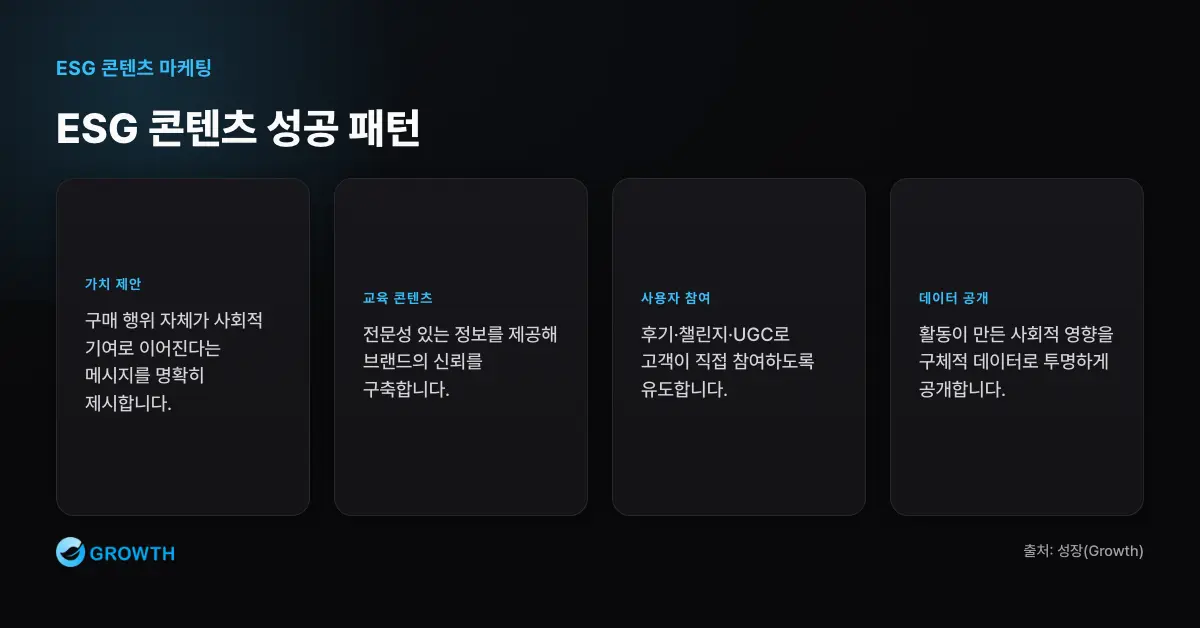
Building on that core value, designing a donation-linked campaign that naturally encourages consumer participation is a strategy that maximizes marketing impact. Donating a portion of sales revenue, or supporting a specific organization tied to a specific purchase, gives consumers a way to participate in creating social value through the act of buying.
The key here is transparently disclosing the donation process and honestly conveying the moving stories of beneficiaries, crafting ESG content compelling enough to earn genuine consumer empathy. Actively using visual elements like photos and video is what effectively conveys the emotion and builds a positive perception of the brand.
Finally, consistently sharing your campaign and its progress through the social channels your target audience actually uses, and drawing out voluntary consumer participation, are essential steps for spreading content and converting prospects.
Spreading an ESG message effectively requires a systematic viral strategy. See viral marketing starts and ends with planning for more detail.
Building Trust and Driving Engagement With Educational ESG Content
Producing useful information or expertise related to your company’s core field as educational content is a strategy that effectively communicates both your brand’s expertise and its ESG values at the same time.
Here, it’s important to naturally connect your product or service’s eco-friendliness or social responsibility efforts to the educational content, highlighting your brand’s differentiated value.
You should also design campaigns that encourage customers to actively participate and create content, expanding the brand experience and driving prospect engagement. Events like product review-sharing campaigns or challenges can strengthen your bond with customers and build a positive brand image.
Using image-centric platforms to produce high-quality visual ESG content, and sharing user-generated content, is a core strategy for maximizing content spread and appealing to prospects.
Compelling ESG Content Built Around a Social Message
Choose a social issue that connects naturally to your company’s business area or values, and weave it into your brand message to produce compelling ESG content that earns prospects’ empathy.
Developing a symbolic design or motif that effectively conveys your social message, and applying it across your products and content, is a good strategy for highlighting your brand’s distinctiveness.
Storytelling content that movingly conveys your company’s efforts to realize social value, the meaning embedded in your product, or the stories of beneficiaries can leave a lasting impression on prospects who value “conscious consumption.”
Ultimately, you need to run campaigns that let consumers participate in creating social value through their purchase, and package that as effective ESG content that achieves your marketing goals.
To connect your ESG message to consumers’ deeper psychological needs, see applying Maslow’s hierarchy of needs to marketing for ways to build genuine resonance.
Educational ESG Content That Shifts Perception and Drives Engagement
Building a business model that creates social value — using your company’s expertise to solve a social problem, or support a vulnerable population — can become a core source of competitive appeal for prospects.
From there, produce educational ESG content that clearly explains the severity of the social issue, potential solutions, and your company’s role, shifting prospects’ perception and building genuine resonance.
You’ll also need a diversified media-mix strategy — using text, images, video, and other formats — to spread your content and widen your points of contact with prospects.
Finally, measure the positive social impact of your activities with concrete data and disclose it transparently, building trust with prospects and giving them a clear rationale for using your service.
ESG Content Marketing: The First Step Toward Sustainable Growth
The successful ESG content marketing examples we’ve walked through, from companies both in Korea and abroad, make it clear that ESG has moved beyond simply being a corporate social responsibility obligation — it’s now a core strategy for sustainable growth. The UN Global Compact states plainly that “corporate sustainability starts with a company’s value system and a principles-based approach to doing business.” Turning authentic ESG activity into compelling content, communicating with consumers, strengthening brand partnerships, and building a positive corporate image all lay the groundwork for securing competitive advantage and long-term success.
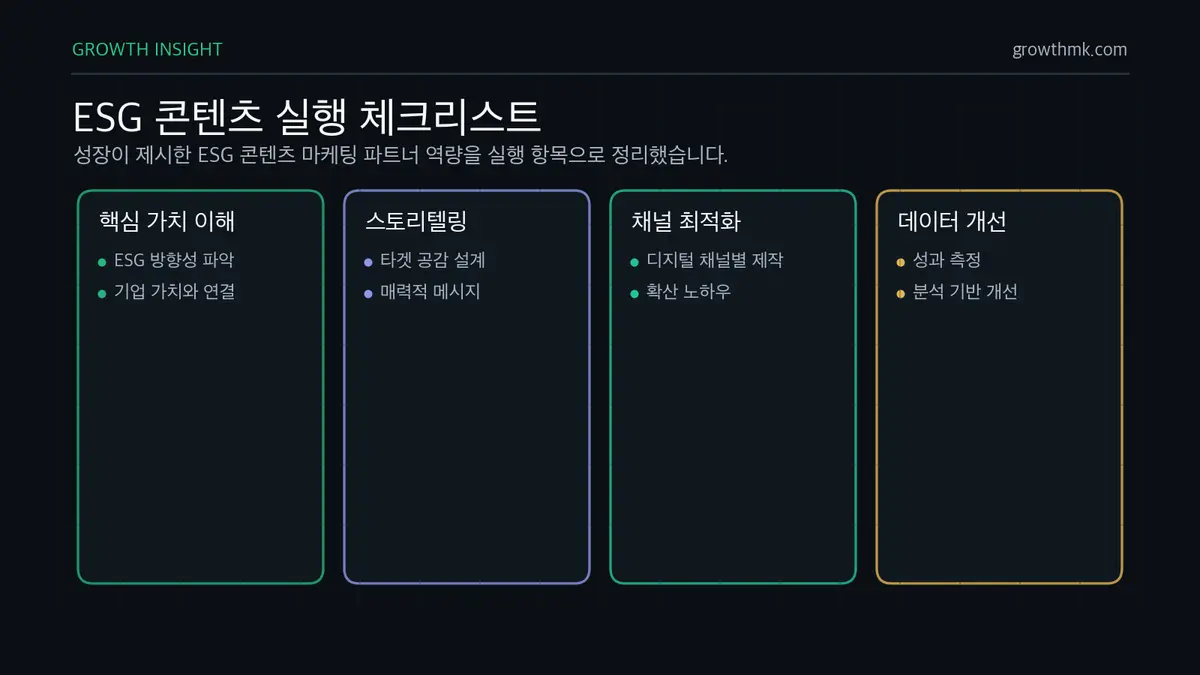
For small and mid-size companies especially, ESG content marketing can become an effective tool for creating differentiated value, leaving a lasting impression on prospects, and discovering new business opportunities.
Still feel like getting started with ESG content marketing is overwhelming? It’s understandable if you’re not sure where or how to begin. But while you hesitate and stay cautious about change, your competitors are already using ESG to secure new growth drivers and strengthen their bond with customers. Now is exactly the time to start with ESG content marketing.
If you’re finding it difficult to go from strategy to execution on ESG content marketing, partnering with a trusted marketing agency can be a smart choice. Growth focuses on more than just producing beautiful content — we center the following values to run ESG content marketing successfully:
- Accurately understanding your company’s core values and ESG direction,
- Building a compelling storytelling strategy that resonates with your target audience,
- Bringing the know-how to produce and spread content optimized for a range of digital channels, and
- Offering data-driven performance measurement and analysis to drive continuous improvement.
Growth is ready to be the reliable partner who brings exactly these capabilities to guide your ESG content marketing journey to success. Take the first step toward sustainable growth alongside Growth. We’ll do everything we can to help your story become content that moves the world.
Related Reading
- A Guide to Content Marketing, From Definition to Strategy
- What Is Earned Media?
- What Is Evergreen Content?
- A Guide to Brand Content Marketing
- Content Marketing Case Studies and the Latest 2025 Trends
If you’d like to apply this to your own business — you can see how Growth approaches it in our content marketing service, and if you need a specific diagnosis of your situation, reach out through contact us. We answer based on the one customer who becomes revenue, not the volume of traffic.
Frequently Asked Questions
Can small and mid-size companies really do ESG content marketing?
Yes. ESG content doesn’t have to be a grand or expensive undertaking. You can start by sincerely documenting and sharing small activities you’re genuinely doing — an office energy-saving campaign, community volunteering, adopting eco-friendly products. What matters isn’t scale, but authenticity and consistency.
What is greenwashing, and why is it risky?
According to the UN’s definition, greenwashing means misleading the public into believing a company is doing more to protect the environment than it actually is. Packaging appearances without real effort behind them deepens consumer distrust and erodes trust in genuine environmental activity, ultimately harming your company’s image.
How do you measure the effectiveness of ESG content marketing?
You need measurable metrics instead of an abstract goal like “improve our image.” Track things like visits to ESG-related pages, the number of ESG-related inquiries, and social media engagement rate, and consistently analyze performance after publishing content to identify what’s working and keep improving.
Does ESG activity actually translate into real business results?
Over the long term, yes. A joint study from NielsenIQ and McKinsey found a clear, substantive link between ESG-related messaging and consumer spending across a majority of categories. ESG content can contribute to sustainable growth in a range of ways — customer loyalty, attracting top talent, drawing investment, and more.