GEO’s Real Bottleneck Is Organizational: 3 Conditions for Enterprise GEO Execution
 임재복
임재복
This article is chapter 12/20 of Growth’s GEO Whitepaper series — Part IV, Sub-Pillar (WHO & WHEN). You can find the full table of contents and the complete PDF on the whitepaper page.
Answer-First: GEO isn’t a technology project — it’s an organizational one. According to BCG’s “The Widening AI Value Gap” (2025), which surveyed roughly 1,250 companies worldwide, only 5% of companies are generating real value from AI at scale, and the cause of this gap isn’t access to technology — it’s organizational structure and execution systems. This article covers the three conditions an organization needs to execute GEO, and the path from there to organizational design and a rollout roadmap.
The tools are there. So why does value only show up at 5%?
Most large enterprise marketing organizations are still run as channel-based silos. The SEO team tracks search rankings, the content team fills its monthly publishing quota, the PR team reports media impressions, and the IT team runs its own dev sprints. Each team’s KPIs point in a different direction, and a shared, company-wide goal like “AI visibility” isn’t built into any single team’s performance framework. For instance, if the content team refactors an existing article into an AI-optimized, question-based structure, that work doesn’t contribute to the “new publications” KPI — and the team may actually be penalized for it in performance reviews. In a structure like this, no matter how brilliant your GEO strategy is, it runs aground at the execution stage on conflicting team interests. Where the Generative Engine Optimization (GEO) Guide covers the full strategic picture, this article covers the organizational conditions that make that strategy actually work.
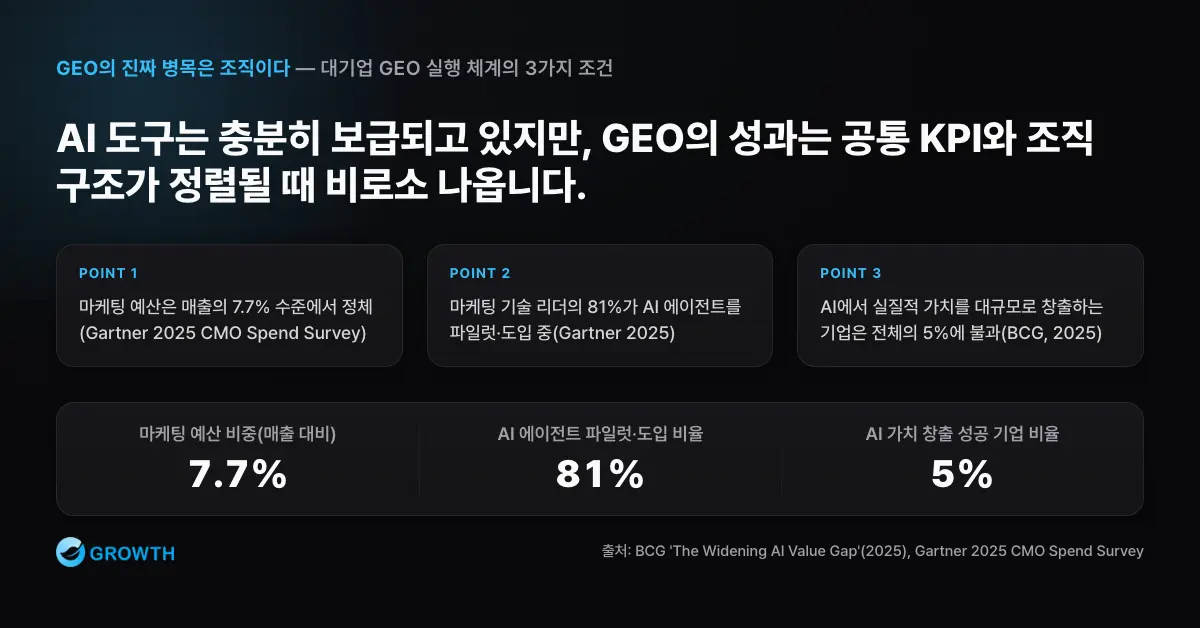
According to Gartner’s 2025 CMO Spend Survey, marketing budgets are stuck at around 7.7% of revenue, and that same year, Gartner’s marketing technology survey found that 81% of marketing technology leaders are already piloting or adopting AI agents. The tools are already there in abundance. ChatGPT, Perplexity, AI-visibility monitoring platforms, automated structured-data generators — technical access has never been lower a barrier. And yet only a tiny fraction of companies have an organizational structure capable of operating all these tools under a single, integrated strategy. This gap between tools and organization is precisely the root cause of what BCG calls the “Widening AI Value Gap.” The bottleneck for GEO isn’t technology — it’s organization.
The 3 conditions of Organizational Readiness
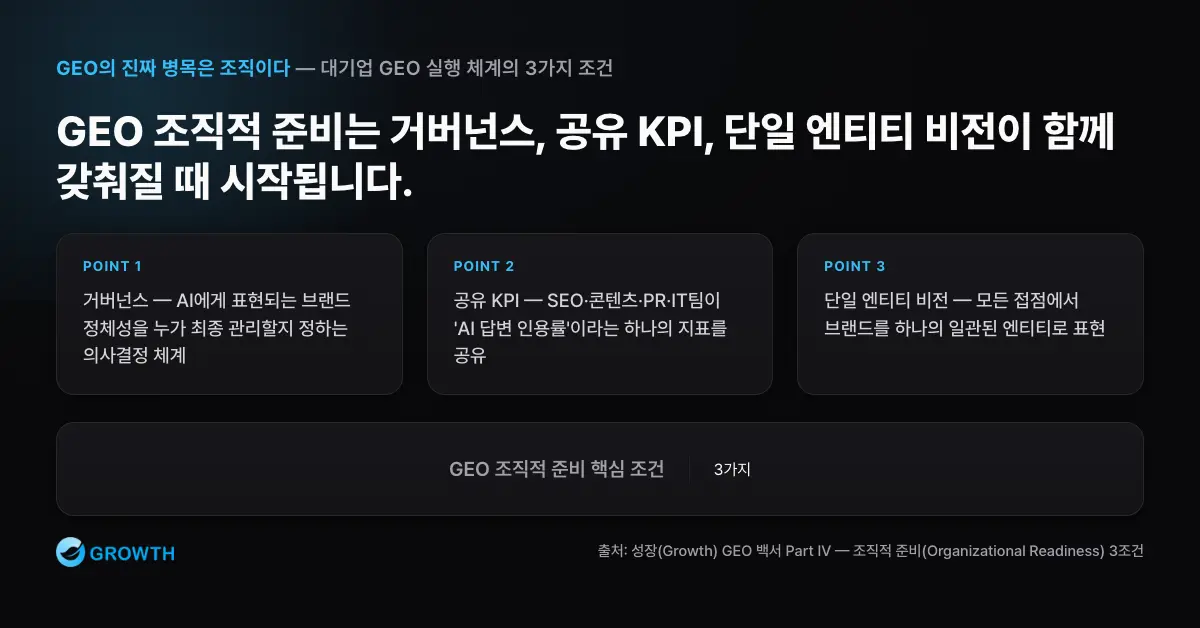
“Organizational Readiness” for GEO doesn’t simply mean designating an owner or hiring more headcount. There are three essentials. First, governance — who has final ownership of the brand identity that gets presented to AI, and what decision-making process do they follow? Second, shared KPIs — a structure where the SEO, content, PR, and IT teams all share a single north-star metric — “AI answer citation rate” — and are evaluated against it together. Third, a single-entity vision — a system that ensures the brand is represented as one consistent entity across every touchpoint, from blog posts and press releases to schema markup and social media profiles. Without these three elements in place, GEO degrades into “the marketing team’s side project,” and the brand signals AI collects remain fragmented.
If your organization can’t realistically build all three in the short term with internal resources alone, working with an external partner is also an option. The criteria and questions for vetting a partner are covered separately in the GEO Agency Selection Guide.
Why GEO Is Inherently a Cross-Functional Project
There’s a specific reason this problem is especially acute for GEO. In traditional SEO, the marketing team could absorb the whole workflow — researching keywords, optimizing meta tags, publishing content, and building backlinks — within a single team. GEO, by contrast, is inherently cross-functional. Technical GEO requires development capability for server configuration and schema markup; Contents GEO requires editorial capability to restructure content the way AI prefers; and Off-Page GEO requires communications capability to get the brand mentioned on external platforms. On top of all three axes, you also need someone managing the consistent brand message that ties them together — the “single entity identity” at the heart of Entity Authority. At minimum, four distinct areas of expertise have to move in sync at the same time.
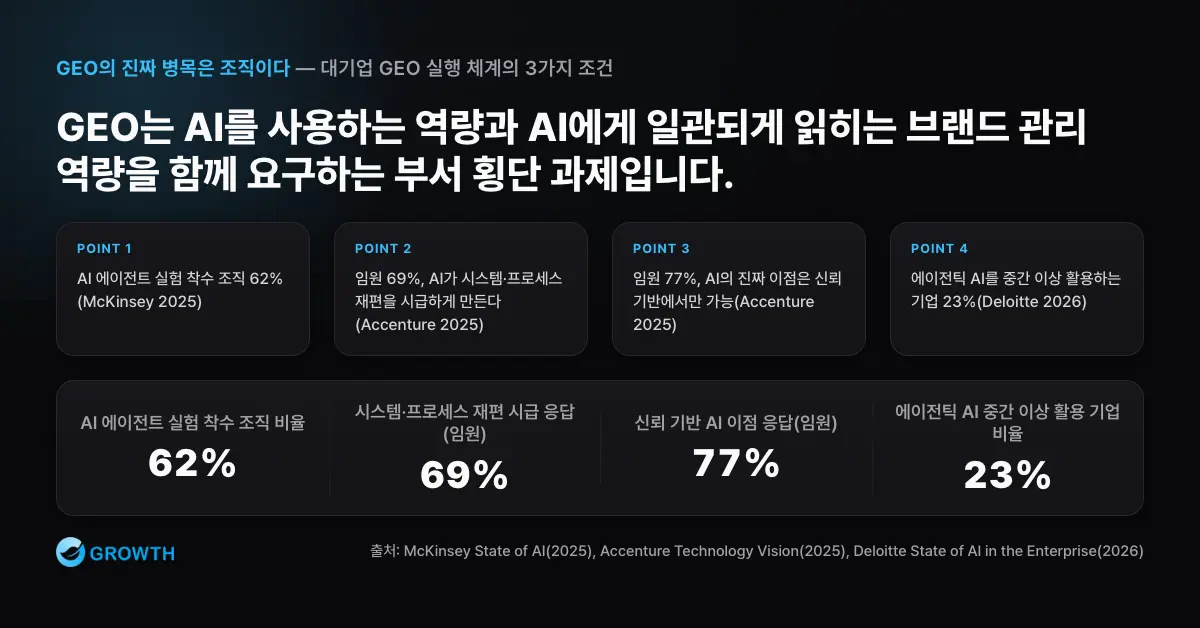
There’s an interesting asymmetry worth pointing out here. According to McKinsey’s State of AI 2025, 62% of organizations have already begun experimenting with AI agents. Most companies are working hard at “using” AI. But very few companies have a system in place to manage the quality and consistency of the brand data that these very AI agents are collecting about them. Being capable of using AI, and being capable of managing your brand information as the subject that AI uses — building both capabilities at the same time is the central task of organizational readiness. Enterprise technology investment keeps expanding, but that investment only produces real results when it translates into a shift in organizational structure, not just tool adoption.
Accenture’s Technology Vision 2025 lays this gap out even more starkly. 69% of executives say that AI’s adoption — faster than any technology before it — makes it urgent to redesign how technology systems and processes are designed, built, and operated, and 77% believe AI’s real benefits are only possible on a foundation of trust. Here, “a systematic approach built on trust” is fundamentally a question of organizational structure. Who manages the consistency of the brand message conveyed to AI? Who resolves conflicting priorities between departments? Which team’s performance framework does this new “AI visibility” KPI belong to? Without answering these questions, GEO degrades into a project that is “everyone’s concern but no one’s responsibility.” Deloitte’s State of AI in the Enterprise 2026 survey found something similar: while roughly 60% of employees have been given access to approved AI tools, only 23% of companies use agentic AI at a moderate level or above. That gap is exactly the state of “having the tools but not the organization.”
The First Step Isn’t Technology — It’s Organizational Alignment
Ultimately, GEO’s organizational challenge converges on one thing: Entity Authority — the brand identity as AI perceives it — must be managed consistently across the entire organization. The content team’s blog posts, the IT team’s schema markup, the communications team’s press releases — the brand has to be expressed with the same core message across every one of these touchpoints. If even one is out of sync, AI collects contradictory information, and Entity Authority shatters. And because the AI search market moves far faster than traditional SEO ever did, an agile organizational structure with a short decision-and-execution cycle is essential.
This is especially true for large enterprises, where the sheer scale of already-accumulated digital assets compounds the complexity of any GEO transition. Thousands of web pages, hundreds of press releases, and profile information scattered across various social channels were often written by different teams at different points in time, which means entity information is frequently already inconsistent. Starting GEO in this state means AI collects fragmented information, which can actually produce worse AI visibility results than your competitors get. That’s why the first step in executing GEO isn’t technology — it’s organizational alignment.
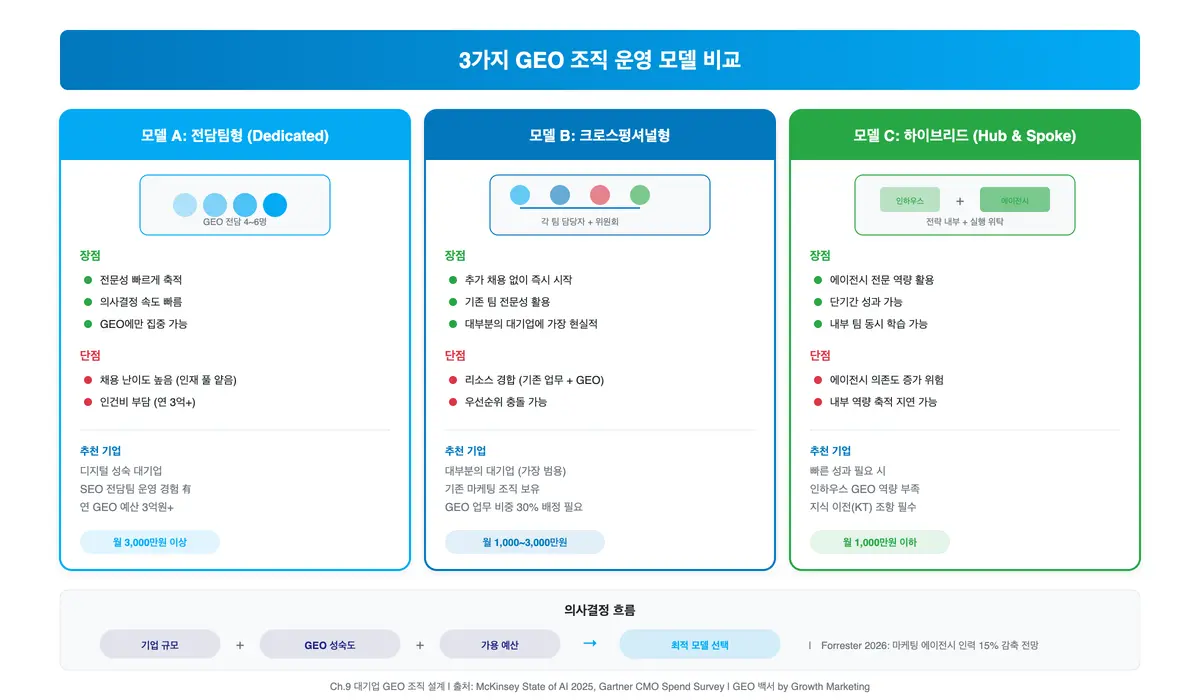
Two key questions remain to solve this challenge. First, “who” should execute GEO — answered in GEO Organizational Design: A 4-Team Collaboration Model and RACI. Second, “when” to start and in what order to proceed — covered in the 90-Day GEO Rollout Roadmap. No matter how sophisticated the strategy, if the organization to execute it isn’t ready, it’s nothing more than a diagram on a slide.
Curious how your brand currently shows up in AI answers? Request an AI Answer Share diagnostic. You can also download the full GEO Whitepaper PDF.
Frequently Asked Questions
What’s the most common reason GEO adoption fails?
It’s organizational, not technical. In a silo structure where SEO, content, PR, and IT teams’ KPIs each point in a different direction, a shared goal like AI visibility isn’t built into any team’s performance framework — so the strategy runs aground on conflicting interests at the execution stage.
What does organizational readiness for GEO actually mean in practice?
Three things: governance that gives final ownership of the brand identity presented to AI to someone; shared KPIs where all four teams are evaluated against one north-star metric — AI answer citation rate; and a single-entity vision that represents the brand as one consistent entity across every touchpoint.
Which department should own GEO?
It’s not a single department’s project. Technical GEO requires development skills, Contents GEO requires editorial skills, and Off-Page GEO requires communications skills — and on top of that, managing entity identity means at least four areas of expertise have to move in sync. The concrete collaboration model and division of roles are covered in the GEO organizational design article.
What’s the very first thing a large enterprise should do before starting GEO?
Organizational alignment. You first need to audit and unify the consistency of entity information scattered across thousands of web pages, press releases, and social profiles. Starting GEO on top of fragmented information means AI collects contradictory signals — which can actually produce a worse outcome than doing nothing.
GEO Whitepaper series: ← Previous chapter · Full table of contents · Next chapter →