
The GEO 90-Day Roadmap — When and In What Order to Start
 임재복
임재복
This article is chapter 14 of 20 — Ch.10 Timing and the 90-Day Roadmap — in Growth’s GEO whitepaper series. You can find the full table of contents and the complete PDF on the whitepaper page.
The answer to “when should we start GEO (generative engine optimization)?” is “now.” That’s because of the Matthew effect: brands that get included in AI’s default answers early enjoy a compounding advantage. This article lays out the entire adoption journey for decision-makers evaluating GEO — a 20-item readiness assessment, a 90-day roadmap running from diagnosis through Technical, then Content and off-page, then monitoring, and finally the change management needed to handle organizational resistance.
Why “now” — the competitive dynamics of first-mover advantage
The answer to when to start GEO is uncomfortably simple: now. This isn’t marketing rhetoric — it’s a judgment grounded in the structural logic of competitive dynamics. AI’s knowledge base forms based on the data it’s currently collecting, and brand information AI learns early tends to become locked in as the “default” for future answers. Research by Algaba et al., published at NAACL 2025 (Findings), showed that LLMs amplify a “Matthew effect,” citing sources that are already cited frequently even more often. A brand that’s once included in AI’s default answer keeps getting cited, while a brand entering late needs many times the effort to overturn that default.
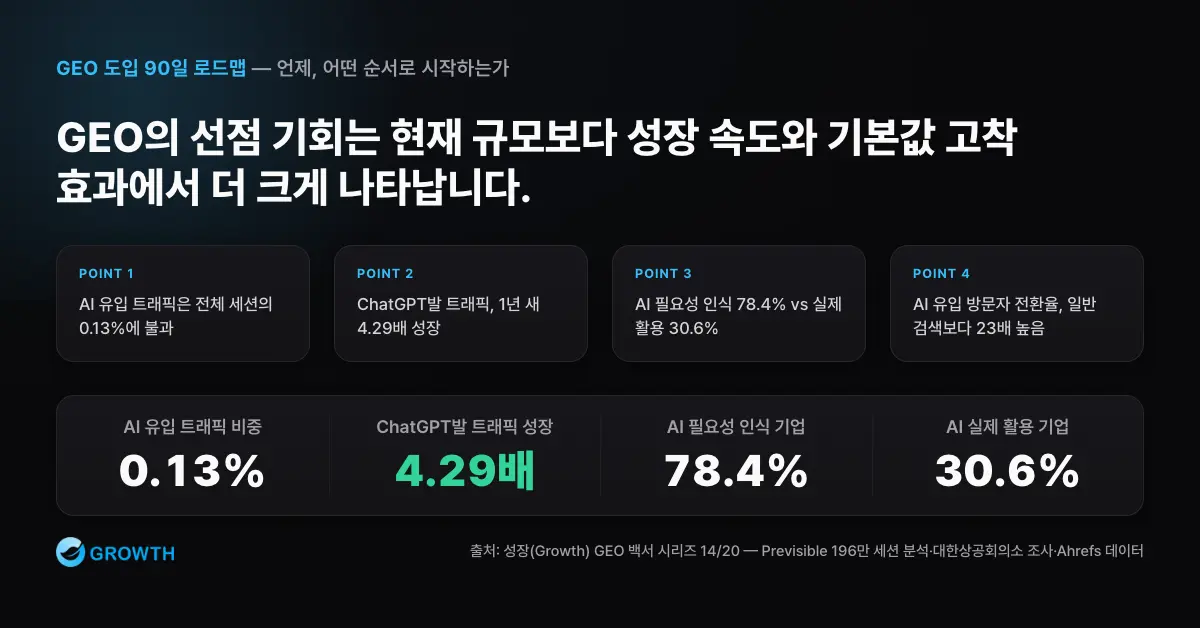
The numbers make this even clearer. According to Previsible’s analysis of 1.96 million LLM sessions, AI-driven traffic is still only 0.13% of total sessions, but traffic from ChatGPT alone grew 4.29x in a single year. That means the overall pie is small right now, but its growth curve is steep. Getting included in AI’s default answers at this point, versus trying to enter late after the pie has grown, are completely different games. In a survey by the Korea Chamber of Commerce and Industry, 78.4% of companies recognize the need for AI, but only 30.6% are actually using it — and that 48-point gap is exactly the size of the first-mover opportunity. And that window keeps narrowing.
We cover this in more depth in measuring GEO ROI, but visitors who arrive through AI already have high intent, so their conversion rate is far higher than from general search. In Ahrefs’ own data, that gap reached as much as 23x. First-movers capture this high-intent traffic early, while later entrants have to invest far more to earn the same traffic.
The GEO readiness assessment — a 20-item checklist
Once you accept that you need to start now, the next question is “where do we start?” You can’t do everything at once, so the first step is accurately diagnosing your current state. The 20-item checklist below condenses the GEO whitepaper’s framework into four areas, each checking a different foundation of GEO.

Technical foundation (5 items): This area checks whether AI “can read” your site. It confirms whether an llms.txt file exists and is current, whether Schema.org structured data is applied to your key pages, whether your access policy for AI crawlers (GPTBot, PerplexityBot, etc.) is deliberately configured, whether your site structure has a clear hierarchy, and whether your site performance — Core Web Vitals and the like — is solid. The Technical foundation is a prerequisite for every other GEO activity; if this area scores low, AI may not be able to collect your content no matter how well you execute everything else.
Content foundation (5 items): This area checks whether your content is “in a form AI can cite.” It looks at whether your core content uses question-style headers, whether you apply an Answer-First format, whether statistics, data, and sources are naturally woven into the body copy, whether sources and expert information are clearly credited, and whether your key pages include an FAQ section. Studies analyzing content that gets cited by AI repeatedly confirm that question-style headers and short, concise paragraph structure are common patterns in cited content.
Off-page foundation (5 items): This area checks “how your brand is perceived by AI from the outside.” It confirms whether your brand information is registered on knowledge platforms like Wikipedia, whether your Google Business Profile and reviews are actively managed, whether brand mentions exist on AI training sources like Reddit and communities, whether you’re earning brand mentions in authoritative media, and whether multimodal content like YouTube videos exists.
Measurement foundation (5 items): The final area checks “whether you have a system to measure GEO performance.” It looks at whether you’re separately tracking AI referral traffic in GA4, whether you’re using an AI visibility (Share of Answer) measurement tool, whether you’re running a “how did you hear about us” (HDYHAU) survey, whether a dashboard exists for reporting GEO performance to leadership, and whether GEO KPIs are integrated into your company-wide marketing KPIs. We cover AI citation tracking tools and specific setup methods separately in our GEO measurement guide. You can self-assess with 5 points per item, for a maximum of 100. A score of 60 or above means you can start straight from Phase 2, while a score under 40 means you should allocate ample time to Phase 1’s diagnosis and foundation-building.
The 90-day roadmap — a systematic entry journey
The first 90 days of starting GEO are like the first 5 kilometers of a marathon — the stretch where you find your pace, steady your breathing, and build the stamina and rhythm you’ll need for the remaining 35 kilometers. Resist the temptation to do everything at once, and build your foundation in stages.
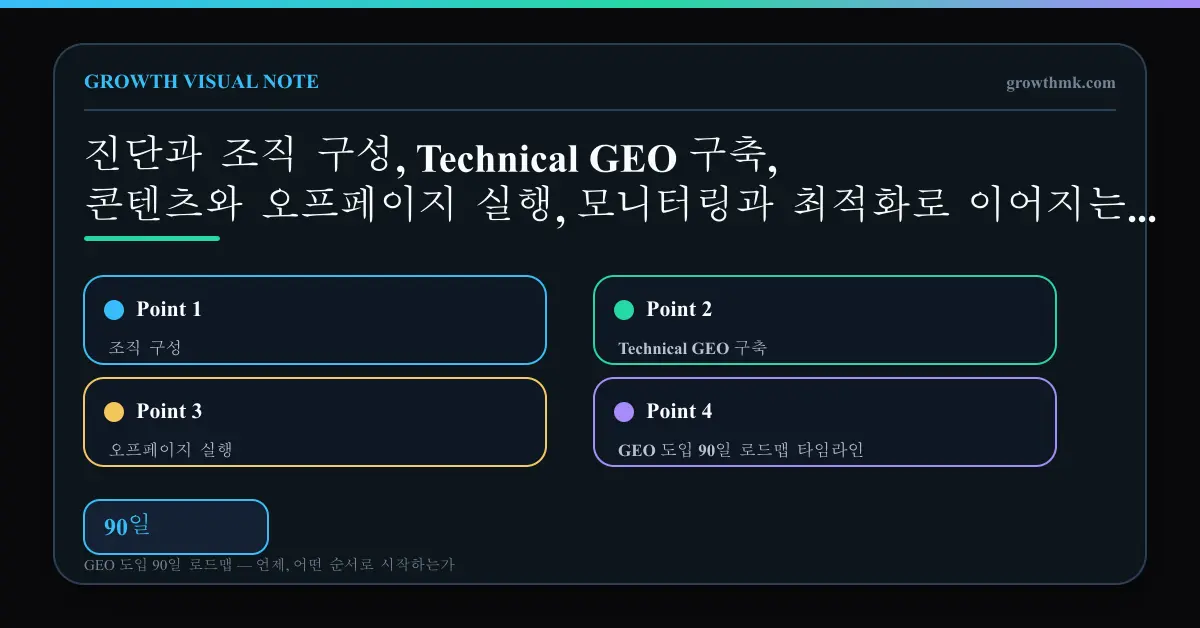
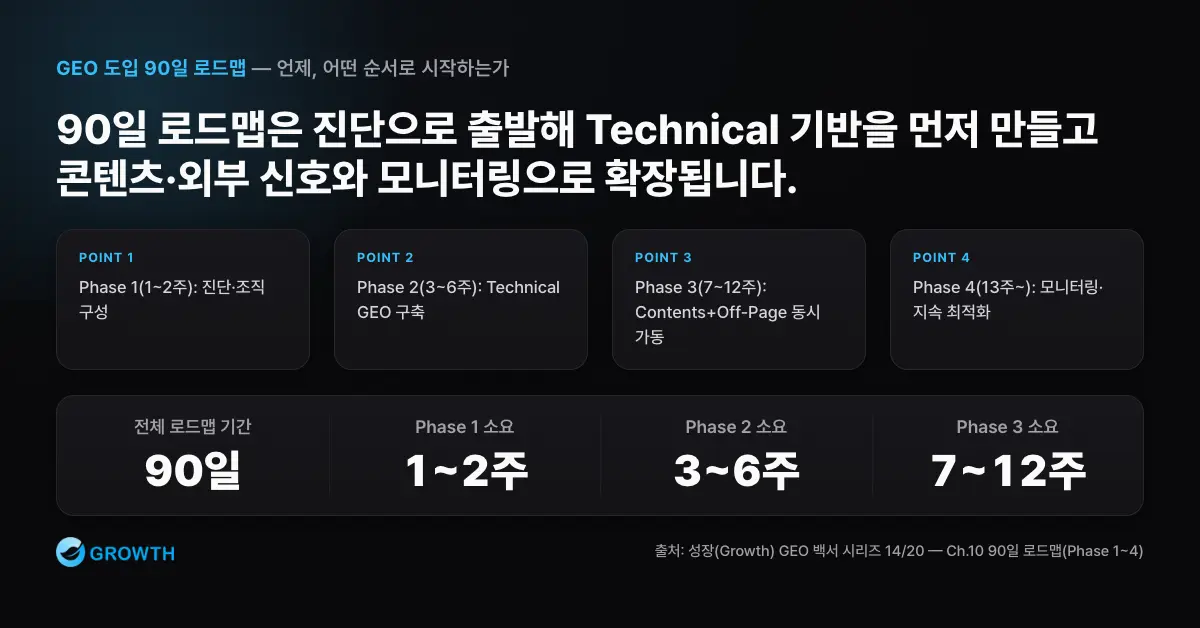
Phase 1 (weeks 1–2): Diagnosis and organizational setup. The very first thing to do is understand how AI currently perceives your brand. Ask ChatGPT, Perplexity, Gemini, and Naver AI 20–30 core questions relevant to your industry, and record whether your brand gets cited and how competitors are mentioned. At the same time, choose one of the organizational models discussed in designing your GEO organization and designate a GEO owner on each team. Hold your steering committee’s first meeting to agree on the 90-day goal and milestones for each phase. These two weeks are the “crouch before the leap.”
Phase 2 (weeks 3–6): Build Technical GEO. This stage is led by the IT team. Create an llms.txt file to guide AI to your site’s core content, apply Schema.org markup to key pages, and deliberately configure your AI crawler policy in robots.txt. There’s a reason this stage needs to come before Content GEO: no matter how good your content is, it means nothing if AI can’t collect it. Think of the Technical foundation as GEO’s “road,” and content as the “vehicle” that drives on it. You can’t drive a car without a road.
Phase 3 (weeks 7–12): Run Content and Off-Page simultaneously. This is the core execution stage, led by the content and PR teams. Refactor existing content with the highest AI citation potential through a GEO lens first, and plan new content with GEO structure from the outset. At the same time, PR starts systematically earning brand mentions on external platforms. What matters most at this stage is quality over quantity — producing 5 pieces of AI-citable content contributes far more to GEO performance than publishing 20 mediocre pieces a month. Specific content and technical execution tactics are laid out in our AI search optimization execution guide.
Phase 4 (week 13 onward): Monitoring and continuous optimization. This is the ongoing operations stage, overseen by the brand marketing team. Start separately tracking AI referral traffic in GA4, and check changes in Share of Answer weekly through an AI visibility monitoring tool. In your monthly report, analyze “which content got cited by AI” and “how we stack up against competitors,” and feed that into next month’s content and off-page strategy. GEO isn’t a project you set up once and finish — like SEO, it requires a continuous optimization cycle.
| Phase | Duration | Lead team | Core activities | Output |
|---|---|---|---|---|
| 1. Diagnosis | Weeks 1–2 | Brand marketing | Assess current AI visibility, competitive analysis, organizational setup | Current-state report, org design |
| 2. Technical | Weeks 3–6 | IT/Engineering | llms.txt, schema, crawler configuration | Technical GEO infrastructure |
| 3. Content + Off-Page | Weeks 7–12 | Content + PR | Content refactoring, new production, earning mentions | GEO-optimized content, mention report |
| 4. Monitoring | Week 13+ | Brand marketing | Performance tracking, dashboard, continuous optimization | Monthly GEO report |
How to convert your existing SEO assets into GEO assets
Most companies already hold substantial SEO assets. Recycling those assets through a GEO lens is the most efficient starting point. The conversion process runs through four stages.
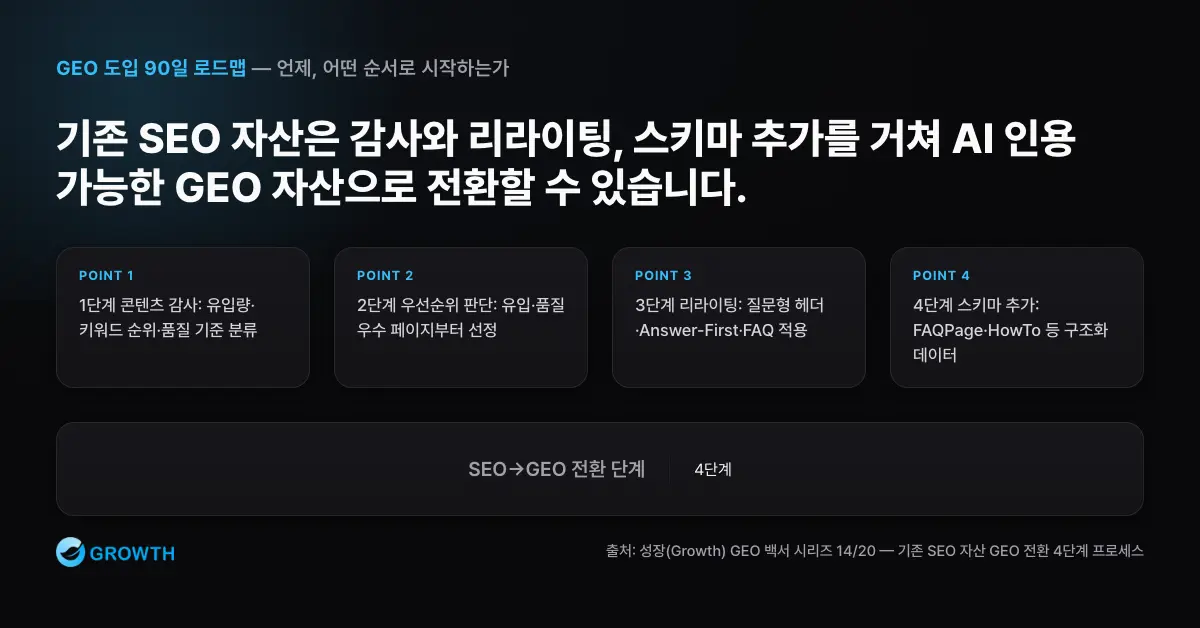
First, content audit. Review your existing content in full and classify it by search traffic, keyword rankings, and content quality. Second, GEO priority assessment. From the audit results, select pages with high search traffic and solid content quality as your top-priority refactoring targets. These pages already have proven value in the eyes of search engines, so applying GEO structure to them has the highest probability of AI citation. Third, rewriting. Apply Content GEO strategy to selected content — question-style headers, an Answer-First format, inserting statistics and sources, and adding FAQ sections. Fourth, adding schema. Add appropriate structured data — FAQPage, HowTo, Article, and so on — to the rewritten content.
As the AI-driven conversion data above suggests, investing in converting existing SEO content into GEO can have a higher ROI than producing new content. Turning already-proven content into a form AI can cite is more efficient in time and cost than building new content from scratch.
Change management — handling organizational resistance to GEO
Every change meets resistance, and the shift to GEO is no exception. The most common resistance comes from the existing SEO team: “Is SEO being replaced by GEO? What happens to our role, then?” That anxiety is entirely understandable and needs to be addressed with empathy. The core message is simple: GEO doesn’t replace SEO — it extends it. The keyword analysis, content optimization, and technical optimization capabilities built up in SEO are exactly what GEO needs too. What changes is simply that those capabilities now apply to AI systems as well as search engine crawlers.
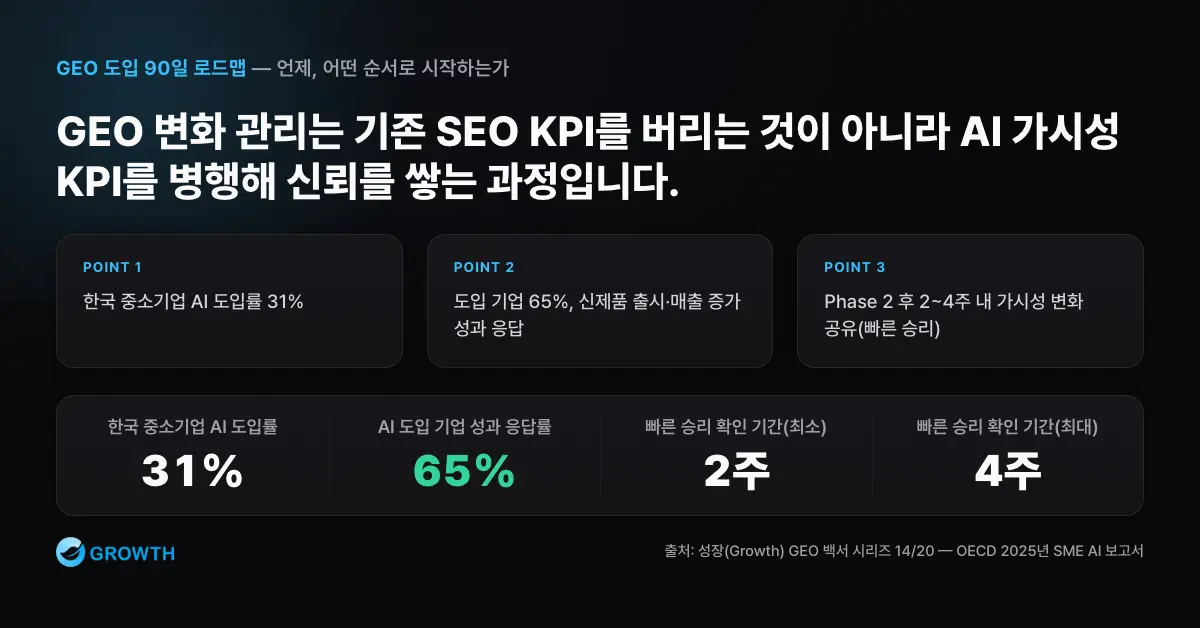
Your leadership reporting cadence also needs a gradual transition. Abruptly dropping existing SEO KPIs (keyword rank, organic traffic, conversion rate) to report only AI visibility KPIs will confuse and erode leadership’s trust. The recommended approach is “parallel reporting” — reporting AI visibility metrics alongside your existing SEO performance metrics, and gradually increasing the weight of AI visibility metrics each quarter. According to the OECD’s 2025 SME AI report, 31% of Korean SMEs have adopted AI, and 65% of adopters say generative AI helped them launch new products or grow revenue. GEO will likely follow the same trajectory, and once results become visible, organizational resistance naturally fades.
The most effective tool in change management is the “quick win.” After deploying llms.txt and applying schema markup in Phase 2, sharing metrics showing AI visibility shifting within 2–4 weeks raises interest and motivation across the organization. The gap between “we should do this in theory” and “this is actually changing” makes an incomparable difference in the force that actually moves an organization.
Key Takeaway
- The Matthew effect: brands included in AI’s default answers early enjoy a compounding advantage, while the cost of entering late multiplies
- The 90-day roadmap: diagnosis (weeks 1–2) → Technical (weeks 3–6) → Content + Off-Page (weeks 7–12) → monitoring (week 13+)
- Don’t discard your existing SEO assets — convert them to GEO: audit → prioritize → rewrite → add schema
- Use “quick wins” to build organizational interest and motivation, and report existing SEO KPIs alongside AI visibility KPIs in parallel
If you’re curious how your brand currently shows up in AI answers, get in touch about an AI answer share diagnosis. You can also request the full GEO whitepaper PDF.
Frequently asked questions (FAQ)
When is the best time to start GEO?
Given the competitive dynamics, the answer is “now.” Brands included early in AI’s default answers enjoy a compounding advantage (the Matthew effect), and the cost of overturning that default grows the later you enter. AI-driven traffic is still small, at about 0.13% of the total, but its growth curve is steep — traffic from ChatGPT alone grew 4.29x in a single year.
What results can I expect within 90 days?
90 days isn’t about completing results — it’s about building the foundation and confirming your first signals. You can see “quick win” metrics like shifts in AI visibility within 2–4 weeks of deploying llms.txt and schema, while the full impact of content and off-page work accumulates from Phase 3 onward.
Do I need to discard my existing SEO content?
No. Converting existing content that’s already proven in search traffic and quality — through audit, prioritization, rewriting, and adding schema — is a more efficient starting point than producing new content from scratch.
What score on the readiness assessment means I can start?
With 20 items worth 5 points each, for a maximum of 100, a score of 60 or above means you can go straight into Technical build-out (Phase 2). Below 40, it’s safer to allocate ample time to Phase 1’s diagnosis and foundation-building.
How should I handle resistance from the SEO team?
Make it clear that GEO extends SEO rather than replacing it, and use a gradual transition — reporting existing SEO KPIs alongside AI visibility KPIs and adjusting the weighting each quarter. Sharing quick-win metrics is the single most persuasive tool you have.
GEO whitepaper series: ← Previous chapter · Full table of contents · Next chapter →