GEO’s Battlefield Isn’t Your Own Site: On-Site, Off-Site, Cross-Platform
 임재복
임재복
This article is chapter 15/20 of Growth’s GEO Whitepaper series — Part V, Sub-Pillar (WHERE). You can find the full table of contents and the complete PDF on the whitepaper page.
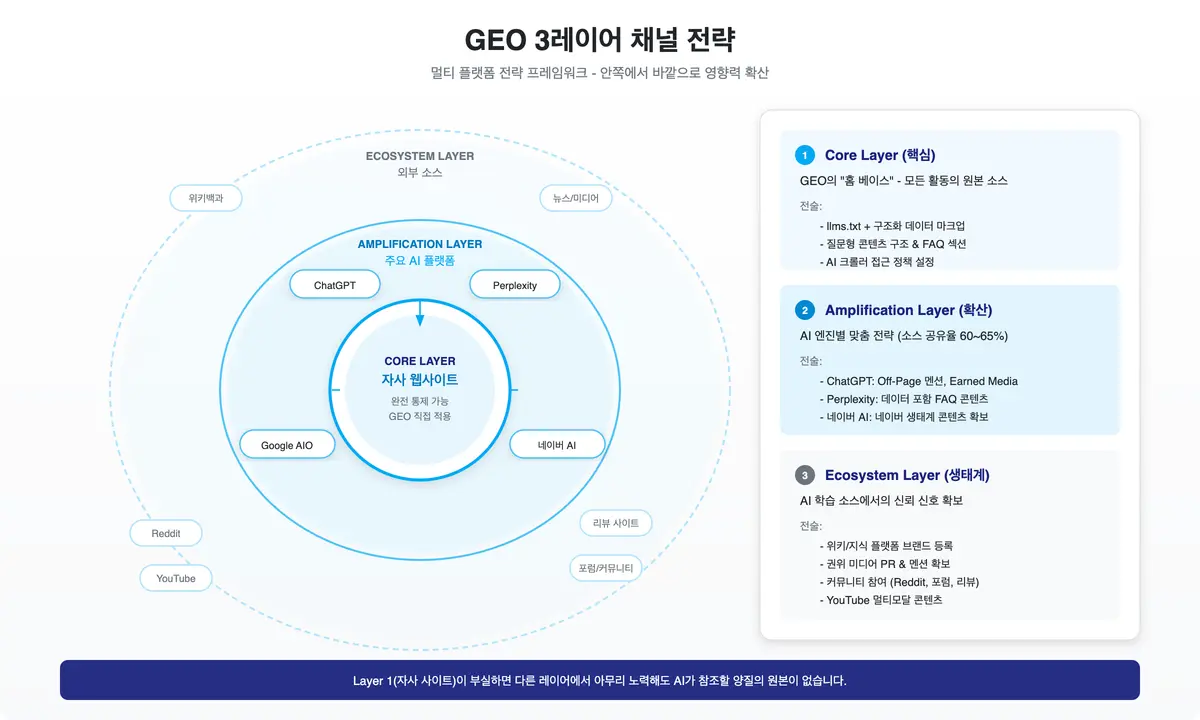
Answer-First: GEO’s battlefield extends beyond your own website to everywhere AI learns from. According to SearchAtlas’s analysis of 5.5 million AI answers, questions where all three AI engines cited even one common source made up only 60–65% of the total — in the remaining 35–40%, each engine referenced a completely different set of sources. Simultaneous coverage of three layers — your own site (On-Site), external platforms (Off-Site), and per-engine strategy (Cross-Platform) — is essential.
The 3 layers — the flagship store, the department-store counter, and the customer’s neighborhood
To make GEO’s (Generative Engine Optimization) three layers intuitive, it helps to compare them to offline retail. If your own website is the flagship store, external platforms are your counter inside a department store, and AI engines are the neighborhood where customers actually shop. No matter how beautifully you decorate the flagship store, without a department-store counter you lose your touchpoint in high-foot-traffic areas — and if you never enter the customer’s neighborhood at all, you never even register as existing. Layer 1 (On-Site) is the home base where you manage your brand’s original information; Layer 2 (Off-Site) is your presence on external platforms — Reddit, YouTube, industry media, Wikipedia — that AI treats as “third-party verification”; and Layer 3 (Cross-Platform) is the set of individual battlefields where each AI engine — ChatGPT, Perplexity, Google AIO, Naver’s AI Briefing — operates by its own distinct rules. Only when you manage all three layers at once does AI come to perceive your brand as “a trustworthy entity, consistently confirmed across multiple independent sources.”
Most companies are still stuck at Layer 1
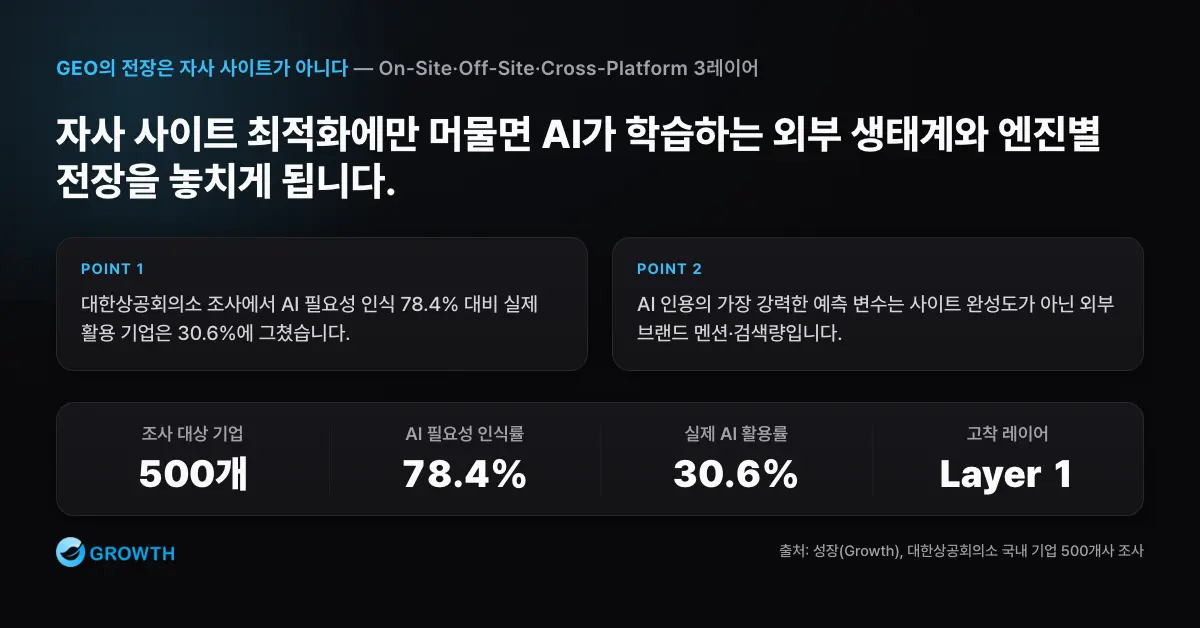
Unfortunately, most Korean companies are still concentrating all their resources on Layer 1 — optimizing their own website. In a survey of 500 domestic companies by the Korea Chamber of Commerce and Industry, 78.4% recognized the need for AI, but only 30.6% actually used it — and in the same way, companies work hard on the technical optimization of their own sites but pay too little attention to how their brand is represented across the external ecosystem, or which external sources AI is actually learning about their brand from. But as we confirmed in the Entity Authority and Off-Page GEO chapters, the single strongest predictor of AI citation isn’t your own site’s technical polish — it’s “brand mentions and search volume,” i.e., how much you’re mentioned and searched elsewhere. Clinging to Layer 1 while ignoring Layers 2 and 3 is like remodeling only your flagship store and wondering why customers aren’t coming in.
The Korean market — three independent AI search battlefields
The Korean market makes this three-layer strategy especially complex. Because Naver blocks major AI crawlers like GPTBot and PerplexityBot outright, content assets built within Naver’s ecosystem are invisible to ChatGPT or Perplexity. Conversely, content optimized for the Google index may not get used by Naver’s AI Briefing. Add in the domestic spread of Google AIO, and Korean marketers effectively have to manage three independent AI search battlefields at once. The era when a single platform’s optimization could cover everything is over — the strategic judgment of choosing “where (WHERE)” to fight and allocating resources accordingly determines half of your GEO performance. The practical mechanics of how each AI crawler behaves and how to configure allow/block settings are covered separately in the AI Crawler robots.txt Guide.
Each engine cites different sources — 35–40% are completely separate battlefields
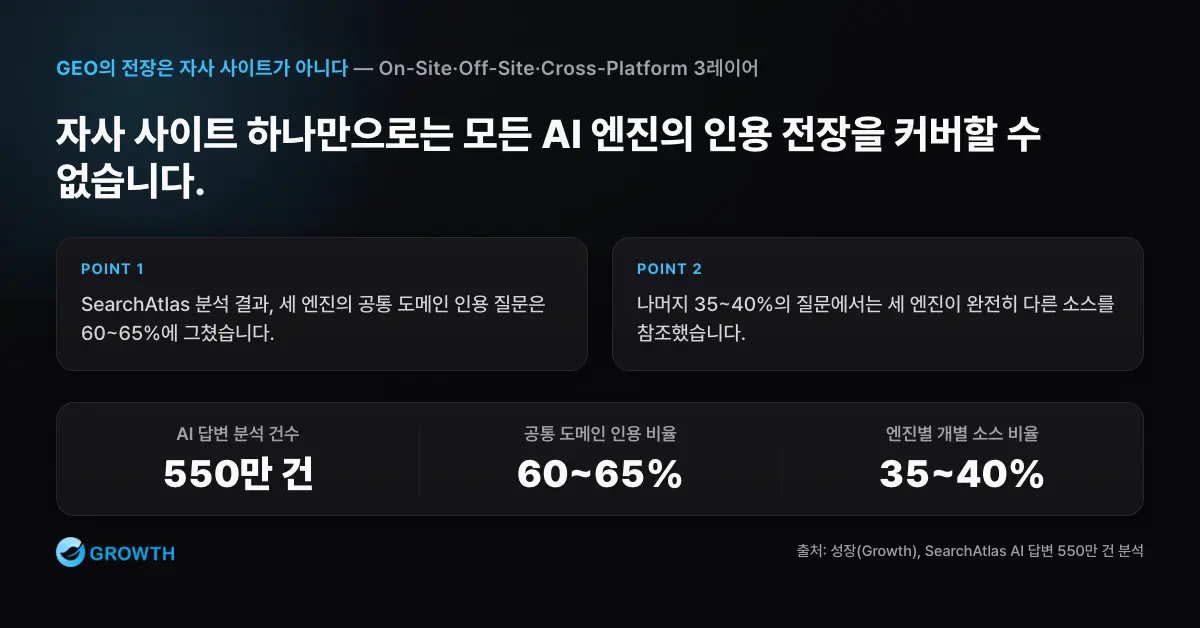
When people discuss GEO, many think only of optimizing their own website. That’s certainly the core foundation of GEO, but the sources AI actually references when generating an answer aren’t limited to your own site. SearchAtlas’s analysis of 5.5 million AI answers found that questions where all three engines (OpenAI, Gemini, Perplexity) cited even one common domain made up only 60–65% of the total — and in the remaining 35–40%, all three engines referenced completely different sets of sources.
In the AI search era, multiple engines operate simultaneously — ChatGPT, Perplexity, Google AI Overview (AIO), Gemini, Claude, and Naver’s AI Briefing. Each engine runs a different crawler, favors different sources, and shows different citation patterns. As confirmed in Chen et al.’s (2025) GEO research, differentiating strategy by engine and by language in AI search is an essential and urgent task.
GEO’s battlefield isn’t singular — it’s plural, and each battlefield plays by different rules. Fortifying your own site as your “home base” is table stakes, but you also need activity at your “forward outposts” on external platforms and adaptation on the individual “combat fronts” of each AI engine. Digital Bloom’s large-scale citation aggregation analysis, covered earlier in the Entity Authority chapter, found off-site signals — brand mentions and brand search volume — to be the strongest predictor group for AI citation, which quantifies just how much your presence outside your own site matters.
Users are already cross-using multiple AI engines
Opensurvey’s 2026 AI Search Trend Report gives a concrete picture of how Korean users search with AI. As of December 2025, ChatGPT usage was the highest among AI engines at 54.5%, and notably, the share of users who — when they don’t get the answer they want — switch to a different generative AI rather than falling back to standard search has climbed to 30.0%. Because users cross-use multiple AI engines to verify information, optimizing for a single AI engine alone isn’t enough. It’s becoming routine behavior to re-verify a brand recommended by ChatGPT on Perplexity, and then finally confirm Korean-language reviews on Naver.
The “time” dimension also matters for understanding GEO’s battlefield. Different AI engines update their data on different cycles. Perplexity and ChatGPT, which support real-time web search, reflect relatively current information, but engines that rely mainly on training data can take weeks to months to incorporate new information. On real-time search engines, breaking-news content has an immediate effect; on training-data-based engines, authority accumulated over the long term wields greater power. A channel strategy that accounts for this time dimension too is what genuine multi-platform GEO looks like.
Resource allocation — where should you fight?
What this triple structure means is clear: if a global company applies a GEO strategy optimized for English-language AI engines directly to the Korean market as-is, it misses the massive battlefield that is Naver’s AI Briefing — and conversely, focusing only on Naver means losing visibility on global AI engines. GEO in the Korean market requires an integrated strategy that covers all three search ecosystems simultaneously, which ultimately comes down to a question of channel selection and resource allocation: “where should we do the work?”
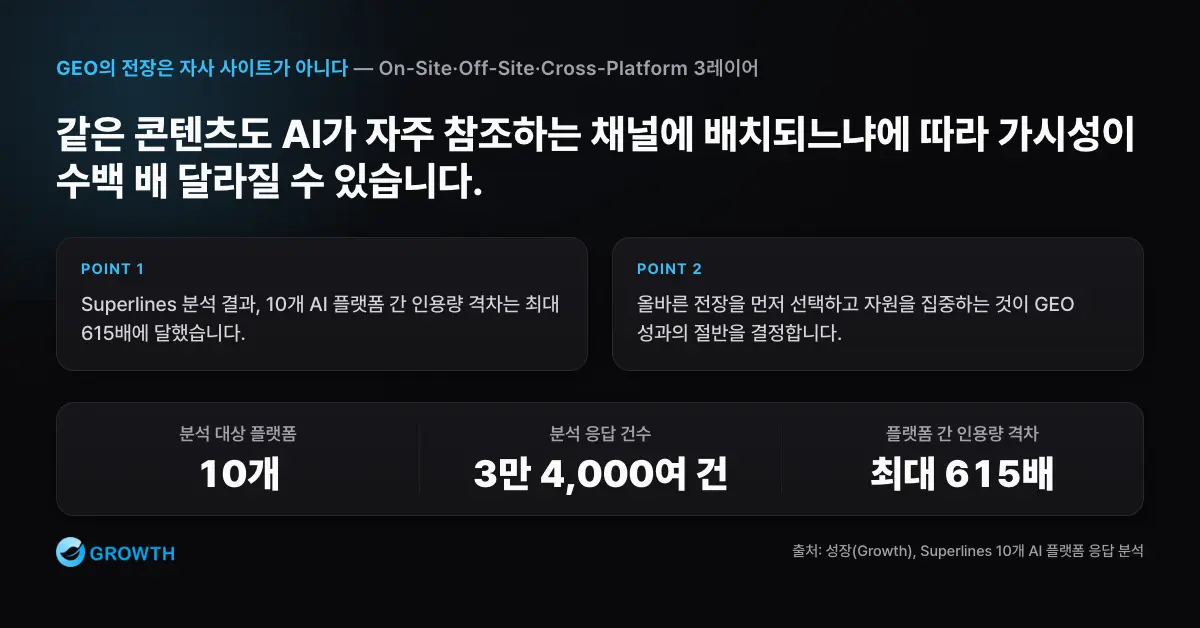
The numbers make clear just how much channel choice determines outcomes. Superlines’ analysis of roughly 34,000 responses across 10 AI platforms found citation volume varying by up to 615x between platforms. That means even identical content, produced at identical quality, can see its AI visibility differ by hundreds of times depending on whether it’s placed on channels AI engines actually reference frequently. Choosing the right battlefield first and concentrating resources there determines half of your GEO performance. Part V of the GEO Whitepaper moves beyond “what to do (HOW)” to focus on the final piece of the execution puzzle — “where is it most effective to do it (WHERE)” — and the detailed comparison of citation patterns by engine and channel-priority allocation is covered concretely in the next chapter, Multi-Platform GEO Strategy.
Curious how your brand currently shows up in AI answers? Request an AI Answer Share diagnostic. You can also download the full GEO Whitepaper PDF.
Frequently Asked Questions
What are GEO’s three layers?
Your own website (On-Site), external platforms AI treats as third-party verification (Off-Site), and the individual battlefields of engines like ChatGPT, Perplexity, Google AIO, and Naver’s AI Briefing (Cross-Platform). Like a flagship store, a department-store counter, and the customer’s neighborhood, AI only perceives your brand as a consistent entity when you manage all three at once.
Why isn’t optimizing your own site enough?
Large-scale citation analyses have found that the strongest predictor of AI citation isn’t your site’s technical polish — it’s external signals like brand mentions and search volume. On top of that, the sources each engine cites for the same question vary enormously, so your own site alone can’t cover every battlefield.
Which battlefield should Korean-market companies address first?
Given the triple structure of Naver, Google, and global AI engines, you need to prioritize based on which engine your actual customers are asking questions on. Because Naver is a closed ecosystem that blocks external AI crawlers, it requires a separate track — the detailed, engine-by-engine response is covered in the Multi-Platform GEO Strategy chapter.
What does the 615x gap in citation volume between platforms mean?
It’s the finding from Superlines’ analysis showing that, even for the same brand over the same period, citation volume can vary by up to 615x depending on the AI platform. It means channel selection and resource allocation drive GEO performance just as much as content quality does.
GEO Whitepaper series: ← Previous chapter · Full table of contents · Next chapter →