Multi-Platform GEO Strategy — Optimizing for ChatGPT, Perplexity, Google AIO, and Naver’s AI Engine
 임재복
임재복
This article is Chapter 11, part 16 of 20, in Growth’s GEO whitepaper series — our multi-platform strategy chapter. You can find the full table of contents and the complete PDF on the whitepaper page.
A multi-platform GEO strategy means allocating limited resources according to the different citation rules of each AI engine — ChatGPT, Perplexity, Google AI Overviews, Naver’s AI briefing, and so on. Each engine references different sources, follows different citation patterns, and rewards different optimization moves, so no single strategy can cover all of them at once.
Building on the channel execution covered in Off-Page GEO, this article focuses on how citation patterns differ across AI engines and how to prioritize channel investment accordingly. If you want the core GEO concepts and the overall framework first, start with our guide to AI engine optimization (GEO).
The 3-Layer GEO Channel Strategy
GEO work happens across three layers. Understanding these three layers clarifies where and how to allocate limited resources. We covered the full picture of the 3-layer concept in the GEO 3-layer channel structure.
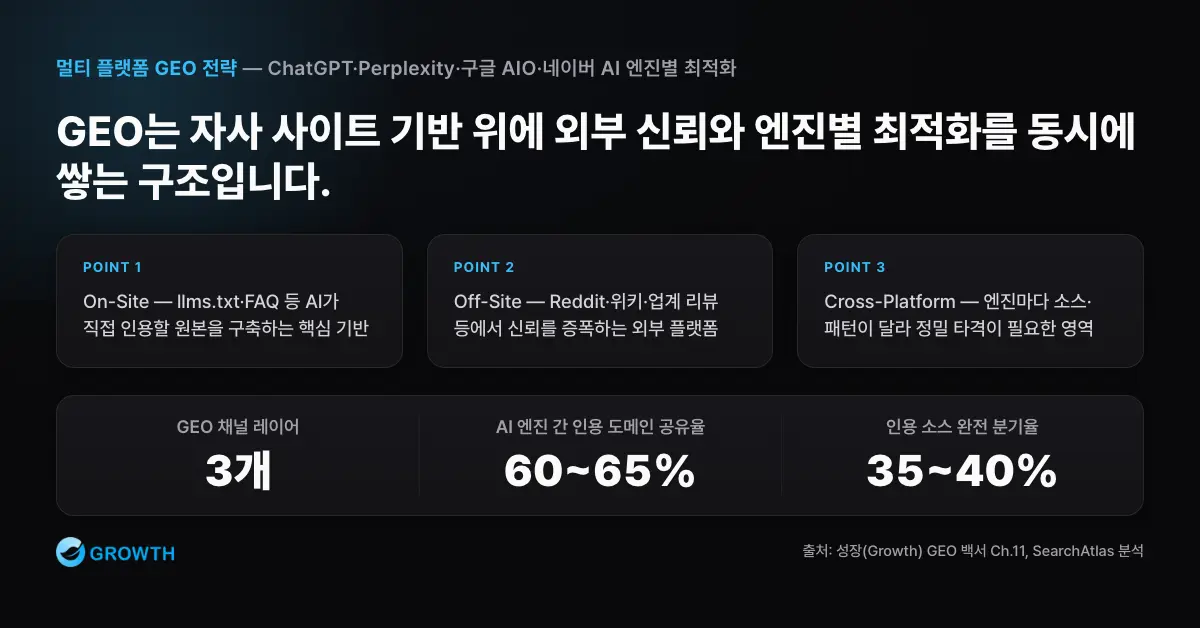
Layer 1: On-Site is GEO’s core foundation. This is where the Technical GEO and Contents GEO work covered in earlier chapters actually happens. It’s where you build the original source material AI engines crawl and cite directly — llms.txt files, structured data markup, question-based content structure, FAQ sections. It’s the “home base” for every GEO activity: if this layer is weak, no amount of effort on the other layers gives AI a quality original source to reference in the first place. As we saw in how SEO, AEO, GEO, and AIEO relate to each other, sites with a strong existing SEO foundation start out ahead on Layer 1.
Layer 2: Off-Site is GEO’s trust amplifier. This is where the Off-Page GEO strategy plays out — activity on external platforms that AI engines treat as training and reference sources: Reddit, Quora, YouTube, Wikipedia, Namuwiki, industry review sites, authoritative media. As covered in the Entity Authority and Off-Page GEO chapters, branded search volume is one of the strongest predictors of AI citation — and what generates that search volume is exactly this kind of external-platform mention.
Layer 3: Cross-Platform is GEO’s precision-strike territory. Every AI engine references different sources, follows different citation patterns, and rewards different optimization points. In SearchAtlas’s analysis, major AI systems shared even a single cited domain for the same query only 60–65% of the time — meaning the remaining 35–40% of the time, their citation sources diverged completely. This layer demands engine-specific tactics. A strategy that gets you cited well on ChatGPT may not work at all on Perplexity or Naver’s AI briefing, and vice versa.
Optimizing by AI Engine — Each One Plays by Its Own Rules
Looking at how AI engines differ from each other makes it clear why an engine-specific approach is necessary. Let’s walk through how each one actually works.
ChatGPT has the largest user base of any AI engine. According to Opensurvey’s “AI Search Trends Report 2026,” 54.5% of Korean users had used ChatGPT for search within the past three months, as of a December 2025 survey. ChatGPT combines Bing search results with data collected by its own crawler (GPTBot) to generate answers. Research from University of Toronto researchers Chen et al. (2025) found that ChatGPT overwhelmingly favors earned media (third-party content) — content written by outside experts or media outlets is more likely to be cited than a brand’s own direct marketing content. Notably, ChatGPT’s 2026 rollout of paid advertising (Sponsored Results) has created an environment where organic GEO and paid ads now coexist. It’s a structural shift reminiscent of Google’s early-2000s rollout of AdWords, and it may end up making organic GEO even more valuable, not less.
Perplexity is the engine that most explicitly shows its work — “answer plus cited sources.” Every answer carries inline citation numbers with a source list at the bottom. That transparent citation structure also makes Perplexity the easiest engine to measure GEO performance against. Perplexity combines its own crawler (PerplexityBot) with the Bing API to strongly support real-time search. It favors authoritative primary sources — academic papers, official reports, government data — and cites well-structured FAQ pages especially often.
Google AI Overviews (AIO) displays AI-generated answers on top of Google’s existing search results. Since it’s built on Google’s existing index, pages that already rank well under traditional SEO are more likely to get cited in AIO too — a structure that favors companies with a strong existing SEO foundation. That said, AIO can drive zero-click search behavior and reduce actual click-through traffic, so it’s worth tracking brand mentions inside AIO itself as an awareness metric in its own right.
Naver’s AI briefing matters especially for the Korean market. Naver, which forms a duopoly with Google in Korean search (Google at 47.9%, Naver at 41.7%, per StatCounter as of May 2026), has stated that queries triggering an AI briefing crossed 20% of total query volume in December 2025, and in the Place section where it rolled out first, saw a 10.4% increase in time-on-page and a 137% jump in “see more” tab click-through. Naver, however, blocks external crawlers entirely via robots.txt, including GPTBot and PerplexityBot. That makes optimizing for Naver’s AI briefing effectively a separate track from optimizing for ChatGPT or Perplexity (we cover the practical setup for allowing or blocking crawlers per engine in our AI crawler robots.txt guide). To get cited in Naver’s AI briefing, what matters most is your presence in content Naver’s own crawler actually collects — Naver Blog, Naver Cafe, and web pages indexed by Naver itself.
| AI Engine | Source Preference | Citation Pattern | Real-Time Search | Korean-Language Quality | Key Optimization Focus |
|---|---|---|---|---|---|
| ChatGPT | Earned media, Bing | Natural in-sentence citation | Bing + GPTBot | Good | Off-page mentions, authoritative sources |
| Perplexity | Primary sources, academic | Inline numbers + source list | PerplexityBot + Bing | Good | FAQs, data-rich content |
| Google AIO | Google index | Source links at bottom | Google crawler | Excellent | Existing top-ranking SEO pages |
| Gemini | Google index + proprietary | In-sentence citation | Google-based | Excellent | Structured data, E-E-A-T |
| Claude | Training-data driven | In-text mention | Limited | Good | Authoritative primary sources |
| Naver AI | Naver crawler | Summary + source link | Naver’s own | Best-in-class | Naver-ecosystem content |
Channel Priority Matrix — Allocating Limited Resources
Putting equal resources into every channel at once is inefficient. Plotting channels on two axes — AI citation impact and execution difficulty — into a four-quadrant matrix makes the priorities clear.
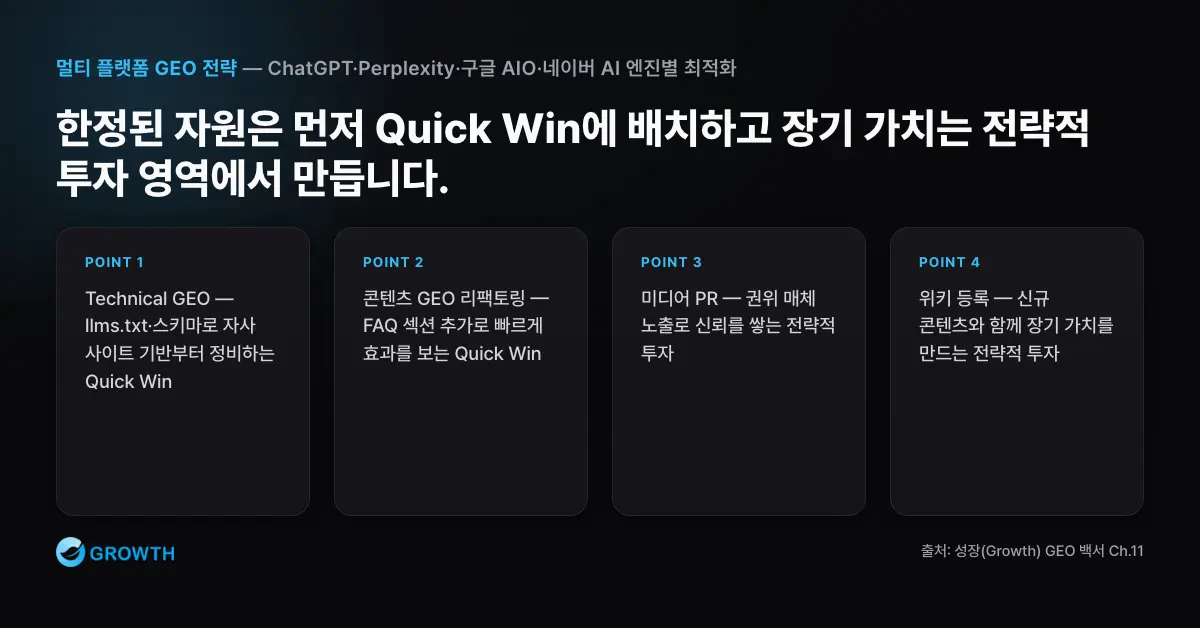
The “high impact, low difficulty” quadrant is your Quick Win zone. Technical GEO on your own site (llms.txt, schema), GEO refactoring of existing content, and adding FAQ sections all belong here (we cover step-by-step execution tactics in our AI search optimization execution guide). These deliver outsized results for relatively little effort, so start here first. The “high impact, high difficulty” quadrant is your strategic investment zone — producing high-quality new content, PR outreach to authoritative media, and wiki registration all fall here. These create the most long-term value, but they take time and resources.
The “low impact, low difficulty” quadrant is your opportunistic zone. Things like optimizing social media profiles or managing existing reviews don’t take much effort, so knock them out in spare moments. The “low impact, high difficulty” quadrant is lower priority — don’t commit resources there for now, but revisit as the market shifts. This matrix isn’t fixed. As AI engine algorithms change and new platforms emerge, where each channel sits can shift too, so revisit it every quarter.
Korea’s Triple Structure — An Integrated Approach
Korea’s search market structure is unusual even by global standards. It’s a triple structure where Naver and Google split traditional search (Google at 47.9%, Naver at 41.7%, per StatCounter as of May 2026), alongside AI-native search engines like ChatGPT and Perplexity. Because these three axes differ in crawlers, indexes, and citation logic, no single strategy covers all three at once.
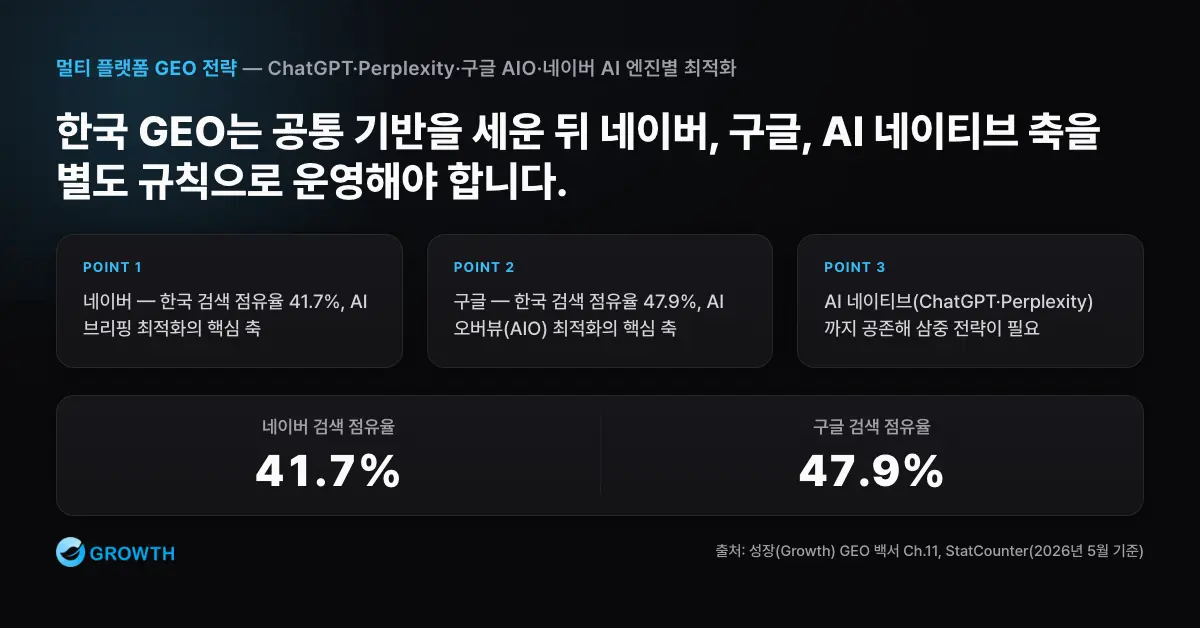
In practice, a “shared foundation plus channel-specific tactics” dual-layer approach works well. The shared foundation covers elements that work across every channel: question-based content structure on your own site, Schema.org markup, consistent entity information, and high-quality original content. These pay off no matter which AI engine is doing the crawling. Channel-specific tactics adapt to each axis’s own rules. On the Naver axis, that means presence in Naver Blog and Naver Cafe; on the Google axis, traditional SEO excellence; on the AI-native axis, external-platform mentions and earned media. This integrated approach improves resource efficiency while still respecting what makes each channel unique.
The Arrival of Paid Ads on ChatGPT — What It Means for Organic GEO’s Value
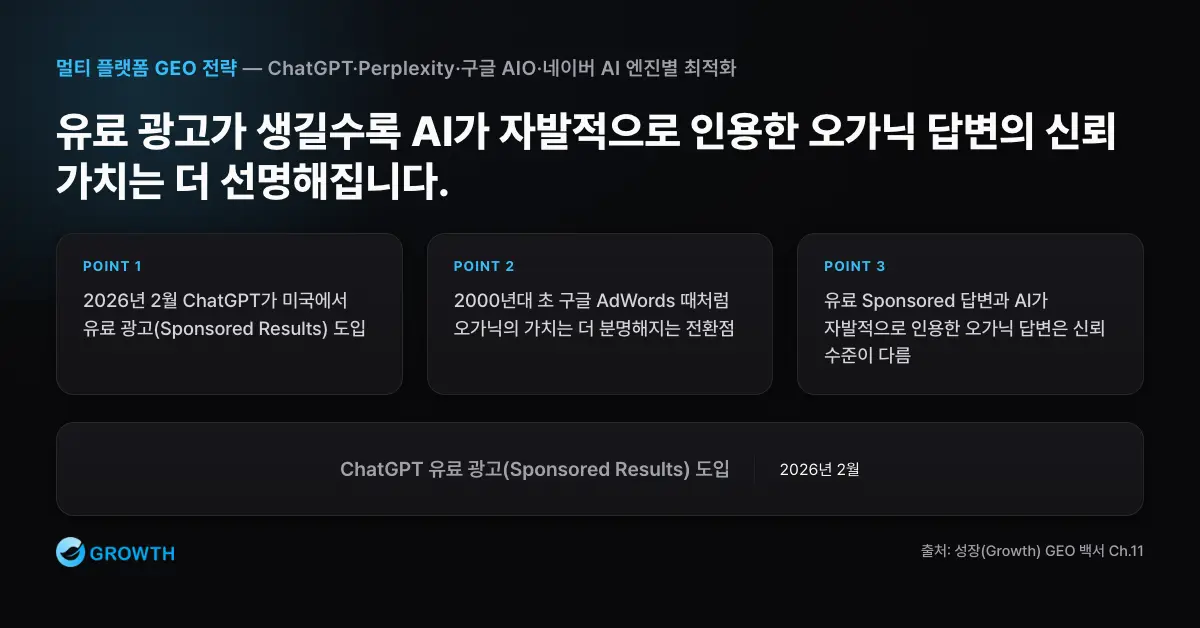
In February 2026, ChatGPT rolled out paid advertising (Sponsored Results), starting in the US, which introduced a paid-versus-organic distinction into AI search for the first time. It’s a turning point that echoes Google’s early-2000s introduction of AdWords. Back then, there were similar fears that “SEO is dead, everyone just has to buy ads now” — but in reality, the value of organic SEO only became clearer, because users learned to distinguish ads from organic results, and trust in “a genuine recommendation, not an ad” grew accordingly. We expect the same pattern in AI search. Users perceive a different level of trust in a paid Sponsored answer versus an organic answer AI cited on its own initiative. Investment in organic GEO actually becomes more important, not less, once paid ads enter the picture.
Key Takeaways
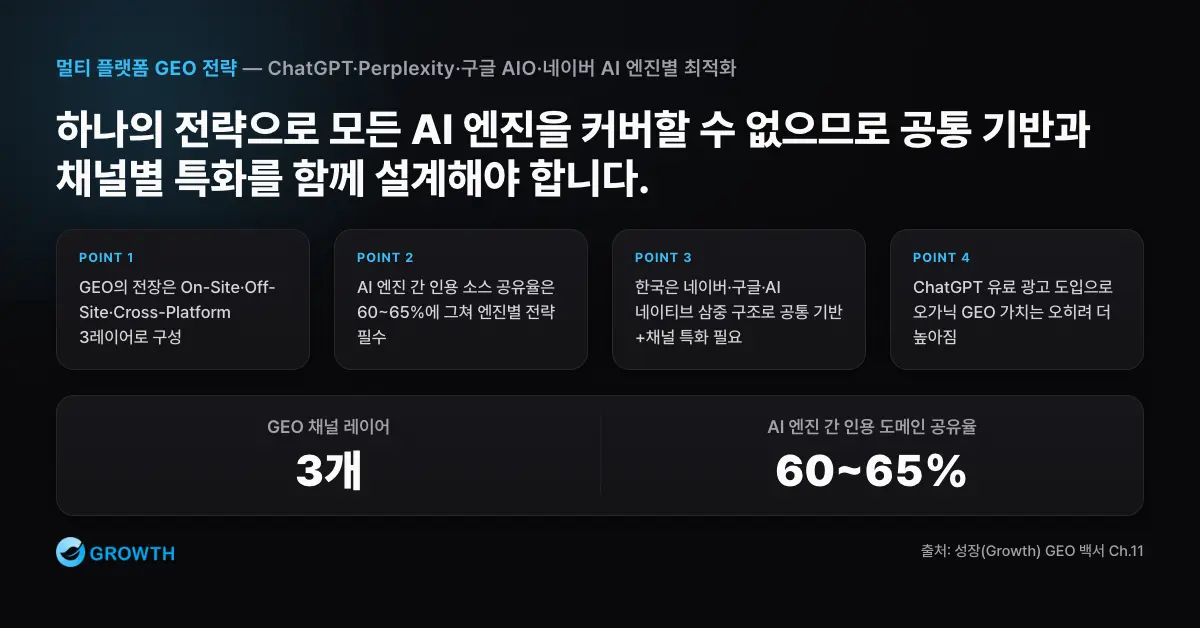
- GEO’s battlefield spans three layers: On-Site (your own site), Off-Site (external platforms), and Cross-Platform (per AI engine).
- Major AI engines share citation sources for the same query only 60–65% of the time, which makes engine-specific tactics essential.
- Korea’s triple structure of Naver, Google, and AI-native search calls for a “shared foundation plus channel-specific tactics” approach.
- ChatGPT’s rollout of paid ads actually raises the relative value of organic GEO.
Curious how your brand shows up in AI answers right now? Reach out for an AI answer share diagnostic. You can also request the full GEO whitepaper PDF.
FAQ
Do I need a completely separate optimization strategy for every AI engine?
Not entirely separate. A shared foundation — question-based content structure, Schema.org markup, consistent entity information — works across every engine. That said, since major AI systems share cited domains for the same query only 60–65% of the time, it’s effective to build a dual-layer approach: that shared foundation, plus channel-specific tactics like Naver-ecosystem content and earned media, layered on top.
How is optimizing for ChatGPT different from optimizing for Perplexity?
ChatGPT combines Bing search with data collected by GPTBot, and strongly favors external media and third-party content (earned media). Perplexity performs real-time search through its own crawler and the Bing API, and frequently cites primary sources like academic papers and official reports, along with well-structured FAQ pages. Earning external mentions matters relatively more for ChatGPT; content with clear data and sourcing matters relatively more for Perplexity.
What does it take to get cited in Naver’s AI briefing?
Naver blocks external crawlers, including GPTBot and PerplexityBot, and generates its AI briefing from content its own crawler collects. So what matters most is your presence within the Naver ecosystem — Naver Blog, Naver Cafe, and web pages indexed by Naver — and this needs to run as a separate track from your ChatGPT and Perplexity efforts.
Now that ChatGPT has paid ads, does organic GEO stop mattering?
The opposite, actually. Just as organic SEO’s value became clearer after Google introduced AdWords, once paid and organic citations become distinguishable, the trust value of “an answer AI cited on its own” only goes up. Organic GEO becomes a more differentiated asset, not a less relevant one, once paid ads enter the picture.
GEO whitepaper series: ← Previous chapter · Full table of contents · Next chapter →