
B-Grade Marketing
 임재복
임재복
What Is B-Grade Marketing?
B-grade marketing is a marketing strategy that deliberately uses a lower-polish, rougher style. In contrast to traditional “A-grade” marketing, which chases perfection and polish, it’s a technique that uses intentionally rough production or an unpolished feel to communicate authenticity and approachability to consumers.
B-grade marketing is a methodology that can deliver strong results even on a small budget, and it’s drawing particular attention in digital media environments. The strategic intent hiding behind that seemingly imperfect surface makes consumers feel closer to the brand and opens the door to more authentic communication.
History and Origins
How B-Grade Marketing Emerged
The concept of B-grade marketing started drawing serious attention in the late 2000s, alongside the spread of social media. Traditional mass-media marketing demanded high cost and long production time, while individual creators and small businesses needed to run effective marketing on limited resources. That environmental constraint ended up becoming the foundation for a new marketing approach.
The growth of social media platforms like YouTube and Facebook, in particular, was the decisive catalyst that helped B-grade marketing take off. As more individual creators produced content without professional equipment or a studio and still got a huge response, companies started paying attention to this approach too. Consumers increasingly came to prefer authentic, natural content over polished, over-produced advertising — and that’s the backdrop against which B-grade marketing became mainstream.
How the Concept Evolved
Early B-grade marketing was really just a passive approach that accepted the limits of a small budget, but it gradually evolved into a deliberate strategy. By the 2010s, cases started appearing where brands with plenty of budget were intentionally staging a B-grade feel anyway. That reflected a shift in the market — consumers were growing tired of overly polished ads and wanted more human, approachable brand communication instead.
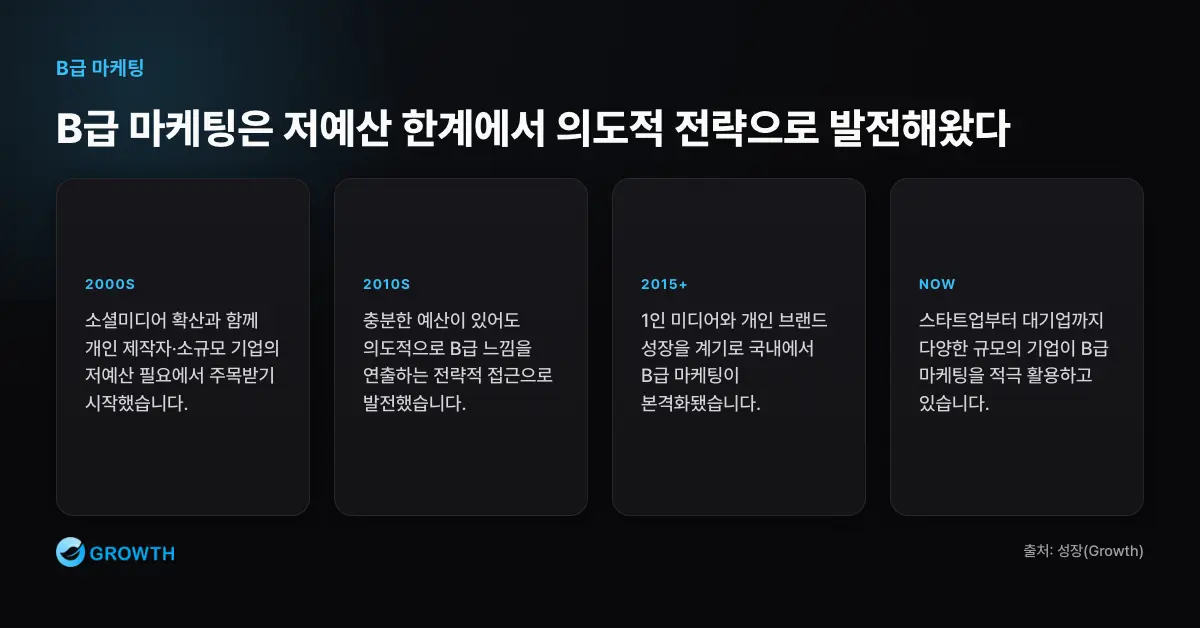
In Korea, B-grade marketing took off in earnest after 2015, alongside the rise of independent media creators and personal brands. As a culture that prized authenticity and candor spread, especially among younger generations, companies started building marketing strategies to match. Today, companies of every size — from startups to major corporations — actively use B-grade marketing.
Key Characteristics and Components
Deliberate Imperfection

The single most defining trait of B-grade marketing is deliberate imperfection. It shows up as technically imperfect video quality, unpolished editing, or a script that isn’t fully refined. But this imperfection isn’t just careless, thrown-together work — it has to be strategically dialed to a level that fits the brand’s message and target audience. The Chungju City case pictured above is a textbook example: Chungju City’s YouTube channel, run on an annual budget of roughly $450, focused entirely on view count and became the No. 1 subscribed public-agency channel in the country.
Think of footage that looks like it was shot on a smartphone, natural mistakes, or unexpected moments left in the final cut instead of edited out — that’s the kind of thing this refers to. This approach makes consumers feel the brand is genuine rather than artificial. And this preference for natural-feeling content over polished, over-produced content is especially strong among younger generations. According to a Stackla survey, 86% of consumers said authenticity is an important factor in choosing a brand, and 90% of millennials said they preferred what’s “real and natural” over what’s “perfectly packaged.”
Authenticity and Approachability

The second core element of B-grade marketing is communicating authenticity and approachability. It shows up as introducing a brand or product the way a friend might casually recommend it. Instead of formal ad copy, it uses everyday language, and it often candidly mentions a product’s shortcomings too.
This approach is effective at closing the distance between consumers and a brand, building a more human relationship. Two-way communication with followers matters a great deal in a social media environment especially, and B-grade marketing has the advantage of naturally inviting that kind of interaction.
Consumers tend to feel a deeper affection for a brand that’s human — one that makes mistakes and is occasionally clumsy — over one that’s flawless. To understand that consumer psychology, it’s worth also looking at the fundamental human needs framework covered in Applying Maslow’s Hierarchy of Needs to Marketing.
Storytelling and Humor
B-grade marketing often focuses less on the functional side of a product or service and more on the story or amusing episode wrapped around it. The storytelling used here doesn’t need to be grand or moving — in fact, it lands better when it’s an everyday, small-scale story.
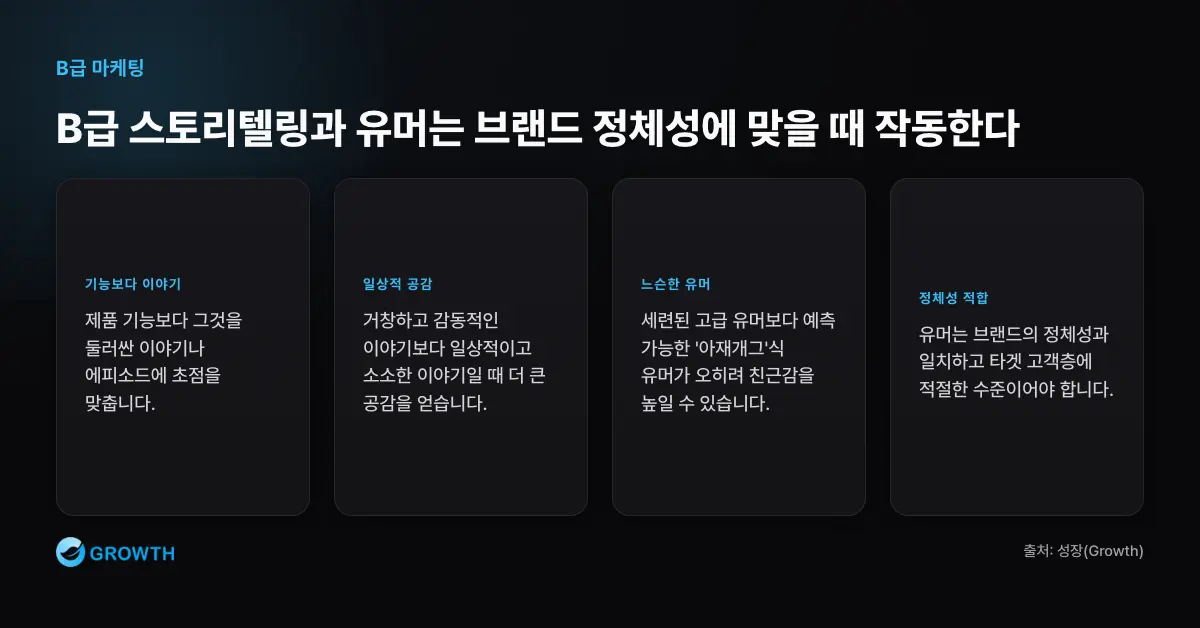
Humor is another important component of B-grade marketing. But the humor here tends to be a bit rough or predictable, rather than polished and witty. That “dad joke” level of humor actually tends to boost approachability and raise favorability toward the brand. What matters is that the humor fits the brand’s identity and lands at the right level for the target audience. For more on producing effective content that stays true to brand identity, see The Brand Content Marketing Guide.
Use Cases and Real-World Applications
Success Stories on Social Media
Chungju City’s results, discussed above, are backed up by hard numbers. Using wordplay and parody in its B-grade social media promotion, Chungju City grew its visitor count from 8,000 in 2016 to 3.1 million in 2019, and one festival-promotion comment event drew more than 10,000 replies. In the private sector, a well-known domestic case of B-grade marketing done well is how several chicken-restaurant brands run their social media. Instead of professional food photography, they post slightly clumsy-looking photos that look like they were taken by staff on the fly, and they talk to customers in a casual, everyday voice. Notably, when responding to customer questions or complaints, they skip the stale corporate boilerplate in favor of humorous but genuine replies — and it’s landing well.

If you’d like to dig deeper into successful content marketing cases like these, check out our content covering a range of successful examples from both Korea and abroad.
Another success story comes from how startups market their product launches. Instead of a fully polished product-launch event, a founder films a product introduction on their own smartphone and posts it to social media directly. Leaving in the imperfect lighting or a bit of unclear speech, rather than editing it all out, ends up communicating the founder’s authenticity and passion even more effectively.
Established Companies Adopting B-Grade Marketing
Large enterprises are increasingly recognizing the value of B-grade marketing and adopting it as a deliberate strategy. This is especially true for products or services targeting younger generations, where more companies are running separate B-grade-style campaigns that stand apart from their existing polished brand image. What matters here is finding a balance point that lets a company connect with a new generation without damaging its existing brand identity.
For example, some major brands run a separate, B-grade-flavored sub-account apart from their official account, providing more casual, approachable content there. This lets them show off different facets of the brand and communicate simultaneously with consumers across a wide range of ages and tastes.
Collaborating With Creators
Another important way B-grade marketing gets used is through partnerships with individual creators. In these partnerships, brands avoid giving creators overly restrictive guidelines, letting them keep as much of their own unique style and tone as possible. This approach lets the creator’s followers see the brand in a way that feels far more natural and genuine.
The key to a successful partnership is finding the point where the brand’s identity and the creator’s identity blend together naturally. Rather than pushing hard to promote a product, it’s more effective to let it show up naturally within the creator’s everyday content. If you’d like to learn more about marketing strategies built around partnering with influencers and creators, check out How Should You Choose an Experience-Group Marketing Channel? or How Much Budget Do You Need to Run a Supporters Program?
Related Concepts and Marketing Theory
Its Connection to Underdog Marketing
B-grade marketing is closely related to underdog marketing. Where underdog marketing draws out consumers’ sympathy and support by positioning a brand as the “little guy,” B-grade marketing communicates approachability and authenticity by deliberately showing an imperfect side. Both strategies share a common thread: emphasizing a human quality over perfection.
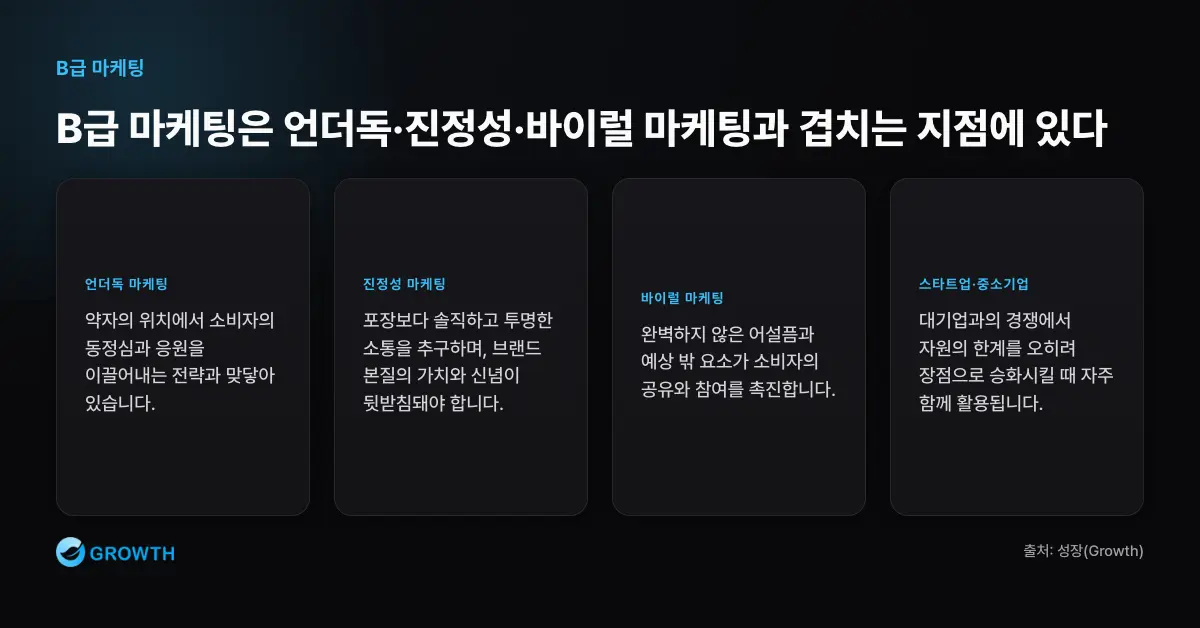
Startups and small businesses in particular often use underdog marketing and B-grade marketing together, turning their limitations into an advantage against larger competitors. What matters most here is taking a strategic approach without losing authenticity along the way.
Its Relationship to Authentic Marketing
Authentic marketing provides the theoretical backbone for B-grade marketing. As consumers place more and more weight on brand authenticity, the preference for honest, transparent communication over over-produced marketing keeps growing stronger. B-grade marketing can be seen as one concrete methodology for expressing that authenticity.
But for B-grade marketing to succeed, real brand values and beliefs need to sit underneath that surface-level roughness. Simply staging a B-grade feel doesn’t automatically communicate authenticity — the message needs to genuinely align with the brand’s core values before it can earn real resonance with consumers.
Its Synergy With Viral Marketing
B-grade marketing also has strong synergy with viral marketing. Imperfect content often ends up drawing more reaction from consumers than polished content does. People tend to pay more attention to content with a bit of roughness or an unexpected element than to a flawless ad, and they’re more inclined to share it with others.
Secondary spread through comments and shares matters enormously in a social media environment, and B-grade marketing is effective at encouraging exactly that kind of voluntary participation. Consumers actively engage — joking about or offering advice on a brand’s mistakes or clumsy moments — which ends up boosting both brand awareness and favorability at the same time.
If you’re curious about the specific planning methods and execution strategy behind viral marketing, you can find more detail in Viral Marketing Starts and Ends With Planning.
Related Reading
- What Is Growth Hacking? Definition, AARRR, Experiment Design, and Real-World Cases — The Complete Growth Strategy Pillar
- What Is Marketing Channel Mix?
- CDJ (Customer Decision Journey)
- What Is a Persona?
- The Difference Between Customer Needs and Wants
If you’d like to apply this to your own business — if you need a specific situational diagnosis, reach out through Contact Us. We’ll answer based on the one customer who becomes revenue — not the volume of traffic.
Frequently Asked Questions (FAQ)
Can you just throw B-grade marketing together carelessly?
No. The imperfection in B-grade marketing isn’t the result of careless work — it’s the result of strategically dialing the level of polish to fit the brand’s message and target audience. Real brand values and beliefs need to sit underneath that surface-level roughness; simply mimicking a B-grade feel doesn’t automatically communicate authenticity.
Is B-grade marketing only suited to companies with a small budget?
It started as a passive approach that accepted the limits of a small budget, but today plenty of brands with plenty of budget deliberately stage a B-grade feel anyway — because consumers are tired of overly polished ads and want more human, approachable communication. In fact, companies of every size, from startups to large enterprises, are using B-grade marketing.
How can a large company do B-grade marketing without damaging its existing brand image?
The key is finding a balance point that lets you connect with a new generation without damaging your existing brand identity. Some major brands run a separate, B-grade-flavored sub-account apart from their official account to provide more casual, approachable content. This lets them show off different facets of the brand while communicating with consumers across a range of ages and tastes at the same time.
What’s the difference between B-grade marketing and underdog marketing?
Underdog marketing draws out consumers’ sympathy and support by positioning a brand as the “little guy,” while B-grade marketing communicates approachability and authenticity by deliberately showing an imperfect side. Both share the common thread of emphasizing a human quality over perfection, which is why startups and small businesses in particular often use the two strategies together.
Marketing Insights
Marketing insights, delivered weekly
Practical growth and GEO/B2B marketing insights, summarized in your inbox every week.
Subscribe for insights