The GEO Business Case — Speaking Opportunity Cost to Executives
 임재복
임재복
This article is part 17 of 20 in Growth’s GEO Whitepaper series — Part VI, Sub-Pillar (HOW MUCH). You can find the full table of contents and download the complete PDF on the whitepaper page.
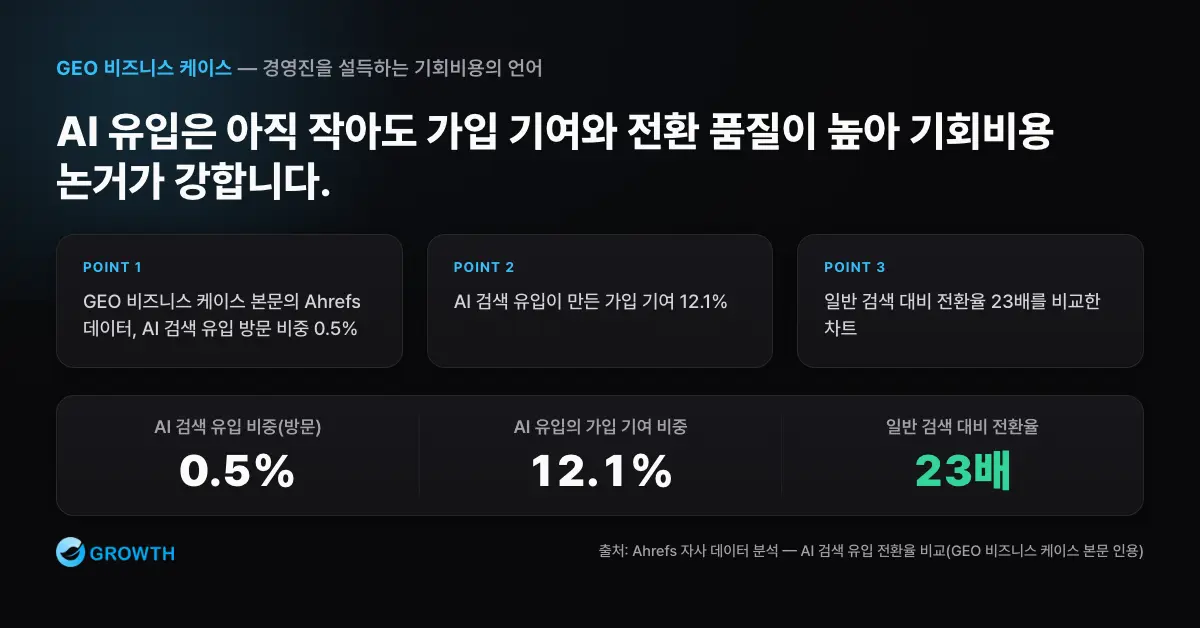
Answer-First: The real question behind GEO investment isn’t “how much should we spend” — it’s “how much opportunity are we already losing.” Ahrefs’ own data shows AI search traffic converting 23x better than regular search (just 0.5% of visits generated 12.1% of sign-ups), and Previsible’s analysis of 1.96 million LLM sessions found ChatGPT-driven traffic growing up to 4.29x year over year. Entering after the pie has grown is a completely different game from claiming your share now.
Even after you understand what GEO is, its strategy, the team that runs it, and the channels it touches, none of that moves without a business case executives can act on with numbers. Executive decisions ultimately come down to figures: how much should we invest, what return can we expect, and how do we prove it? This is where our “HOW MUCH” trilogy begins — budget planning, ROI measurement, and case studies and outlook — answering exactly those three questions.
“How much” is really two questions in one. “How much should we invest” is the input side; “how much comes back” is the output side. Measurement is what connects them. You can’t expect returns without investment, and you can’t justify investment without measurement. The three articles that follow tackle this triangle in turn: budget planning (input) → ROI measurement (the link) → case studies and outlook (output and what’s next). Follow that sequence and you’ll have a complete business case to bring to leadership.
Building a GEO business case is harder than pitching a traditional marketing channel, and for good reason. Traditional digital ads have a fairly clear input-output relationship — spend $10,000, get a certain number of clicks and leads. GEO doesn’t work that way. How do you put a dollar value on your brand being cited inside an AI answer? How do you trace a customer who arrived through the “dark funnel” of an AI conversation? The industry doesn’t have standard answers yet — but that absence is precisely the opportunity for companies willing to define the framework first. Whoever builds the measurement system becomes the industry benchmark, and building that benchmark is itself part of doing GEO well (we cover the specific methodology for tracking AI citations in our GEO measurement guide).
Fortunately, the numbers already make a strong case. We go deeper in the ROI measurement article, but visitors arriving via AI consistently convert at dramatically higher rates than regular search traffic — the “quality” of AI-referred traffic is simply different. Even while the absolute volume of AI traffic is still small, the growth curve and conversion quality together already make the business case for GEO investment a strong one.
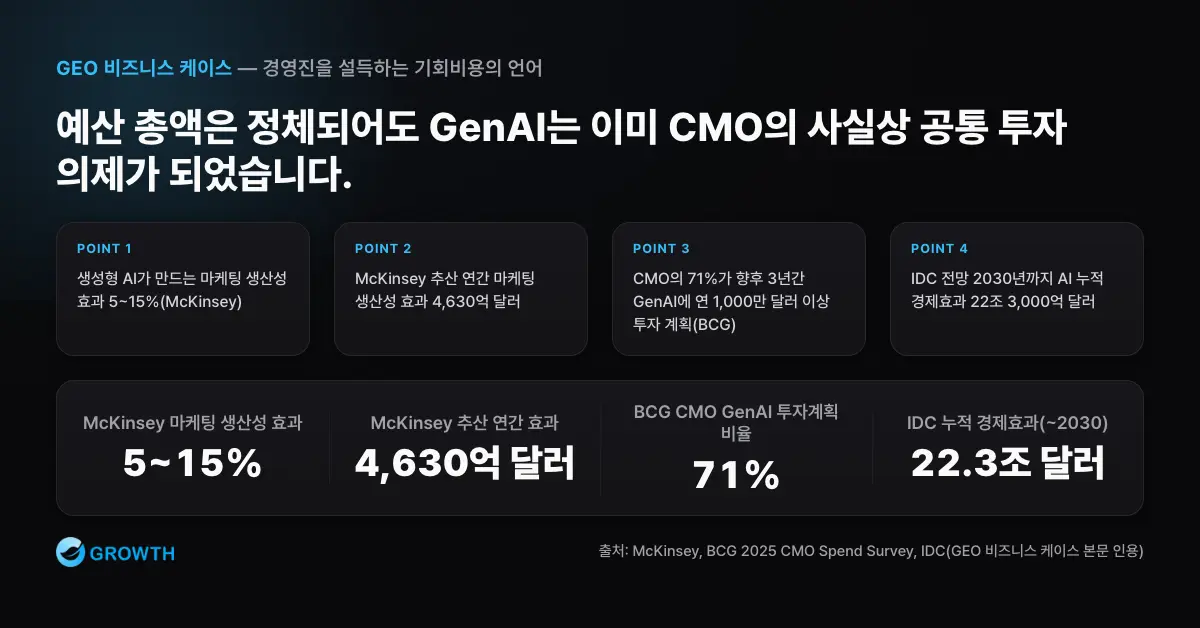
McKinsey estimates generative AI could lift marketing productivity by 5–15% of marketing spend, worth roughly $463 billion annually. In BCG’s 2025 survey, 71% of CMOs said they plan to invest more than $10 million a year in GenAI over the next three years. IDC projects AI will generate $22.3 trillion in cumulative global economic impact by 2030, with global AI solution investment already at $307 billion in 2025 alone. The market is clearly moving. The remaining question is where your company stands in that movement. Gartner’s 2025 CMO Spend Survey found marketing budgets stuck at around 7.7% of revenue — yet only 1% of CMOs said GenAI investment wasn’t a priority. In other words, essentially every CMO is investing in GenAI even though total budgets aren’t growing. So far, though, most of the reported gains are in productivity — time saved, costs reduced — while brand visibility inside AI answers (GEO) remains a largely open field. That window is open right now.
The most persuasive way to frame a GEO business case isn’t “cost” — it’s “opportunity cost.” As we discussed in our piece on zero-click search, traditional search volume and organic traffic are both projected to decline. In that context, choosing not to invest in GEO effectively means watching the value of your existing marketing assets erode. Investing in GEO, by contrast, lets you offset that decline in traditional search traffic with AI-driven traffic — and that traffic converts better besides. In the OECD’s 2025 report on generative AI adoption among SMEs, 65% of Korean SMEs that adopted generative AI reported gains in new product or service delivery and revenue growth. Regardless of company size, the business case for investing in AI is already well established.
Companies that delay GEO investment miss one crucial dynamic: AI citation patterns are self-reinforcing. Research presented at NAACL 2025 found that LLMs, having learned from human citation behavior, actually amplify the bias toward citing sources that are already cited often — a Matthew Effect. Applied to brand citations, this plays out as follows: once an AI starts treating a brand as a trustworthy source, that citation itself boosts the brand’s digital authority, and the added authority in turn draws even more citations — a virtuous cycle. The reverse is equally true. A brand missing from AI’s early answer sets gets read as lacking authority, which makes it progressively harder to earn citations later — a vicious cycle. Companies that invest in GEO early claim the position of AI’s “default answer.” Based on what we’ve seen, a late entrant needs 3–5x the cost and time a first mover spent to unseat them. That’s a different order of problem than losing the #1 search ranking. SEO rankings are fluid, but once an AI’s citation pattern sets, it has strong inertia. Money spent on GEO today isn’t simple marketing cost — it’s a competitive moat for the AI era.
The business case for GEO is especially strong in the Korean market. According to Fortune Business Insights, Korea’s AI market is projected to grow from $7.17 billion in 2025 to $53.87 billion by 2032 — a 33.4% CAGR. That growth rate translates directly into the growth of AI search. As more consumers turn to AI search, the visibility gap between companies that invested in GEO and those that didn’t widens exponentially. The gap looks small at first, but compounding makes it progressively harder to close over time. Money spent on GEO today isn’t so much marketing spend as basic infrastructure investment for a brand to exist in the AI era. Like most infrastructure investment, the visible returns are modest early on — but once the foundation is in place, it lifts the efficiency of every other marketing activity built on top of it.
A 3-Step Framework for Justifying GEO Investment
When building the evidence base executives will judge, this three-step framework works well.
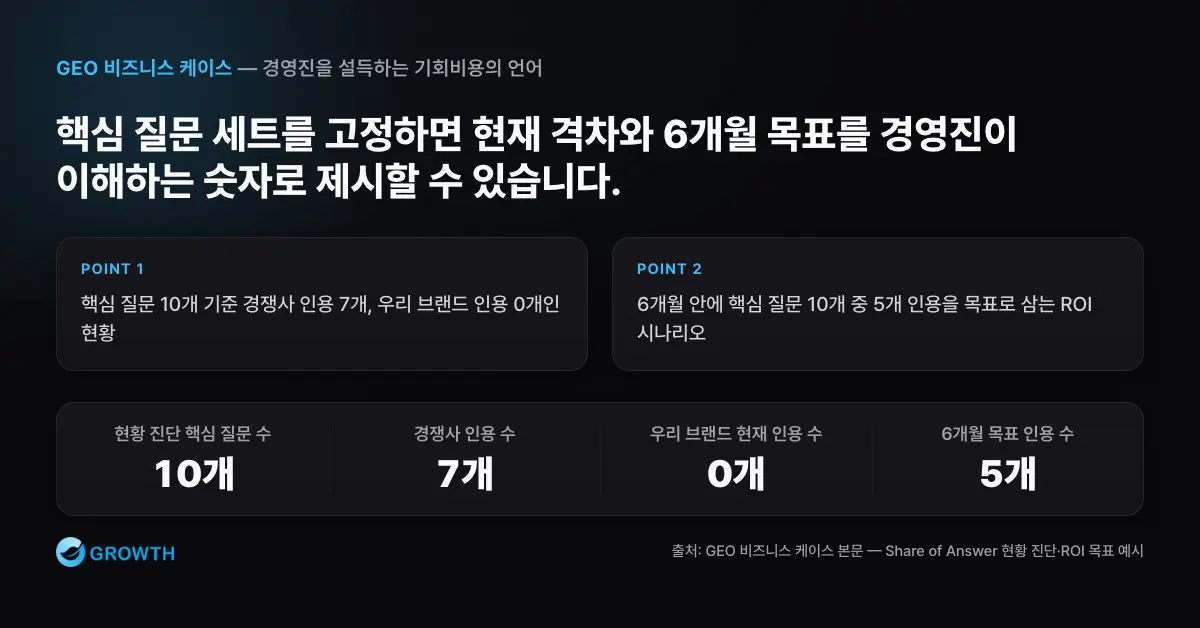
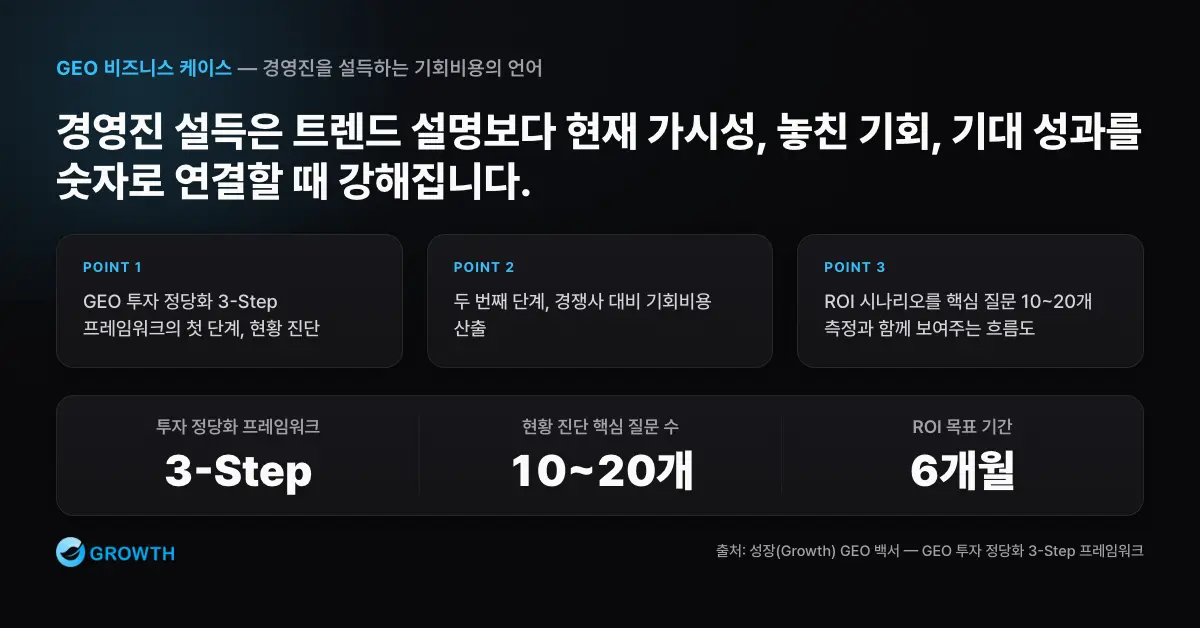
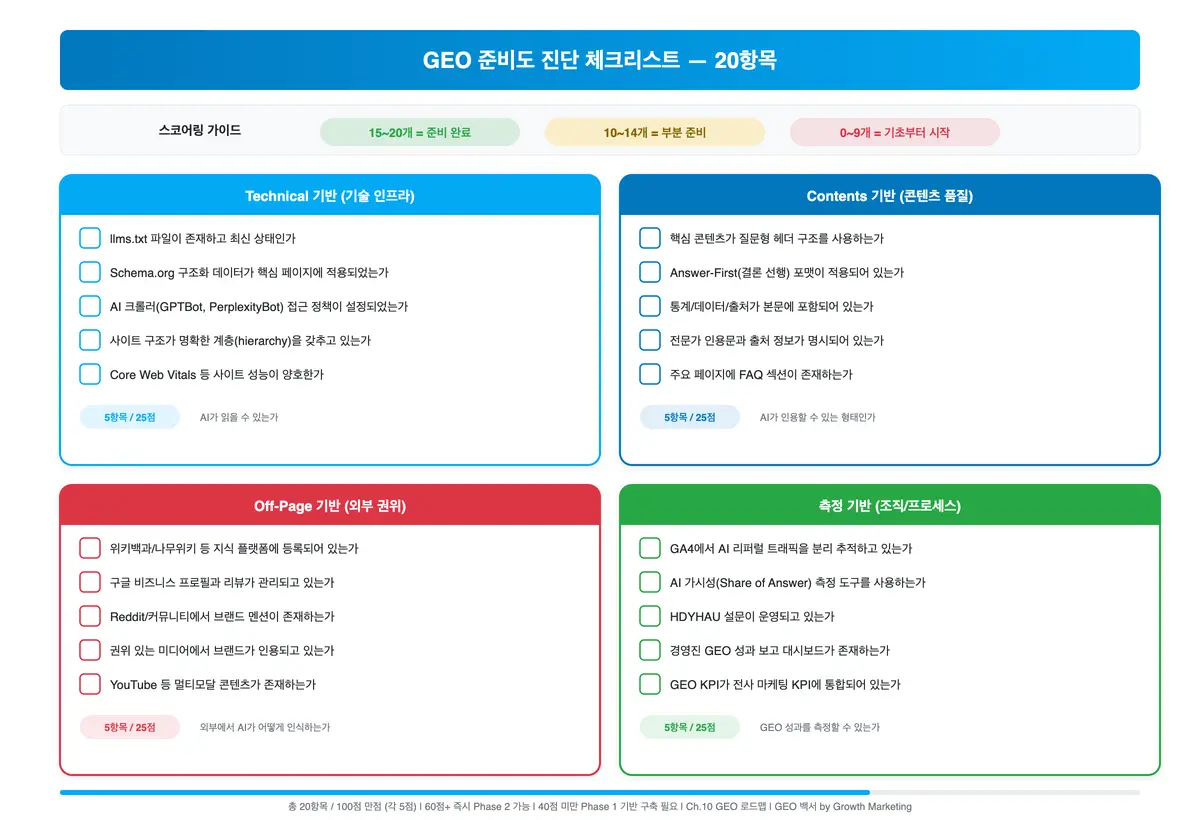
(1) Current-state diagnosis — measure your AI visibility score. Pick 10–20 core questions from your industry, run them against the major AI engines, and measure how often your brand is cited (Share of Answer). A concrete finding like “of our industry’s 10 core questions, competitors are cited in 7 AI answers — we’re cited in none” carries far more weight than an abstract trend argument.
(2) Opportunity cost — the revenue impact of being absent from AI answers versus competitors. Apply the data point that AI-referred customers convert at up to 23x the rate of regular search to your own numbers. Once you calculate the volume of high-intent traffic and potential revenue you’re losing by being absent from AI answers, “the cost of not investing” becomes a concrete figure.
(3) ROI scenarios — expected returns on investment. Present a concrete goal and budget: “to be cited in 5 of our 10 core questions within 6 months, we need a monthly investment of $X.” Laying out conservative, base-case, and optimistic scenarios side by side makes the executive decision much easier.
Our GEO budget planning article covers budget design and allocation by company size, our GEO ROI measurement article covers the specific measurement methodology, and our GEO case studies and outlook article covers real-world results and what’s ahead. A strategy that can’t speak in numbers doesn’t get executed. This “HOW MUCH” trilogy is our attempt to translate GEO into the language of numbers.
Curious how your brand shows up in AI answers right now? Get in touch for an AI answer-share diagnostic. You can also download the full GEO whitepaper PDF.
Frequently Asked Questions
What’s the most effective way to get executive buy-in for GEO investment?
We recommend a three-step framework: measure your current Share of Answer against 10–20 core industry questions to show where you stand, translate the higher conversion quality of AI traffic into an opportunity-cost figure for your own business, and then present conservative, base-case, and optimistic ROI scenarios with clear timelines, targets, and budgets. A concrete finding like “competitors are cited in 7 of these questions, we’re cited in zero” carries far more weight than an abstract trend argument.
AI-referred traffic is still small — why invest now?
Because what matters isn’t absolute volume, it’s the growth curve and conversion quality. In Ahrefs’ own data, AI search accounted for just 0.5% of visits but drove 12.1% of sign-ups — a 23x higher conversion rate than regular search — and Previsible’s analysis found ChatGPT-driven traffic growing up to 4.29x within a year. Factor in the self-reinforcing Matthew Effect in AI citations, and the later you enter, the more it costs to win the same position.
Why is measuring GEO ROI so difficult?
Because there’s no industry standard yet for putting a dollar value on being cited in an AI answer, or for tracking customers who arrive through the dark funnel. The flip side is that whoever defines the measurement framework first becomes the industry benchmark. We cover the specific measurement design in our ROI measurement article and our GEO measurement guide.
How much budget does GEO investment require?
It ranges widely, from a few million won a month for a focused push to a fully staffed program at an enterprise. What matters more than the dollar figure is building your case in the sequence of current-state diagnosis → opportunity cost → ROI scenarios. We cover monthly budget scenarios by company size and the 5-area allocation split in detail in the next chapter, GEO budget planning.
GEO Whitepaper series: ← Previous chapter · Full table of contents · Next chapter →