3 Real GEO Case Studies and the Future — Search in the Age of AI Agents
 임재복
임재복
This article is part 20 of 20 in Growth’s GEO Whitepaper series — Chapter 14, case studies and outlook. You can find the full table of contents and download the complete PDF on the whitepaper page.
GEO results aren’t proven in theory — they’re proven in the field. This article walks through three real cases — B2B SaaS, D2C beauty, and a global IT company — to show the change GEO (AI engine optimization) actually creates. From there, we cover three anti-patterns that lead to failure, the three-stage evolution of the search ecosystem from people asking AI questions to AI agents pre-searching and eventually automating purchases, and what to do about it.
Key Takeaways
- Across the B2B SaaS, D2C beauty, and global IT cases, GEO delivered a 3x-plus increase in AI citation frequency, a 5x higher lead conversion rate than existing SEO traffic, a 40% higher average order value than Instagram ad traffic, and a drop in negative AI citations from 60% to 25%.
- Three anti-patterns cause GEO to fail: the “manipulate the AI” approach, the “technical work alone is enough” mindset, and the “obsession with short-term results.”
- The search ecosystem is evolving from today’s world of people asking AI questions (Stage 1), through AI agents pre-searching on a user’s behalf (Stage 2, 2026–2028), to AI agents autonomously completing purchases and contracts (Stage 3, 2028 and beyond).
- The three proactive strategies for the agent era are building Entity Authority, investing in structured data, and managing community reputation.
- GEO is a mid-to-long-term compounding strategy driven by the Matthew Effect — early movers claim AI’s default answer, and late movers pay several times the cost and time to catch up.
Case 1: B2B SaaS Enterprise — One AI Question From a Buyer Changed the Sales Pipeline
Company A, a mid-sized Korean IT company, sells enterprise project management SaaS. Its sales team struggled every quarter to generate leads. Historically, 70% of leads came from trade shows, seminars, and cold calls, but the efficiency of those in-person channels dropped after COVID, making digital transformation urgent. The company had also run its blog with SEO in mind, but on the core keyword “project management tool recommendation,” it was outranked by global SaaS giants and stuck on page 3 of Google.
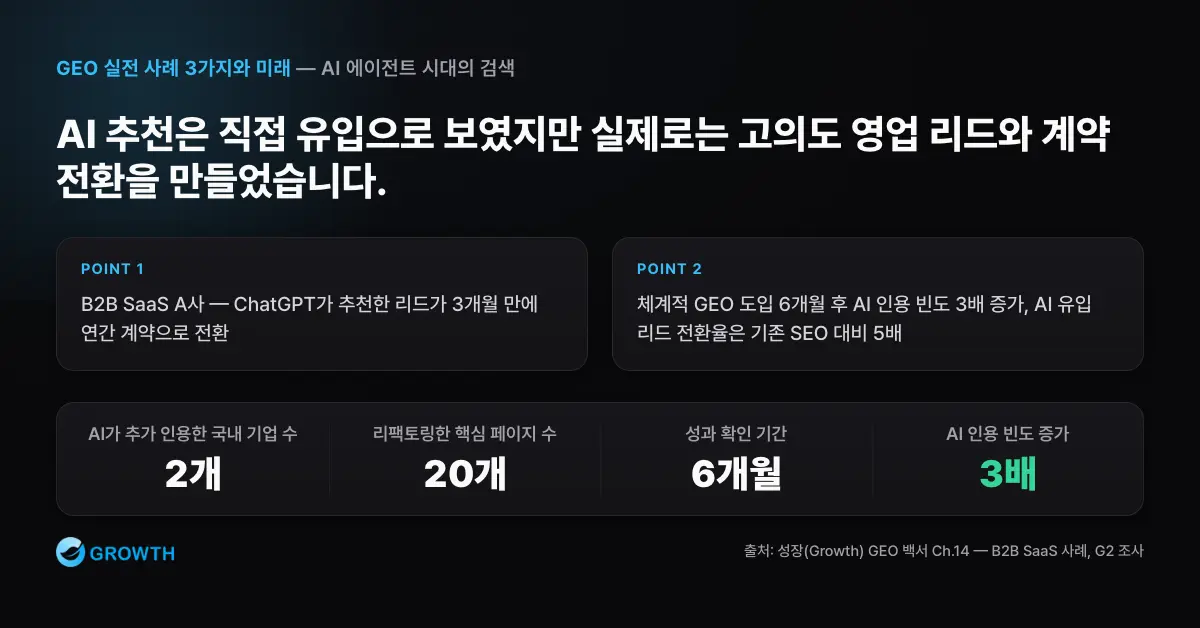
The turning point started when a procurement director at a large enterprise asked ChatGPT to “recommend a project management SaaS suited to the Korean business environment.” ChatGPT named three global solutions first, then added, “for solutions built specifically for the Korean business environment,” citing Company A alongside one other domestic vendor. The director came directly to Company A’s website and requested a demo — a lead that closed into an annual contract within three months. In Company A’s GA4, that visit was logged as “direct traffic,” but the sales team, through conversations during the deal, confirmed the actual source was “ChatGPT recommendation.”
After that experience, Company A began a systematic GEO program. It built an llms.txt file, refactored its 20 most important pages into a question-and-answer structure, and produced in-depth content around the specialized topic of “project management for Korean companies.” Six months later, AI citation frequency had more than tripled, and leads arriving via AI converted at 5x the rate of leads from existing SEO traffic. A G2 survey found that 33% of B2B buyers had purchased from a vendor they hadn’t previously known about, discovered through AI — a finding Company A’s own experience bears out directly.
Case 2: B2C D2C Beauty Brand — Answering Consumers’ AI Shopping Questions
Company B, a Korean D2C skincare brand, runs primarily through its own online store and targets women aged 25–35. In the fiercely competitive K-beauty market, building brand awareness was its biggest challenge. The company had been putting 80% of its budget into Instagram ads and influencer marketing, but rising customer acquisition costs (CAC) made a new channel necessary.
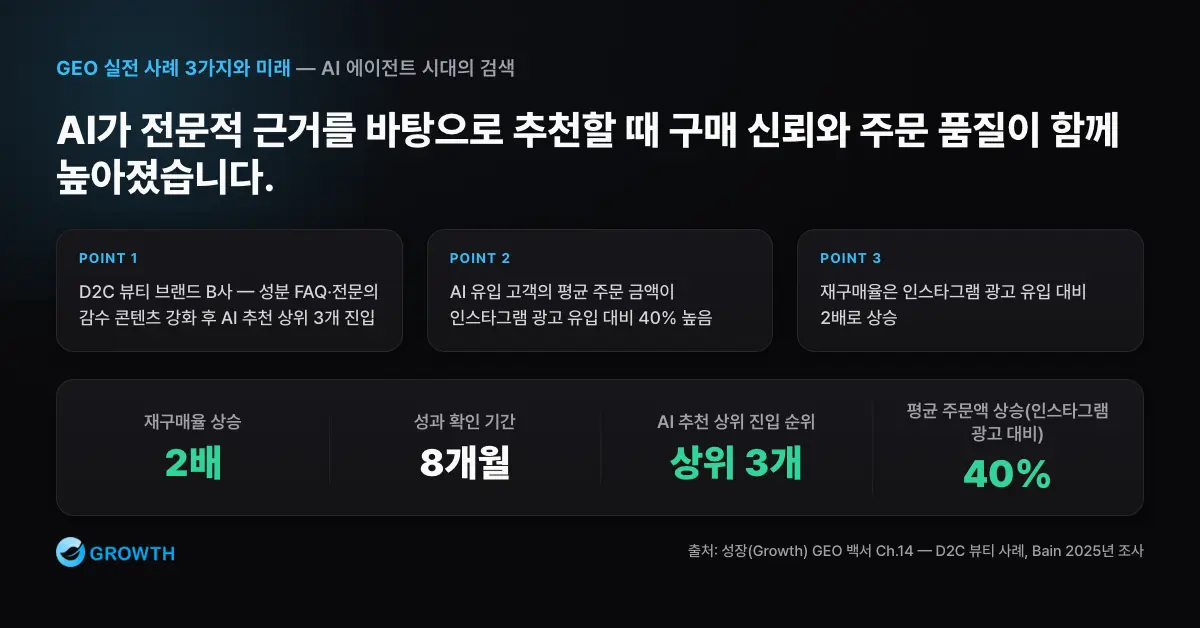
Company B started paying attention to the shopping questions showing up in AI search. Specific product-discovery questions like “recommend a serum for dry skin” or “recommend a gentle retinol serum” were surging on AI platforms. A 2025 Bain study backed this up, finding that roughly 80% of consumers rely on AI summaries — zero-click results — for more than 40% of their searches. Company B restructured its ingredient expertise into a form AI could cite. Each product page got structured FAQs covering ingredient analysis, effects by skin type, and usage instructions, and the company produced dermatologist-reviewed content to strengthen its E-E-A-T.
Eight months later, Company B’s products began appearing among the top three AI recommendations for the question “recommend a serum for dry skin.” Customers who arrived via AI spent 40% more per order on average than those from Instagram ads, and their repeat purchase rate was double. When AI introduces a brand with “expert-backed reasoning,” customers arrive already carrying a high degree of trust. A Pew Research survey found that 20% of users rate AI summaries as “very useful,” and 62% of those under 30 encounter them frequently — a demographic that maps precisely onto Company B’s core audience.
Case 3: A Global IT Company — When AI Decides Your Brand Reputation
The Korean office of Company C, a global IT company, faced a unique problem. AI kept repeating negative information tied to a security incident that had occurred years earlier at the parent company. In response to “how’s Company C’s security?”, AI engines would surface the incident from three to five years ago first, with only partial reflection of the improvements made since. As Khan et al. (2026) showed in their ICLR 2026 paper, “In Agents We Trust,” LLM agents carry “latent source preferences” formed during training, and once a perception sets in, it’s hard to shift.
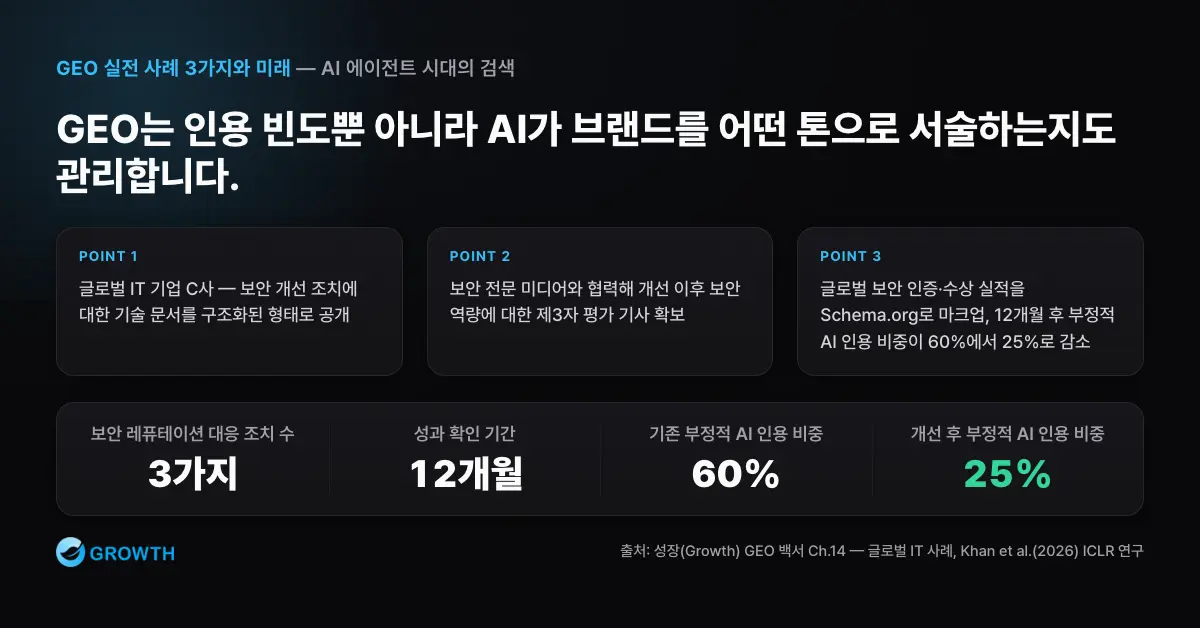
Company C’s Korean office approached this brand-reputation problem through GEO. First, it published detailed technical documentation of its security improvements in structured form on its website. Second, it worked with domestic and international security media to secure third-party assessment articles covering the post-incident security posture. Third, it marked up its global security certifications and awards in Schema.org so AI could gather them systematically. As Rienecker et al.’s (2026) ChoiceEval framework demonstrates, LLM brand bias is systematic — reversing it required an equally systematic approach.
After twelve months of sustained effort, the share of negative citations in security-related AI answers fell from 60% to 25%, and mentions of recent security achievements and certifications appearing first became significantly more frequent. This case illustrates that GEO isn’t simply about “getting cited more” — it’s also a brand-reputation tool for managing how AI describes a brand.
Three Anti-Patterns — Lessons From Failure
Failure patterns matter as much as success stories. Let’s walk through three anti-patterns that keep recurring in the field.
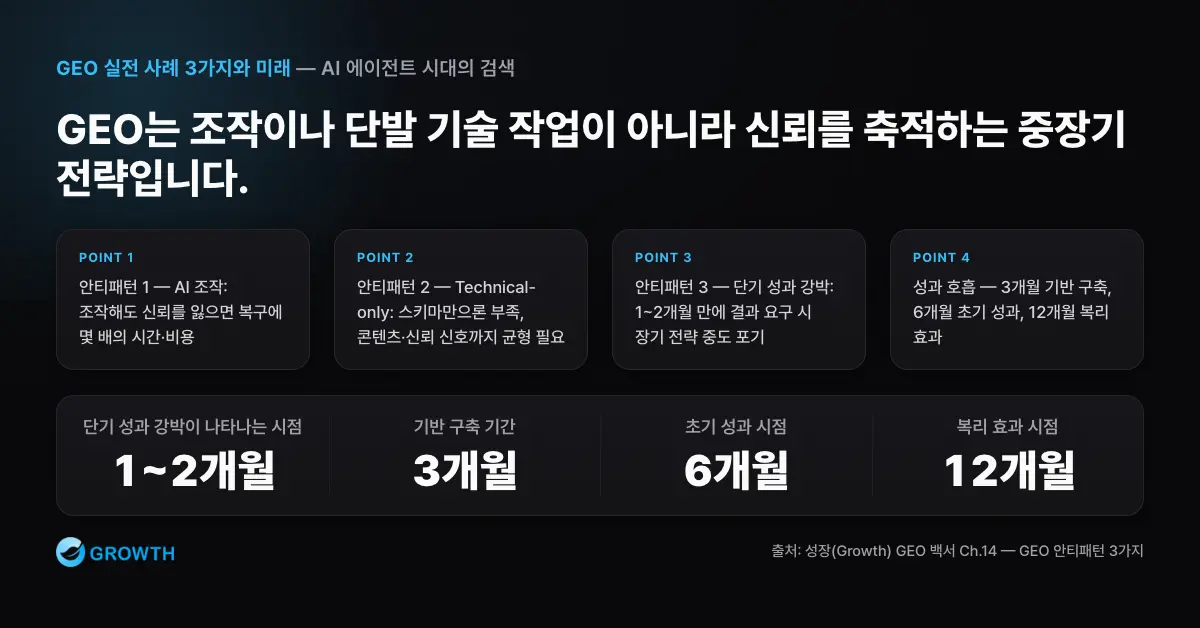
Anti-pattern 1: The “manipulate the AI” approach. Some companies treat GEO as “the art of tricking AI.” A study presented at ICLR 2025, “Adversarial Search Engine Optimization for Large Language Models,” showed that LLM search results can indeed be manipulated. But the same research also revealed a prisoner’s-dilemma structure: the moment everyone starts manipulating, overall answer quality collapses. AI engines keep strengthening their manipulation-detection algorithms, and once trust is lost, rebuilding it costs several times the effort. The essence of GEO isn’t tricking AI — it’s supplying information good enough that AI wants to cite it voluntarily.
Anti-pattern 2: The “technical work alone is enough” mindset. Some teams believe GEO is done once they’ve built an llms.txt file and added schema markup. Technical GEO makes a site “readable” to AI — it doesn’t make AI “want to cite it.” Just as paving a road doesn’t automatically bring visitors, AI citations only follow once quality content and external trust signals build on top of a solid technical foundation. Balancing all three pillars is what matters.
Anti-pattern 3: “Short-term results obsession.” This is the pattern of growing anxious just one or two months into a GEO program and asking “why aren’t we showing up in AI yet?” Like SEO, GEO is a mid-to-long-term strategy that runs on compounding. It takes time for AI to crawl new content, weigh its credibility, and start reflecting it in answers. Think of the first three months as laying the foundation. Early results start to show around six months, and the compounding effect becomes clearly visible by twelve months. Fixating on short-term results is the surest way to abandon a long-term strategy midway — the worst possible outcome.
The Evolution of the Search Ecosystem — Three Future Scenarios
The AI search we’re experiencing today is only the beginning of a much longer evolution. Let’s look at where the strategies covered throughout the GEO Whitepaper are heading, framed as three stages in how the search ecosystem is changing.
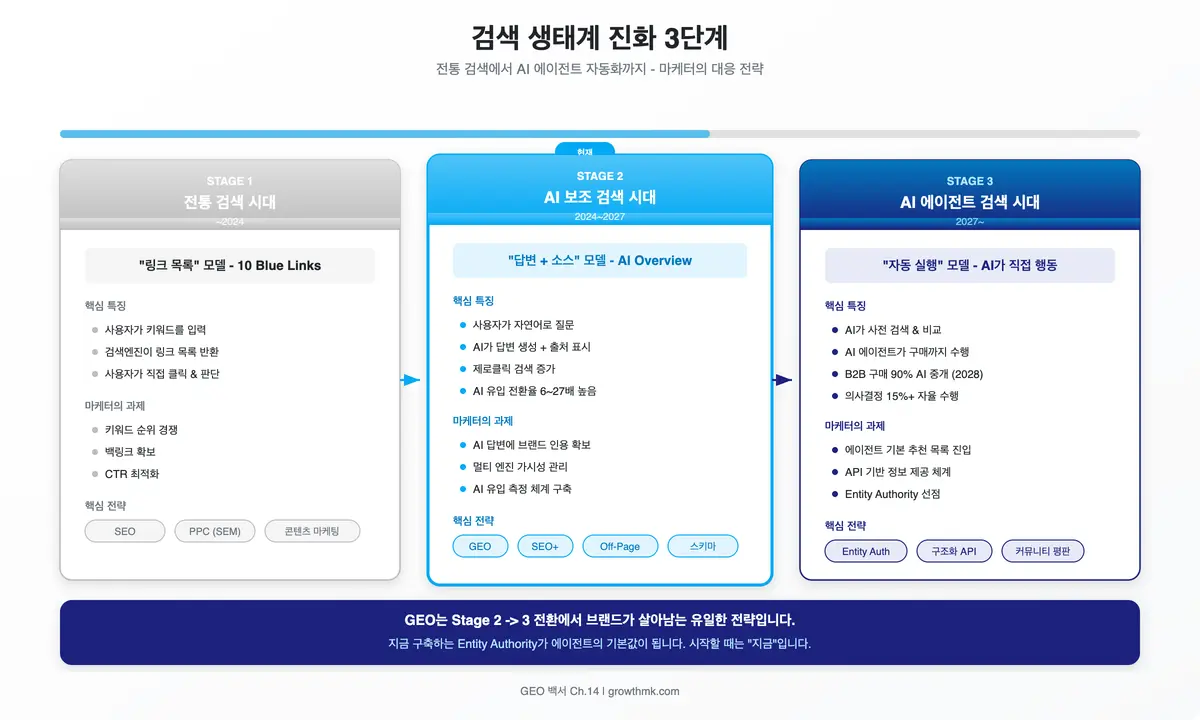
Stage 1 (now–2026): People asking AI questions. This is where we are today. Users type questions directly into ChatGPT, Perplexity, or Naver AI, and the AI generates an answer. The person is still the one driving the search; AI plays the role of a “super assistant” composing the response. At this stage, the core of GEO is making sure your brand’s content is what the AI references when it composes an answer — in other words, laying the groundwork of the Technical, Content, and Off-Page three-axis strategy. In a Pew Research survey, 50% of Americans said their concerns about AI outweighed their excitement. That tells you this stage is still in the early phase of mainstream adoption.
Stage 2 (2026–2028): AI agents pre-searching on your behalf. Gartner projects that by the end of 2026, task-specific AI agents will be embedded in 40% of enterprise applications. At this stage, users no longer need to ask directly — AI agents read their context, search ahead of time, compare options, and make recommendations. For example, when “marketing agency meeting” appears on a calendar, an AI agent might automatically gather information on relevant agencies and build a comparison table. GEO takes on a deeper meaning here. For your brand to be included in what an AI agent “automatically” gathers, structured information needs to sit in a place AI can reach — without anyone asking for it. Schema.org markup, information delivered through APIs, and real-time product data updates all become essential.
Stage 3 (2028 and beyond): AI agents autonomously completing purchases and contracts. Gartner predicts that by 2028, AI agents will independently handle more than 15% of everyday business decisions. In the same forecast, Gartner projects that 90% of B2B purchasing will be mediated by AI agents by 2028, channeling more than $15 trillion in B2B spending through agent-to-agent transactions. At this stage, AI agents don’t just gather information — they carry out the actual purchase decision and contract execution. Humans step in only for final approval. GEO stops being a “marketing strategy” and becomes “revenue infrastructure.” Whether an AI agent considers your brand a default option when making a purchase on someone’s behalf will directly determine your revenue.
Three Proactive Strategies
If we can anticipate the direction of this evolution, it becomes clear what to do right now.
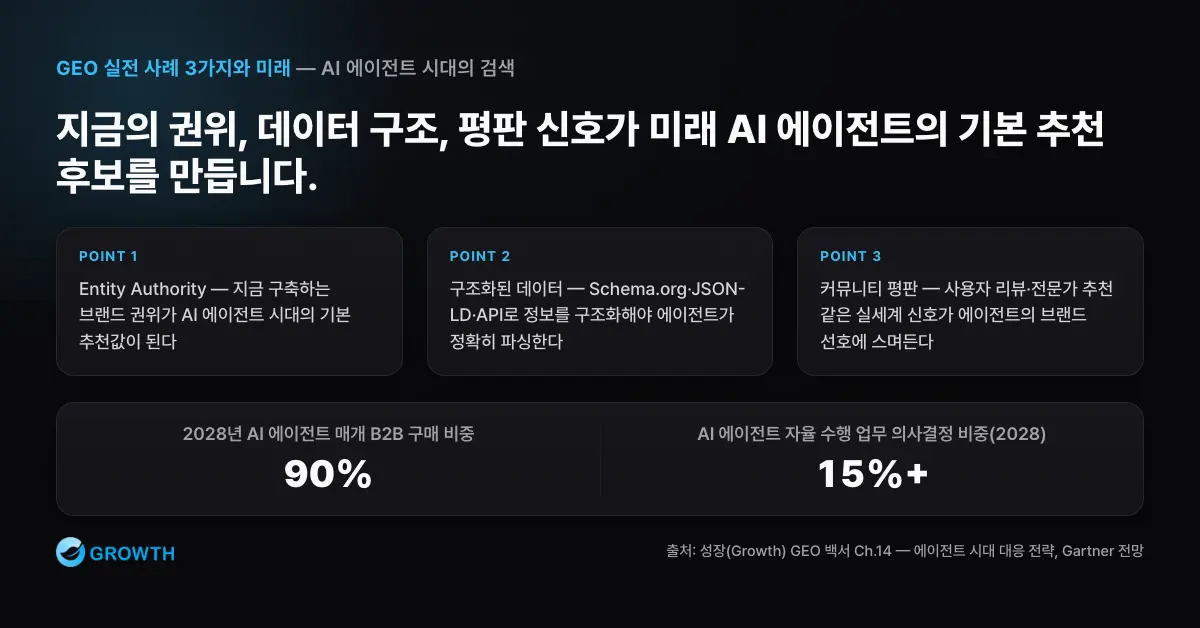
First, the Entity Authority you build now becomes an agent’s default. As the NAACL 2025 citation-bias research shows, LLMs already cite frequently cited sources more often, amplifying the Matthew Effect further. AI systems make judgments based on what they’ve already learned. A brand that AI recognizes today as “an authority in this field” is likely to stay on the default recommendation list even in the agent era. Conversely, a brand AI doesn’t recognize today is effectively invisible in the agent era. Building Entity Authority is an investment in the future that also pays off in the present — a double benefit.
Second, investing in structured data is what lets agents “parse” your brand. When AI agents automatically gather and compare information, they process structured data far more accurately and quickly than unstructured text. As the Graph RAG research covered in our Entity Authority chapter shows, structured data anchored to a knowledge graph substantially improves how accurately AI processes information. Structuring product and service information through Schema.org, JSON-LD, and APIs is essential infrastructure for the agent era.
Third, community reputation shapes agent decisions too. No matter how “objective” an AI agent is designed to be, user reviews, community assessments, and expert recommendations baked into its training data still shape its decisions. As Rienecker et al.’s (2026) research shows, LLMs form systematic preferences about brands, and real-world awareness and reputation signals seep into those preferences. The positive presence you build up in communities and reviews is a long-term asset that determines not only today’s GEO results but tomorrow’s agent-era brand preference.
Now Is the Time to Start
Across this whitepaper series, we’ve walked through the Why, What, How, Who, When, Where, and How Much of GEO. By now you should see that the paradigm of traditional search is shifting, that a brand’s presence in AI answers determines business outcomes, and that concrete strategies and execution systems already exist to handle it. If you need the specific tactics for execution, our AI search optimization execution guide is the next step.
GEO is becoming a necessity, not an option. The decline in traditional search volume and organic traffic we covered in our zero-click search chapter, along with the arrival of the agent era, all point in the same direction. Whether a brand exists in AI’s answers is the new dividing line in digital marketing. Brands already established as AI’s default answer enjoy compounding returns; brands that start late must spend several times the cost and time to catch up.
Key Takeaway
- GEO isn’t “the art of tricking AI” — it’s supplying information good enough that AI wants to cite it voluntarily.
- The search ecosystem evolves in three stages: people ask AI (now) → AI agents pre-search (2026–) → AI agents automate purchases (2028–).
- Entity Authority, structured data, and community reputation determine a brand’s default status in the agent era.
- Avoiding the three anti-patterns (AI manipulation, technical-only thinking, short-term results obsession) sharply reduces the odds of failure.
Closing the Whitepaper — A Summary Across Organization, Timing, Channels, Budget, Measurement, and the Future
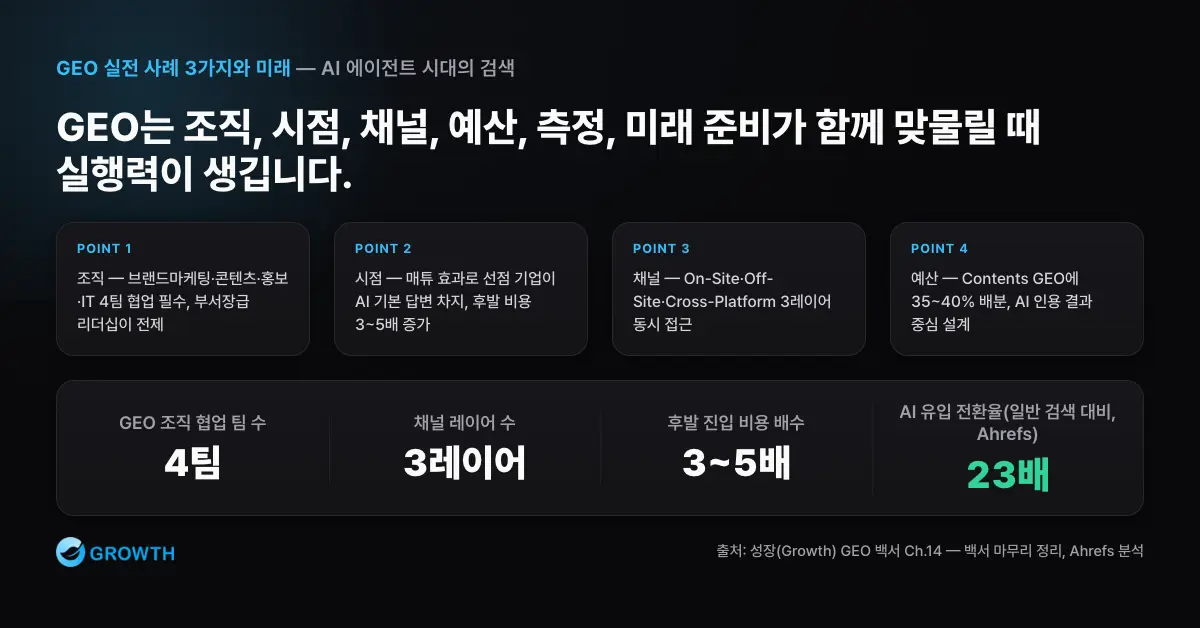
- Organization: GEO requires collaboration across brand marketing, content, PR, and IT, with department-head-level leadership as a precondition for success. (GEO team structure)
- Timing: The Matthew Effect means early movers claim AI’s “default answer,” while late entrants face 3–5x higher costs. (90-day GEO roadmap)
- Channels: A simultaneous three-layer approach is required — your own site (On-Site), external platforms (Off-Site), and per-AI-engine tactics (Cross-Platform). (GEO three-layer strategy)
- Budget: Allocate 35–40% to Content GEO, and design your budget around outcomes (AI citations). (GEO budget planning)
- Measurement: SoA (Share of Answer) is the core KPI, and the dramatically higher AI-referral conversion rate (23x, per Ahrefs’ analysis) is what proves GEO’s business value. (GEO ROI measurement)
- Future: In the agent era, the Entity Authority you build today determines your brand’s default status. The time to start is now.
Curious how your brand shows up in AI answers right now? Get in touch for an AI answer-share diagnostic. You can also download the full GEO whitepaper PDF.
Frequently Asked Questions
Has GEO’s impact actually been proven with real cases?
Yes. In the cases covered here, a B2B SaaS company saw AI citation frequency more than triple six months after adopting systematic GEO; a D2C beauty brand’s AI-referred customers spent 40% more per order than those from paid ads; and a global IT company cut its share of negative citations from 60% to 25%. A G2 survey similarly found that 33% of B2B buyers had purchased from a vendor they hadn’t previously known about, discovered through AI.
What’s the most common cause of GEO failure?
Three anti-patterns: trying to manipulate AI, assuming technical work alone is enough, and demanding results within one or two months. All three miss the fact that GEO is fundamentally a trust-based, mid-to-long-term compounding strategy.
How will search change in the age of AI agents?
It evolves from today, where people ask AI directly (Stage 1), through a stage where AI agents read user context and pre-search on their behalf (Stage 2, 2026–2028), to a stage where agents autonomously handle purchases and contracts (Stage 3, 2028 and beyond). Gartner projects that 90% of B2B purchasing will be mediated by AI agents by 2028.
When is the right time to start GEO?
Now. Because AI runs on a Matthew Effect that trusts already-cited sources more, brands cited early enjoy compounding returns while late movers spend several times the cost and time. Plan for three months of foundation-building, early results by six months, and a clearly visible compounding effect by twelve months.
GEO Whitepaper series: ← Previous chapter · Full table of contents