
How to Write a Content Marketing Plan
 임재복
임재복

Content marketing has firmly established itself as one of the best marketing strategies available today. But executing it well requires a carefully built content marketing plan.
Let’s say you have plenty of content — product photos, blog posts, how-to videos. How do you actually get all of that in front of prospects and customers? Do you have concrete goals tied to that content? Do you want more leads? More brand awareness and social media presence?
If you can’t answer these questions, you need a content marketing plan.
You’re not alone here. According to the Content Marketing Institute’s B2B content marketing research, the highest-performing marketers are more likely to have a documented content marketing strategy. Whether or not you already have one documented, it’s worth revisiting your existing content marketing plan.
This article walks through what the content marketing planning process looks like and how to build your own content strategy.
What Is a Content Marketing Plan and Strategy?
A content marketing plan is a documented strategy that spells out who creates content, what it is, when it’s published, where it’s distributed, why you’re doing it, and how.
- Who creates the content?
- What kind of content is it?
- When is content published?
- Where is content distributed?
- Why are you doing content marketing?
- How are you promoting and analyzing the results?
Why Does Writing a Content Marketing Plan Matter for Marketers?
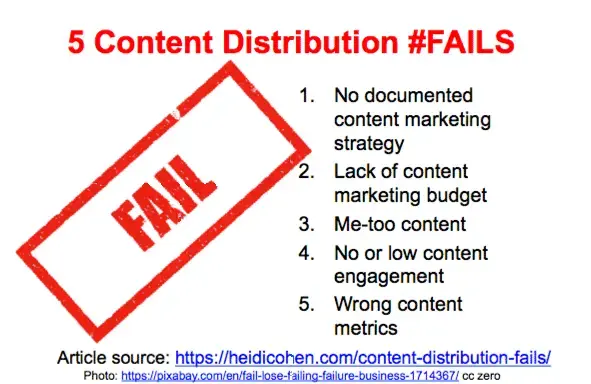
Without a plan, content marketing ends up happening on the fly. If any of the below sound familiar, you need a content marketing plan.
- You don’t have enough content to publish
- You have several channels but don’t know what kind of content fits best where
- You don’t know what topics your audience actually likes
- You’ve realized you didn’t post anything today
- You don’t know what to post
A content marketing strategy gives you a framework for all of the above, and more. And once a strategy is in place, you can use data to check whether it’s actually working.
Content marketing spans multiple departments. Sales can use product sheets and case studies to nurture prospects, while marketing can use a newsletter to build loyalty among existing customers.
Regardless of company size, you’ll inevitably end up using content to market your product or service at some point. And having a plan in place means everyone can work from the same information.
Instead of writing posts on the fly, having content already built and scheduled leads to far more effective content marketing.
10 Steps to Writing an Effective Content Marketing Plan
Set Goals and KPIs
Every strategy starts with a goal. What do you want to achieve through content marketing? In a survey of B2B marketers, content marketing ranked as the most effective way to build brand awareness, build trust, educate an audience, and generate demand and leads. Of those goals, brand awareness is the one the most marketers report seeing results from.
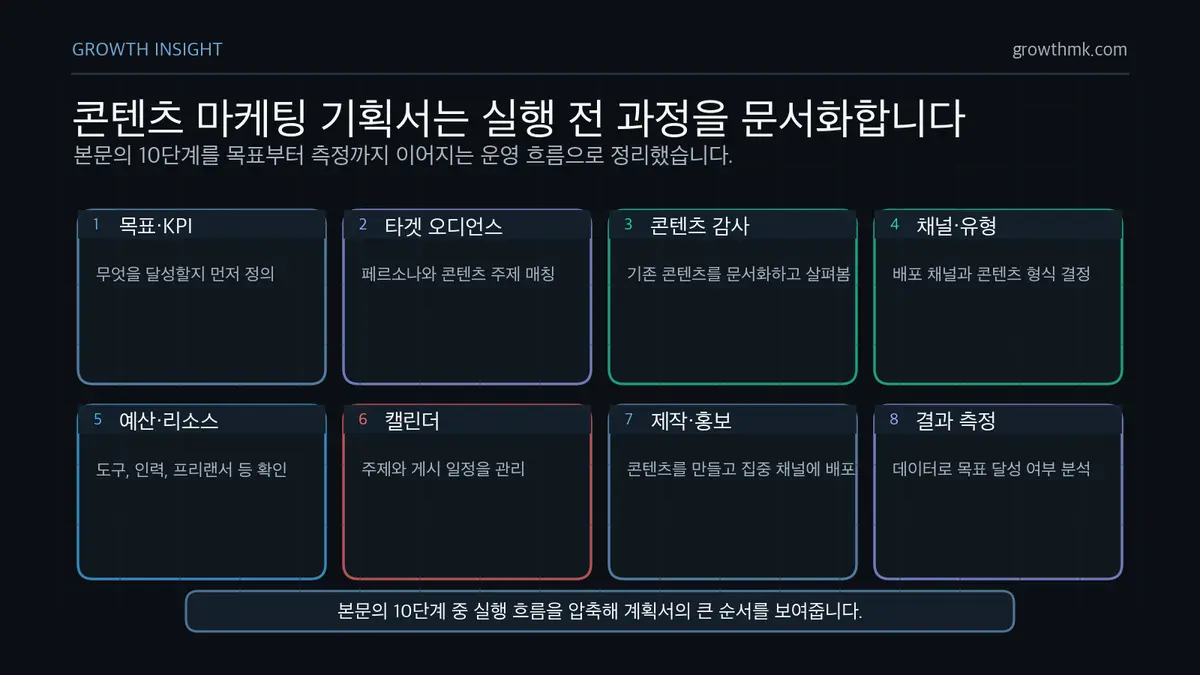
The image above lists a few common goals; check out a social media goals template if you need more guidance.
For every goal, you need at least one KPI to know how well you’re actually achieving it. Look at social media KPIs that are useful for tracking goals like reach, engagement, conversion, and customer loyalty.
Determine Your Target Audience
The next step is determining your target audience. In most cases, this already lines up with your buyer personas or social media personas. Like most businesses, if you have multiple audiences, you’ll need to match content topics and formats to each one.
If you’re starting from scratch, check out Growth’s blog to learn more about audiences and keywords.
Audit Your Current Content

If you don’t know where you’re starting from, how would you know where you’re headed?
So the first step is documenting all your existing content. If there’s too much of it, set a cutoff, like three months or a year. You need a dataset you can actually work through and review.
Running a content audit on your blog posts can help surface content you didn’t even know existed.
If you’re feeling ambitious, you can also add one or two competitors to monitor as benchmarks for your content marketing.
During the audit, look at the following:
- Topic: What subjects are you publishing about?
- Format: What kinds of content are you publishing?
- Channel: Where are you sharing content?
- Performance: How are your posts actually doing?
Once you’ve documented all this, you’ll start to see trends — which content and channels are outperforming others.
Identify Your Best Content Channels
In general, content marketing starts wherever engagement is already strong. During your audit, you likely spotted some trends around which channels fit your content best.
If you need more data, look at your website analytics and check where your referral traffic comes from. Are people reaching your blog posts through a newsletter or social post? Are more of them coming through search? Knowing where your audience comes from helps you focus your effort on the right channel.
A meaningful share of consumers unfollow a brand on social media over content that’s irrelevant to them — a good reminder of just how much channel-content fit matters. If you’re still unsure, or you don’t have enough data, talking to a content marketing specialist can help a lot.
Decide on Content Formats
Not every content format is created equal, and there are several formats worth weighing as you plan your content marketing strategy.
Some formats perform better on specific channels, while others cost more to produce. Common content formats include photos, video, blog posts, podcasts, infographics, and user-generated content.
Your content will also vary depending on the marketing funnel stage and target audience.
Determine Budget, Tools, and Resources
The first thing to figure out when writing your content marketing plan is what budget you’ll need. This covers your budget itself, the tools available to you, and the staff or freelancers you can call on.
Producing creative content remotely can be challenging, but it’s far from impossible. At this stage, identify the resources you already have and the ones you still need (which may require approval).
Most content marketing plans require:
- Content creators: Who’s making the content?
- A content management system (CMS): Where content gets planned, stored, and published
- A content manager: Who’s overseeing topics and production?
- Data collection: Content analytics, reporting, and every digital tool used in your content marketing
Build a Content Calendar

A content calendar sits at the heart of your strategy. You need a space where you can actually plan content.
At minimum, it should let you track what topics and content are going out and when. A more advanced content calendar can also track each piece’s status, its distribution, who’s working on it, and its final performance after it goes out.
There are plenty of content calendar templates out there. You can also just track content with a social media calendar or a spreadsheet.
Create Content Based on Your Plan
Now it’s time to actually create the content you’ll share. By this point, you should have a clear sense of which content formats and channels you’re using. In other words, the next step is content ideation, development, and curation.
Publish and Promote

Once your calendar is set up and your content is built, the next step is publishing and promoting it across whichever channels you’ve decided to focus on. If you’re promoting across multiple channels, it’s best to have one tool that lets you see your entire publishing schedule at a glance.
If a piece of content is performing well and isn’t tied to a specific holiday or moment, you can repurpose it into other channels and formats. Don’t be afraid to re-share the same content in a different way.
Measure Results
Finally, the last stage of your content marketing strategy is analysis. Without collecting data, you can’t know whether you’re hitting the goals you set at the start. Channels like a newsletter or website will need Google Analytics 4 or another tracking tool.
A post performance report, for instance, shows how each piece of published content performed — likes, impressions, and engagement for every post.
Network-specific reports, like an Instagram business profile report, let you dig into performance on each network in detail. You can see your top-performing posts and how your content is doing overall.
- Truly mastering content marketing KPIs
- A guide to analyzing your content marketing KPI results
Conclusion: Start Building Your Content Marketing Plan, Step by Step
Content marketing plays a critical role in promoting your brand and winning customers. Today, many companies rely on content marketing to build a successful marketing strategy, which makes the content marketing planning stage more important than ever. But quality matters more than volume. Google states that content that gets rewarded in search is helpful content created for people, not for search engines, and recommends asking, right from the planning stage, “Is there a clearly defined audience for this?”
For marketers unsure where to start, this article has walked through exactly how to write a content marketing plan.
We’ve seen that writing a content marketing plan requires careful, deliberate thinking. The first step is setting your purpose and goals, followed by defining your audience and target groups.
From there, you need to build out the content itself, factoring in the right channels, distribution methods, and budget.
It’s also worth keeping in mind that a content marketing plan is a living document that needs constant revision and improvement. Updating and evolving it in step with a shifting market and changing customer needs is what ultimately lets you build a successful content marketing strategy.
Finally, we’ve also seen that using content marketing effectively requires ongoing analysis and evaluation. Only by analyzing and improving on the actual results of your plan can you achieve better performance over time.
So use the approach to writing a content marketing plan outlined in this article as a reference, and build your marketing strategy a little more carefully and deliberately. Keep adding new ideas and methods as you go, in step with an ever-changing market.
Here’s hoping a successful content marketing plan helps you promote your brand and win customers.
Related Reading
- A Guide to Content Marketing, From Definition to Strategy
- What Is Earned Media?
- What Is Evergreen Content?
- A Guide to Brand Content Marketing
- ESG Content Marketing Case Studies and Practical Strategy
If you’d like to apply this to your own business — you can see how Growth approaches it in our content marketing service, and if you need a specific diagnosis of your situation, reach out through contact us. We answer based on the one customer who becomes revenue, not the volume of traffic.
Frequently Asked Questions
What absolutely needs to be in a content marketing plan?
At its core, it needs to answer who, what, when, where, why, and how. As covered above, it should include goals and KPIs, target audience, content formats and channels, budget/tools/owners, a content calendar, and a way to measure results. Having all of these in place is what lets you move beyond impulsive publishing and validate performance with data.
Do I really need to document my content marketing strategy?
Yes. A documented strategy lets different departments share the same information and gives everyone a shared standard for what’s being made and why. Content Marketing Institute research also confirms that higher-performing marketers are more likely to document their strategy. A plan that only exists in someone’s head rarely translates into real execution, measurement, and improvement.
How do I set goals, and what do I measure to gauge performance?
First, define what you want content marketing to achieve — brand awareness, trust-building, audience education, lead or demand generation — then attach at least one KPI to each goal. As covered above, use a tool like Google Analytics 4 to track reach, engagement, and conversion for channels like a newsletter or website, and use channel-specific reports to see which content is actually working.
If I’m producing content at scale with AI, do I still need a plan?
Volume alone doesn’t guarantee results. Google has stated that it rewards helpful content built for people, not search engines, so content produced at scale without a clear audience and goal tends to have limited impact. A plan is what defines what you’re delivering, to whom, and why — the foundation that keeps you on track even when you’re using AI to help produce content.